Wind vs. water: Why flooding, surge will be Ida’s ‘biggest nightmare’ for MS Coast
In hurricanes, people watch the wind bend or break trees but underestimate the force of water.
Wind moves faster but water is far heavier. A foot of water can float vehicles, while 2 feet of rushing water will carry away even trucks or SUVs, according to The Weather Channel.
Hurricane Ida is forecast to pound the Gulf Coast shoreline with wind and water, in Louisiana and Mississippi. The Mississippi Coast is under both tropical storm and storm-surge warnings, meaning these conditions can be expected by Sunday.
Storm surge and flash flooding pose the greatest dangers, most often killing motorists who think they can drive through flooded streets.
The Mississippi Coast is “going to be on the east side of the storm, so surge and heavy rain will be our biggest nightmares,” said Dan Kottlowski, senior meteorologist and lead hurricane forecaster at accuweather.com.
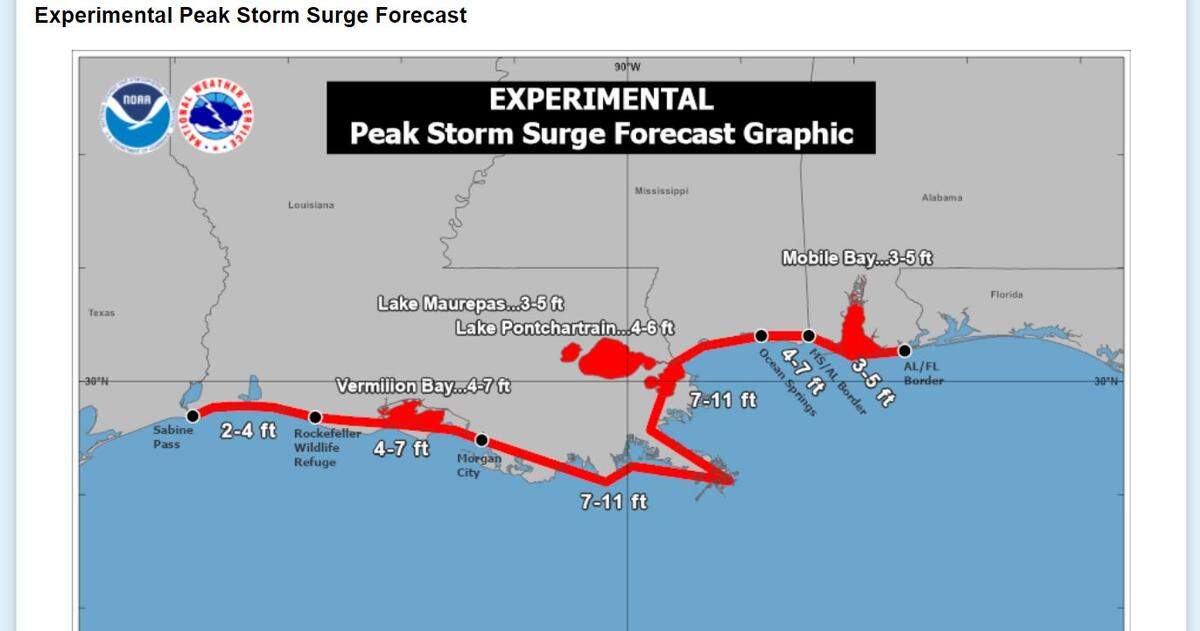
Hurricane Ida is expected to scour the Coast shoreline, from Morgan City, Louisiana, to Ocean Springs, Mississippi, with 7-11 feet of storm surge, the National Hurricane Center forecasts.
Heavy rainfall of up to 20 inches in isolated areas will produce potential for flash flooding in southeast Louisiana, , coastal Mississippi and Alabama from Sunday afternoon through Monday morning, bringing potential for coastal and inland flooding.
In hurricanes, flooded streets kill motorists
At landfall, Hurricane Ida is expected to pack strong Category 4 winds of 140 mph. Based on the current NHC projections of a southeast Louisiana landfall, the Mississippi Coast is expected to face tropical-storm force winds of up to 74 mph. Category 1 winds start at 75 mph.
The worst of the surge will be east and northeast of landfall.
“A large majority of people who have died in hurricanes are dying because they are driving into flooded water,” Kottlowski said.
His statement is borne out by a University of Texas study of flood-related vehicle fatalities from 1959-2019. The study found that 58% of all flood fatalities, a total of 570 deaths, were vehicle-related. Eleven of those deaths were in hurricanes or tropical storms, with 347 from flash flooding.
Surge on the Mississippi Coast pushes water over the main beach thoroughfare, U.S. 90, in many locations, and on beach roads in Hancock and Jackson County. Flash flood, stream and river flooding also can be expected from Ida.
Turn around, don’t drown
People see water on the road and think they can drive through it. But a tidal surge’s force can lift homes off their foundations, as Coast residents learned with Hurricane Katrina’s massive surge of 28 feet in some locations on the same date 16 years ago that Ida’s landfall is expected.
What motorists don’t realize is that, according to the Federal Emergency Management Agency, 6 inches of water will reach the bottom of most cars, causing the driver to lose control. Two feet of rushing water can lift most vehicles, including heavy trucks.
Driving through water is most deadly at night, when Ida’s landfall is expected. People have a harder time judging the depth of water in the dark, Kottlowski said.
So far, Hurricane Ida is not shaping up to be the monster storm that Katrina proved to be. The hurricane wind field is smaller and weaker offshore, offering less opportunity to push up a powerful surge.
But Ida has two days to grow under favorable conditions in the Gulf. Like other meteorologists, Kottlowski says residents should prepare for a storm one category above what is expected. Those in low-lying areas should consider evacuating.
“Katrina was an incredible storm, a huge storm,” he said. “At this point, it doesn’t appear Ida will be nearly as big or as strong as Katrina.
“However, the water conditions are very warm and the conditions are very favorable for this one to intensify. You can’t underestimate these kinds of storms.”