‘Dirty side’ of Ida could hit Mississippi Coast. Here’s why that’s bad
The right side of a storm is often referred to as its “dirty side” or “the bad side” — either way, it’s not where you want to be.
In general, it’s the storm’s more dangerous side.
The “right side” of a storm is in relation to the direction it is moving, according to the National Oceanic and Atmospheric Administration. If traveling north, the right side of the storm is east. If it is moving west, the right side is north.
Tropical Storm Ida’s path shows much of the Mississippi Coast could fall on the “dirty side” of the system, which is expected to intensify as it barrels toward the northern Gulf.
The storm is forecast to reach Category 3 strength by the time it reaches southeast Louisiana this weekend, bringing the risk for heavy rain, hurricane-force winds and “increasing risk of life-threatening storm surge inundation” along parts of the Gulf Coast, according to the National Hurricane Center.
“The greatest impacts of the storm occur on the east side of the storm as it approaches the north central Gulf of Mexico,” Chris Bannan, meteorologist with the National Weather Service in New Orleans, told McClatchy News. A storm surge of 7-11 feet is forecast “from the mouth of the Pearl River to Ocean Springs,” Bannan added, “and between 4 and 7 feet from Ocean Springs to the Mississippi-Alabama border.
Ida is expected to make landfall late Sunday or early Monday.
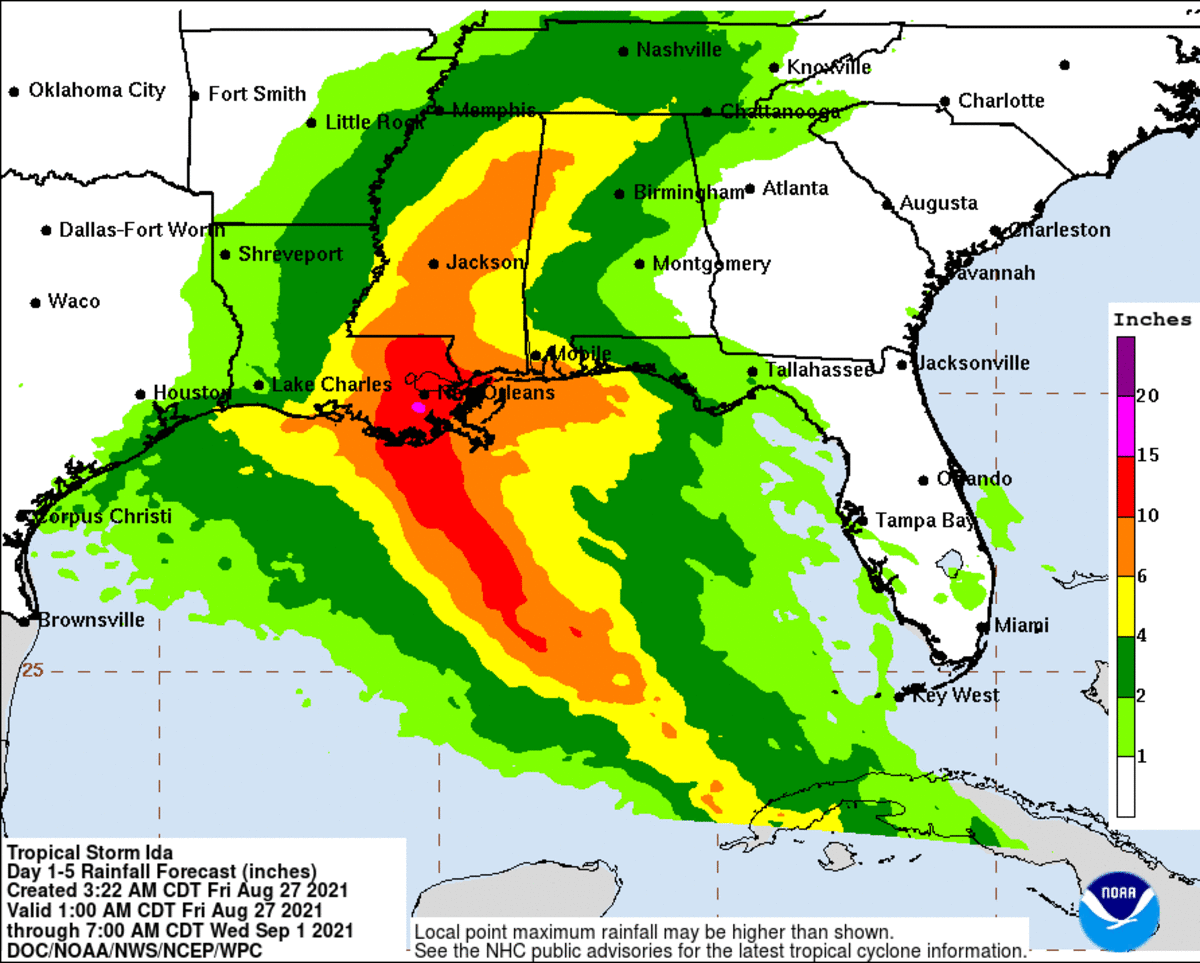
It’s forecast to dump a significant amount of rain across the central Gulf Coast, leading to “considerable flash, urban, small stream and riverine flooding,” weather officials said.
As of 9 a.m. CT Friday, Ida had maximum sustained winds of 60 mph as it churned northward toward the coast at a brisk 60 mph.
Areas in the region remain under a hurricane watch, stretching from Louisiana to the Mississippi/Alabama border. A tropical storm watch is also in effect.
Why is the dirty side worse?
The direction of hurricane winds make the right side of a storm worse, NOAA says.
The winds spiral counterclockwise around the storm’s center in addition to its forward movement. So as the storm moves forward, the winds are moving in the same direction and therefore their speeds are combined.
On the other side of the storm, winds will be slower because “you must subtract the wind velocity from the forward velocity,” NOAA says.
“For example, a hurricane with 90 mph winds moving at 10 mph would have a 100 mph wind speed on the right (forward-moving) side and 80 mph on the side with the backward motion,” NOAA’s website says. “Weather forecast advisories already take this asymmetry into account and, in this case, would state that the highest winds were 100 mph.”
This story was originally published August 23, 2020 at 5:01 PM.