When are Coast police allowed to use deadly force? Some departments won’t say.
READ MORE
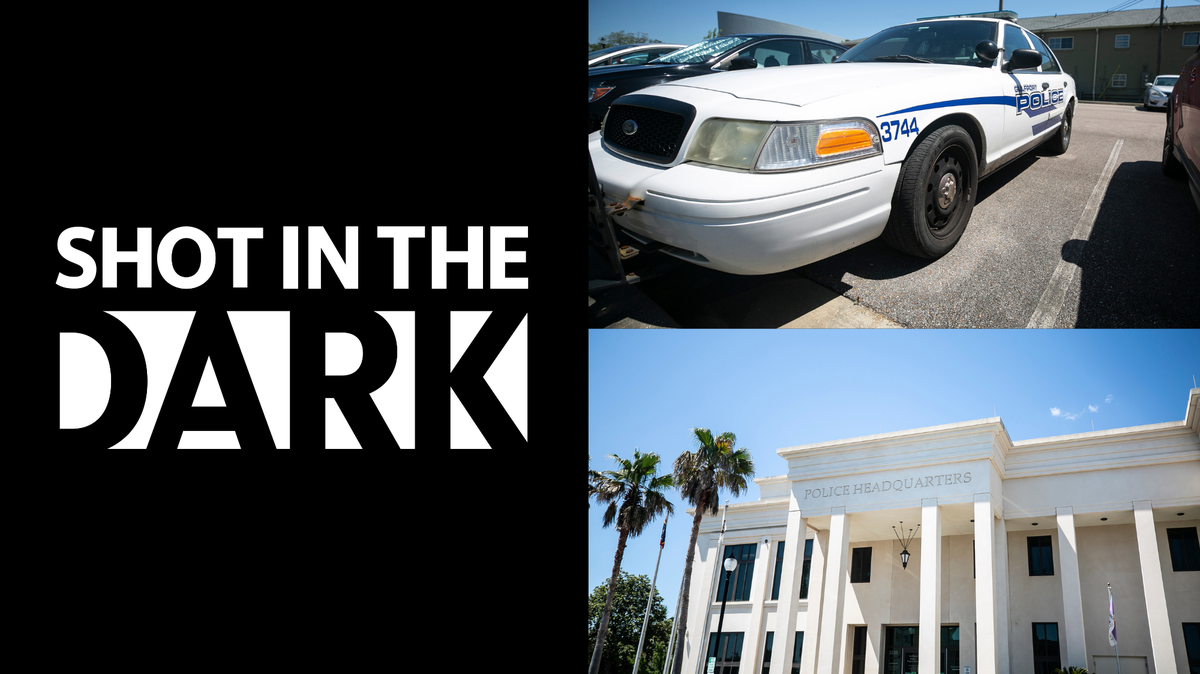
Shot in the Dark
A Gulfport police officer shot and killed an Army veteran named Leonard Parker on Feb. 1, 2020. The officer said Parker was trying to run him over, and Parker’s grieving family got no other details from Mississippi law enforcement. Documents the Sun Herald fought to obtain tell a different story.
Expand All


When are police officers allowed to use deadly force to protect themselves or the public?
The answer is based on principles established by the Supreme Court and on policies created by local police departments.
The Sun Herald requested use of force policies from every law enforcement agency on the Mississippi Coast.
Three refused to provide them: Pass Christian and Gulfport police departments and the Harrison County Sheriff’s Department.
However, a copy of Gulfport’s policy was included in the Mississippi Bureau Investigation records of the shooting of Leonard Parker, which the Sun Herald obtained. That copy is described here.
Long Beach provided a heavily redacted version of the policy which did not include the specific standards governing the use of deadly force.
Gulfport claimed their policy was exempt under the state Public Records Act, citing portions of the law that allow police to withhold information that could hamper investigations, disclose investigatory techniques, or “endanger the life or safety of a public official or law enforcement personnel.”
Ocean Springs Police Chief Mark Dunston said to him, sharing the use of force policy was an easy call.
“I don’t have a problem with our policies,” he said. “Our policies are sound.... If someone wants to be bored and read my policies, they can do that.”
“I’m shocked by that,” he said of the decision by Gulfport, Harrison County, Pass Christian and Long Beach to withhold their policies.

Why do use of force policies matter?
Josh Parker, senior staff attorney at the Policing Project at the New York University School of Law, said making use of force policies easily accessible to the public is “one of the most basic and fundamental elements of democratic and transparent policing.”
“There is no legitimate basis for declining to release it,” he said.
In rare cases, Parker said, a department may be justified in redacting certain details that could reveal information about policing strategy.
But withholding the entire policy, or entire sections of key information as Long Beach did, prevents citizens from participating in the “shared endeavor” of public safety.
If the public can’t see the policy, they can’t evaluate an officer’s behavior and tactics, and they can’t advocate for change, Parker said.
America’s largest police departments generally make their policies easily accessible online. The Police Use of Force Project, a nonprofit that advocates for reforms to reduce violence by police, has analyzed the policies of the country’s 100 biggest departments. Only a handful of the departments initially refused the request for use of force policies.
The policies describe departmental standards that can be stricter than legal standards. So, an officer could be terminated or disciplined for violating department policy without having violated the constitutional standard for using deadly force.
What does the Supreme Court say?
The legal standards governing police use of force are based on precedents set at the U.S. Supreme Court in two key decisions.
The first, Tennessee v. Garner (1985), arose when a Memphis police officer shot and killed an unarmed teenager who was running away from him. At the time, a Tennessee law allowed officers to “use all the necessary means” to arrest a fleeing suspect. The Supreme Court ruled that law unconstitutional, and said officers may use deadly force against a fleeing suspect only when they believe that person poses a serious risk of death or major physical injury to the officer or the public.
The second, Graham v. Connor (1989), gave rise to the justification that almost always prevents the prosecution of an officer who kills someone in the United States: “I feared for my life.” The court concluded that an officer’s decision to use force should be evaluated from the perspective of a “reasonable officer at the scene.”
“Its calculus must embody an allowance for the fact that police officers are often forced to make split-second decisions about the amount of force necessary in a particular situation,” Chief Justice William Rehnquist wrote for the Court.
That standard is still in place today. It means that judges, juries and prosecutors generally take officers at their word when they say they feared for their lives the moment they pulled the trigger.
The standard is part of why the officer who killed Tamir Rice, a 12-year-old boy playing with a toy gun in a Cleveland playground, was not charged with a crime: The officer and his colleague testified they believed the gun was real.
What do MS Coast policies say about lethal force?
Coast law enforcement use of force policies are consistent with the Supreme Court precedents and only rarely impose further restrictions.
Essentially, officers are authorized to use deadly force against a person who they reasonably believe could kill or seriously injure the officer or another person.
Here are excerpts from each department’s use of force policy.
Bay St. Louis
“Officers shall never use deadly force, except to protect his life, or the life of another human being.”
Deadly force is authorized by a police officer “only to achieve the following lawful objectives:
- To defend himself, or others against serious threats of serious bodily injury or death.
- To stop dangerous felony flight, where there is serious imminent risk to the public of death or serious bodily injury.”
Biloxi
Biloxi police are authorized to use deadly force under the following conditions:
- To defend themselves or others against serious threats of serious bodily injury or death;
- To stop dangerous felony flight, where there is serious imminent risk to the public of death or serious bodily injury;
- To prevent roaming at large by obviously mad or vicious animals; to relieve animals so badly injured that it cannot reasonably survive from injuries causing prolonged suffering;
- To stop imminent damage to or theft of property, which by its removal or damage, seriously threatens the life and safety of others.
D’Iberville
“D’Iberville Police Officers are authorized to use deadly force when: (i) There is immediate and serious danger of serious bodily injury or death to an officer or bystander or; (ii) the suspect has demonstrated dangerousness by the previous use or threatened use of deadly force.”
Gautier
The department lists five levels of officer perception of threat and response:
Level 5 is deadly force: “The suspect is perceived by the officer to be assaultive — serious bodily harm or death. The appropriate level of response is deadly force. Deadly force includes firearms, knives, or any other means immediately available that a reasonable officer, in the same circumstance, would consider as potentially causing death or serious bodily injury....
Deadly force is not to be used against a felon simply because of the crime he/she committed; rather, it is used because of the threat he/she poses to the officer’s or public’s safety if allowed to remain at large.”
Gulfport
Gulfport cited exemptions to Mississippi records laws and refused to share their use of force policy.
But the Sun Herald obtained a copy included in the MBI investigation of Leonard Parker’s shooting. The policy says officers are allowed to use deadly force “to achieve the following lawful objectives:
- To defend himself, or others against serious threats of serious bodily injury or death.
- To stop dangerous felony flight, where there is serious imminent risk to the public of death or serious bodily injury.”
Hancock County
Deputies are justified in using deadly force in the following circumstances:
“To protect themselves from what they reasonably believe would be an imminent threat of death or serious bodily injury.
To stop a fleeing suspect when the deputy reasonably believes there is an imminent risk of serious bodily injury or death to any other person if the suspect is not immediately captured.”
Harrison County
The department rejected the Sun Herald’s request for its use of force policy.
Jackson County
An officer may reasonably use lethal force when there is:
- A “reasonable belief the subject presents an immediate threat to cause serious physical injury to the officer, another officer, or another member of the public; or
- Probable cause for the officer to believe the subject has just committed a crime involving inflicted/threatened infliction of serious physical injury to another and deadly force is necessary to prevent the escape of the subject in order to protect the public or another officer(s).
Officers need not exhaust lesser options of force in order to use deadly force, nor are they required to use the least intrusive means of force.”
Long Beach
Long Beach heavily redacted their use of force policy before sending it to the Sun Herald. Section IV: Procedures - Section IIX and the specific language around the use of deadly force and any particular restrictions or exemptions were thus unavailable for review. This portion was not redacted:
“It is the policy of the Long Beach Police Department that police officers will use only that force that is reasonably necessary to effectively bring an incident under control, while protecting the lives of the officer or another and enforce the law under guidelines established in this policy manual.”
Moss Point
Deadly force is authorized only in certain instances to achieve the following “lawful objectives:
- To defend themselves, or others against serious threats or serious bodily injury or death.
- To stop dangerous the felonious flight of an individual where there is “serious imminent risk to the public of death or serious bodily injury.
- To prevent roaming at obviously “mad or vicious animals; to relieve animals so badly injured that it cannot reasonably survive from injuries causing prolonged suffering.’”
Ocean Springs
“The use of firearms or any other device, tool, or tactic used as a lethal force option may be used when an officer has probable cause to believe that the suspect poses a threat of death or serious physical harm, either to the officer or to others.
Currently, the U.S. Supreme Court has stated that officers may use lethal force also in cases where there is probable cause to believe that the suspect has committed a crime involving the infliction or threatened infliction of serious physical harm. Tennessee v. Garner (1985).”
Note: The Tennessee v. Garner decision says that police can use deadly force to stop a suspect from fleeing only when “necessary to prevent the escape and the officer has probable cause to believe that the suspect poses a significant threat of death or serious physical injury to the officer or others.” The Court does not say that if there is probable cause to believe that the suspect committed a dangerous crime previously, that alone is sufficient grounds to use deadly force. The officer also has to believe a fleeing suspect is likely to continue to pose a significant threat of death or serious physical injury.
Pascagoula
Pascagoula officers are authorized to use deadly force for the following purposes:
- “To defend himself, or others against serious threats of serious bodily injury or death.
- To stop dangerous felony flight, where there is serious imminent risk to the public of death or serious bodily injury...
Deadly force is not to be used against a felon simply because of the crime he/she committed; rather, it is used because of the threat he/she poses to the officer’s or public’s safety if allowed to remain at large.”
Pass Christian
The department rejected the Sun Herald’s request for their use of force policy.
Waveland
Deadly force may be used by officers when they reasonably believe that the action is in defense of human life, including the officer’s own life, or in defense of any person in immediate danger of death or serious physical harm.
Coast policies on shooting into moving vehicles
Seven of the 10 use of force policies reviewed by the Sun Herald in full place restrictions on the use of deadly force against a person in a moving vehicle.
The Coast departments that do have restrictions on use of force against people in moving vehicles generally still allow officers to shoot into vehicles if they feel lives are at risk.
Bay St. Louis
Deadly force may not be used “At a moving vehicle that does not present a deadly force situation.”
Biloxi
Deadly force may not be used “at or from a moving vehicle, except in exigent circumstances, and only in an attempt to save human life.”
D’Iberville
“Firearms shall NOT be used to shoot from or at a moving vehicle, unless no other reasonable means of force exist for the emergency circumstances at hand.”
Gautier
Deadly force may not be used under certain circumstances including “At or from a moving vehicle unless no other reasonable means of force exists for the emergency circumstances at hand.”
Gulfport
Gulfport refused to share their use of force policy. But the Sun Herald obtained a copy included in MBI’s investigation of Parker’s death.
Deadly force may not be used under certain circumstances including “At a moving vehicle that does not present a deadly force situation.”
Harrison County
The department rejected the Sun Herald’s request for its use of force policy.
Hancock County
The policy calls shooting at moving vehicles “ rarely effective” and says a deputy should move “out of the path of an approaching vehicle” instead of discharging their firearm at the vehicle or any of its occupants.
However, the policy allows officers to shoot at a moving vehicle if they “reasonably” believe there is no other reasonable means available to avert the threat of the vehicle or “if deadly force other than the vehicle is directed at the deputy or others.”
“Rare circumstances may occur where firing at a person in a moving vehicle is justifiable,” the policy says.
Jackson County
The policy does not mention vehicles or any restrictions on shooting into them.
Long Beach
Long Beach heavily redacted their use of force policy before sending it to the Sun Herald, so it is unclear whether the department places any restrictions on shooting into moving vehicles.
Moss Point
Officers may shoot at or from a moving vehicle only when the police officer has probable cause to believe that there is a threat of serious bodily injury or death to the officer or a third party. “Police officers must always evaluate the surroundings to ensure that an innocent person will not be injured.”
Ocean Springs
The policy does not mention restrictions on shooting into moving vehicles with a firearm. It does say that officers need stronger justifications than typical for using TASERs against people in a number of circumstances including against a “Person operating moving vehicle or machinery.”
Pascagoula
Deadly force may not be used under circumstances including “At or from a moving vehicle unless no other reasonable means of force exists for the emergency circumstances at hand.”
Pass Christian
The department rejected the Sun Herald’s request for their entire Use of Force policy.
Waveland
The Waveland use of force policy does not mention restrictions on use of force against people in vehicles.
Full policies
Bay St. Louis
Biloxi
D’Iberville
Gautier
Hancock County
Jackson County
Long Beach
Moss Point
Ocean Springs
Pascagoula
Waveland
This story was originally published June 2, 2021 at 10:21 AM.