Gulfport says a controversial $45M road project is vital. Were there better options?
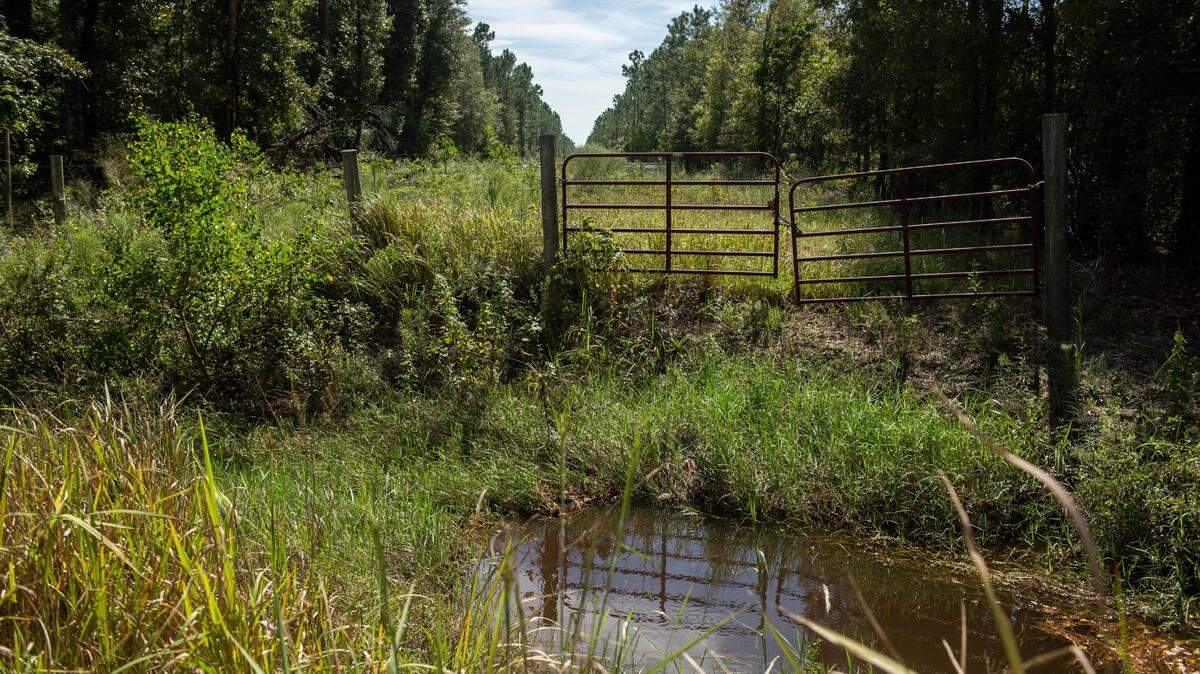
Gulfport leaders have recently described a $45 million road project through wetlands near Interstate 10 and U.S. 49 as a desperately needed solution to congestion around one of Mississippi’s busiest interchanges.
“Our interest and needs are just to provide relief to our citizens to get from point A to point B,” Gulfport Mayor Billy Hewes told the Sun Herald in early September.
But a 2017 study found that other possible projects could better address traffic and safety issues in the area.
Environmental advocates and some community members say the study results, which have not previously been public, suggest the aim of the road project is not primarily traffic relief but rather opening land for development, which was also one emphasis of the city’s application for a federal BUILD grant to help finance the project.
The study was conducted by the engineering firm Garver on behalf of the Mississippi Department of Transportation.
The top-ranked project, improvements to the I-10 interchange at Lorraine Road, scored 10.58 on the researchers’ scale of -20 to 20 points (though no project scored below a -4.67) and was estimated to cost $13.38 million. The study’s lead author said those improvements wouldn’t have had much effect on traffic at U.S. 49, but would reduce crashes in a high-risk area.
The next, improvements to intersections on U.S. 49, scored 9 and would cost $16.64 million.
The Airport Road extension Gulfport is now developing as part of the larger project that won a BUILD grant scored 1.42 and was estimated to cost $27.4 million. The federal grant will cover about $20 million of the larger $45 million project, with the rest from local sources.
“The Airport Road Extension was the lowest scoring concept because although it does have independent utility, it would do little to divert traffic away from U.S. 49 without the interchange with I-10,” the researchers wrote. “This concept also had more environmental impacts than the other concepts.”
In an interview, Hewes said the four-year-old study was just one piece of information the city considered as it planned the BUILD project. The decision was ultimately based on “the real world experiences that our residents are having at these intersections.”
“Given where the growth is happening, where the congestion is at its greatest, and where we cross our connecting roads, this made more sense than anything as far as impacting the greatest number of people from a traffic relief standpoint,” he said.
Gulfport’s BUILD plans
Gulfport’s BUILD project will extend Airport Road west across Old Highway 49, passing north of the historic and predominately Black Forest Heights subdivision, which opened in the 1960s as one of the country’s first integrated homeownership developments. Then it will turn north and cross the KCS rail spur to connect with Factory Shop Boulevard, before passing over I-10. It will link to the Canal/I-10 service road, 34th Avenue and Daniel Boulevard.
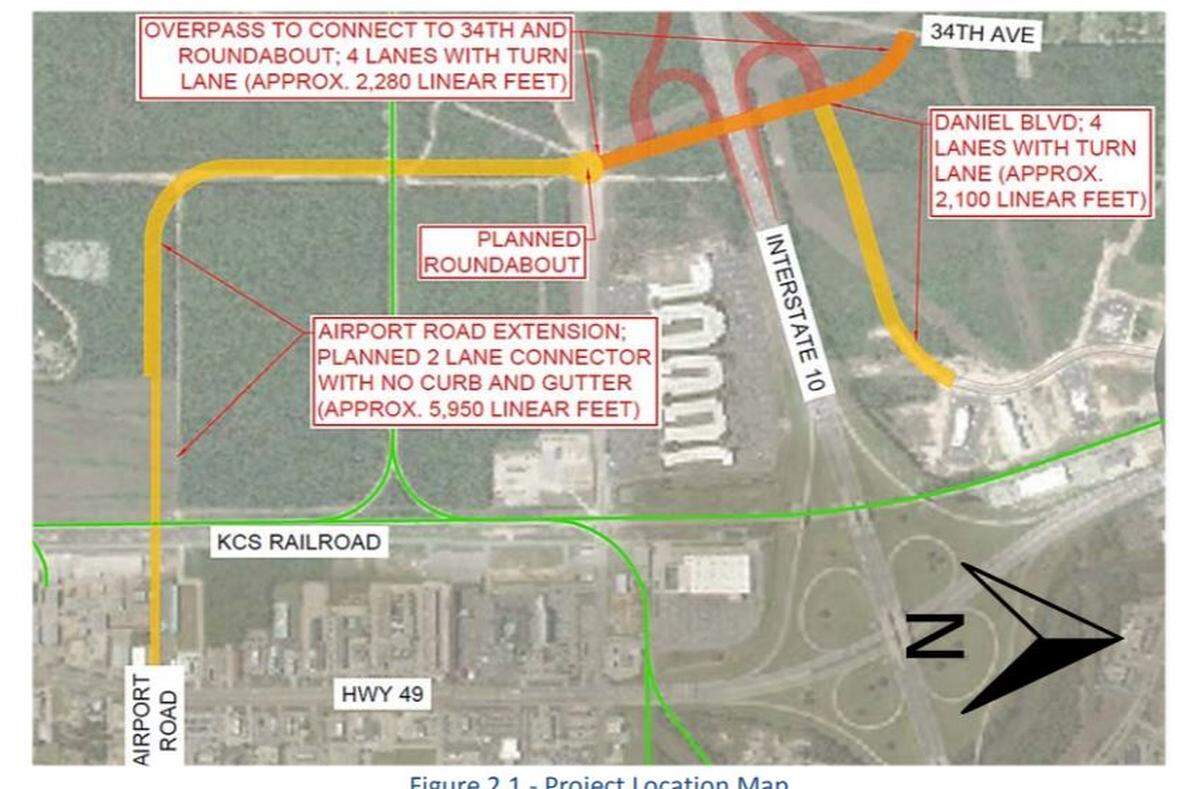
Some residents of Forest Heights and Turkey Creek, another historic African American community south of the project area, have long opposed development between the neighborhood and the outlet mall because they fear it would worsen already frequent flooding. The Ward family of Louisiana owns much of the land but has never developed it.
“I’m hearing on the surface that it’s about ease of traffic,” said Kathy Egland, co-founder of Gulfport nonprofit the Education, Economics, Environmental, Climate, and Health Organization (EEECHO). “But what I’m really seeing and feeling is that this is an entry to the Ward project. It’s going to be at the expense of the residents. This road just makes no sense whatsoever.”
Property owner Jerard Ward said he has no particular plans to develop the land, which he would be willing to sell. He hasn’t kept up with the project since he wrote a letter of support for the application in 2019. Ward and another property owner, Greater Gulfport Properties, also donated right-of-way for the project.
“Right now I’m just paying taxes on it,” he said. “I haven’t been back since the pandemic started.”
Thanks to a letter from the Coalition to Protect and Preserve Forest Heights, of which EEECHO is a member, the Federal Highway Administration’s Office of Civil Rights is currently investigating whether the BUILD project could create “disparate, adverse impacts” for the mostly Black communities nearby.
Gulfport asked the Mississippi Department of Transportation to conduct a study of the area around the I-10 and U.S. 49 interchange. MDOT then hired the engineering firm Garver to determine the consequences of potential road improvements for traffic flow, safety and the environment.
The Sun Herald asked Gulfport’s public works department for a copy of the study, which was submitted as part of Gulfport’s BUILD application. Public works director Wayne Miller shared the final report and supporting documentation with the Sun Herald. MDOT public information officer Katey Hornsby said the study has not previously been publicized.
Easing congestion on US 49?
The project manager on the study, Jeff Pierce, said he can’t remember why he wrote that the road would have little effect on traffic on US 49. He has not been involved in planning or conversations about the project since he completed the PEL study, but said he thinks Gulfport’s BUILD project is a good one.
“So looking at what they had to look at and the amount of money they thought they could get” from the BUILD grant program, “the Airport Road extension would be a good starting point to connect the shops, ballfields, and get people off 49,” he said. “From an engineering standpoint, looking at it, that does make sense.”
Environmental advocates who have long fought against development in that quadrant of I-10 and U.S. 49 disagree.
“It’s quite obvious that there are other things on the table that could have resolved this and they’re not interested,” said Louie Miller, director of the Sierra Club of Mississippi. “I think this indicates the motivation is real estate development of wetlands at the expense of Turkey Creek and the other marginalized communities that are experiencing flooding.”
The road project would affect about 66 acres of wetlands, which act as natural sponges to reduce runoff. It would also provide public access to other undeveloped land, spurring commercial growth.
That was a major component of the city’s BUILD grant application, which said the project would create “newly accessible commercial area... primed for quick development.”
More recently, however, Hewes has emphasized relieving congestion as the key benefit of the road.
“It’s about what the needs of our citizenry is in this community, and again it goes back to, how do we balance addressing the traffic congestion concerns we have as a community, and at the same time take into account the concerns of the adjacent neighborhoods,” he said in early September. “That’s our drive.”
Scoring the projects
For each project, researchers determined a score between -5 and 5 on four different metrics: safety, feasibility, mobility and environmental consequences. Then the four numbers were added together for the final scores.
Every project got a negative score in the environmental category, except for building nothing, which earned a 0. The Airport Road extension got the worst score, -2.25. The Lorraine Road interchange and U.S. 49 intersection improvements scored a -0.75 and a -1.
Within the environmental impacts category, the Airport Road extension’s impact to wetlands scored the worst of all the projects it was compared to. But researchers also found that the road would not affect floodplains.
The Airport Road extension got its highest marks in the feasibility category, earning 3 out of 5 points. It got one point for mobility and -0.33 for safety for its total score of 1.42. Only the “No Build” option scored worse, at -4.67.
The Lorraine Road and U.S. 49 improvements each scored a 5 for feasibility and a 4 for mobility.
Pierce said the improvements at I-10 and Lorraine Road scored high because they would address what the researchers discovered was a large number of crashes in the area. That option got a 2.33 for safety.
“You always want to reduce crashes when you can,” he said.
The only option for Gulfport?
Neel-Schaffer engineer Steve Twedt, who is now working on the project design, said the Airport Road extension was the best option for Gulfport to pursue, because MDOT has jurisdiction over U.S. 49, I-10 and Lorraine Road.
“The only project on here that is a city project is the Airport Road extension,” he said.
The projects are not mutually exclusive and could all be implemented if funding is available.
Gulfport can petition MDOT for a permit to make improvements on roads in MDOT’s jurisdiction. To complete its BUILD project, Gulfport will obtain such a permit to build the new overpass across I-10, MDOT public information officer Katey Hornsby said.
Twedt said the Airport Road extension “is the logical first piece for the system” and will ensure other improvements, like a new I-10 interchange, can be constructed later.
“And if MDOT does not come back and construct their portions, (the PEL study) also says that Airport Road extension does have independent utility,” Twedt said. “So you still have a useful stand alone project, and it enables future construction.”
Hornsby said that funding has not yet been identified for that interchange, so there is no timeline for its completion.
Contested environmental consequences
Hewes has pledged that the project will not increase flooding for residents, but the environmental analysis of the project as part of the required National Environmental Policy Act (NEPA) review won’t be complete until the end of the year.
“I’m not sure I agree with the environmental impact component,” he said of the PEL study’s conclusion that the Airport Road extension would have more significant environmental consequences than other options.
Pierce said the Airport Road extension will be built over currently undeveloped land, whereas other options considered in the study would not.
“When you’re disturbing land that’s untouched, your environmental impacts are higher,” he said. “Simple as that. That’s not always a terrible thing... So you just have to weigh: Is it worth digging up these trees and putting a road in? A lot of times it is.”
This story was originally published October 18, 2021 at 5:50 AM.