
Helene expected to make landfall as major hurricane in two days. See forecast for South MS
Editor’s note: Tropical Storm Helene formed Tuesday in the Caribbean. Our original story from Monday is below.
A storm system is expected to become a hurricane Wednesday as it moves into the Gulf of Mexico and approaches the Gulf Coast, forecasters said.
The system, which would be named Helene, was 150 miles west of Grand Cayman on Tuesday morning.
Forecasters are predicting it will hit the Gulf Coast on Thursday, likely along the Florida panhandle or the state’s Big Bend region. The track could still change. But the National Hurricane Center said Monday that track guidance was “tightly clustered” on landfall on the northeastern Gulf Coast and Florida panhandle.
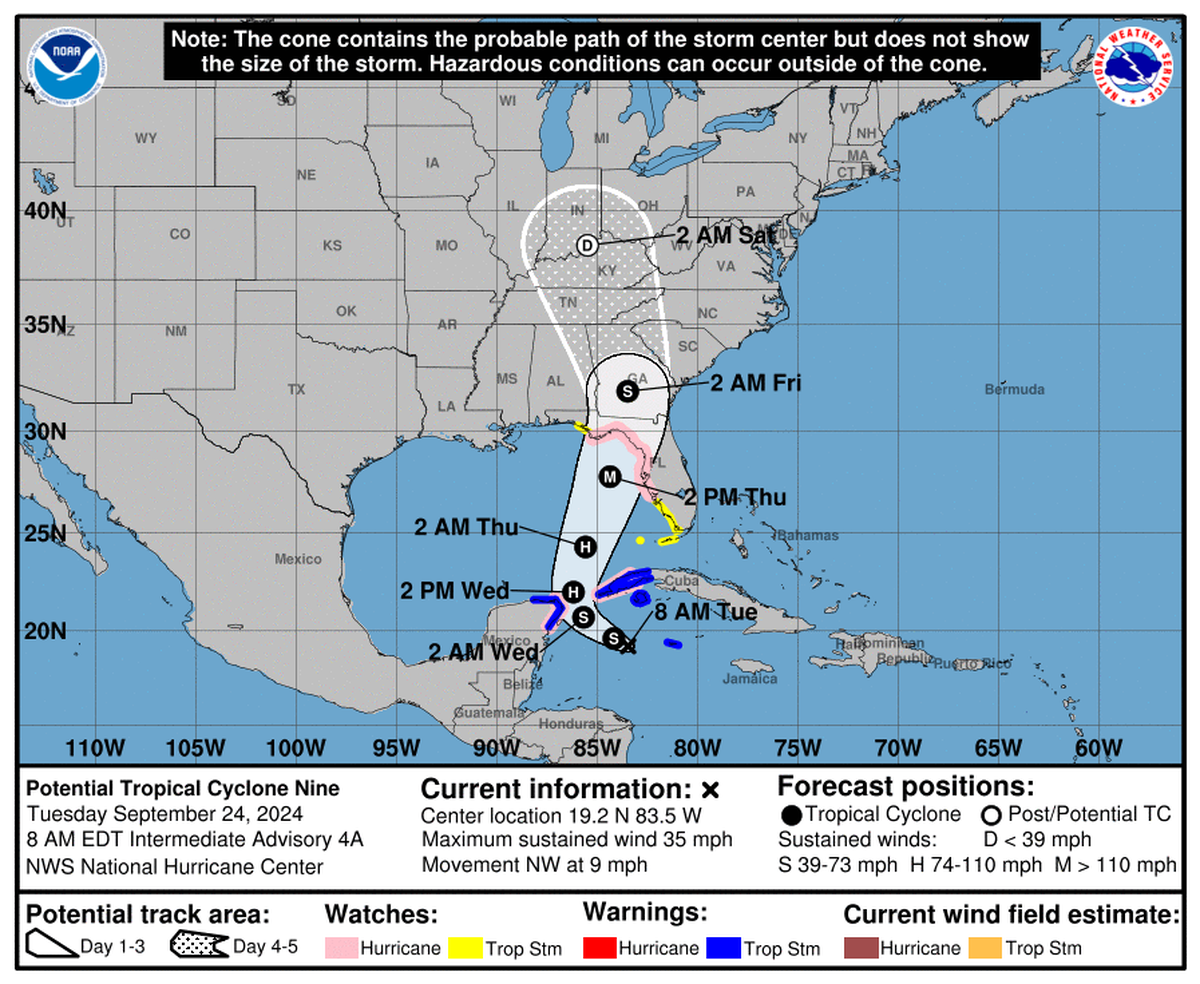
More details about the storm’s landfall and intensity will be clear when it forms a defined center, forecasters said. But the National Hurricane Center predicted the storm would strengthen to “major hurricane intensity.”
“The system is expected to intensify while it moves northward over the eastern Gulf of Mexico, and it could be a major hurricane when it reaches the northeastern Gulf Coast on Thursday,” the National Hurricane Center wrote.
National Hurricane Center forecasters said the storm could strike as a Category 3 hurricane with with 115 mph winds.
Forecast for South MS
South Mississippi is outside the storm’s predicted path.
Forecasters are still warning residents to watch the forecasts closely because the track could change this week as the storm’s center forms. Forecasters urged coastal communities to have a hurricane plan in place.
If the storm makes landfall in Florida, as forecasters are predicting, the Mississippi Coast would be on the west side of the storm. Forecasters say the west side is better than the east side — often called the “dirty side” — which carries more dangerous impacts because winds spiral counterclockwise around the storm’s eyewall.
The worst storm surge, wind and flooding will hit east of the storm’s landfall, Alabama meteorologist James Spann wrote on social media. Spann said it appears the Alabama Coast and western part of the Florida panhandle will be on the safer side of the storm.
But he urged caution. “It is very important to note that until a low-level center forms and we get data from hurricane hunters, this could easily change,” Spann said.
Biloxi-based Hurricane Hunters flew into the system Monday afternoon, the 53rd Weather Reconnaissance Squadron said. The Hurricane Hunters, headquartered at Keesler Air Force Base, said they flew a low-level mission at 500 to 1,500 feet to investigate whether the storm has closed circulation.
The National Hurricane Center said the storm still lacked a well-defined center Tuesday morning.
Rapid intensification expected
The storm could become a major hurricane in part because it will pass over warm waters in the Gulf of Mexico that could fuel it, forecasters said.
In a newsletter on Monday, meteorologist Michael Lowry he is watching for whether the system develops a core and how quickly it organizes. A more organized core could indicate faster intensification later this week, he said.
On Tuesday morning, the storm had maximum sustained winds of 35 mph. Forecasters said it is moving northwest at 9 mph, with the center expected to move Tuesday night across the Caribbean Sea. The storm is then forecast to accelerate northeast, moving over the eastern Gulf on Wednesday and Thursday.
The hurricane center has issued storm surge and tropical storm watches for a portion of Southwest Florida.
Forecasters urged residents to begin preparations immediately. Once the storm forms an inner core, “nothing will stop a very likely rapid intensification,” meteorologist Jim Cantore wrote on social media. “So by this time Wednesday, we are looking at a whole different animal.”
Communities outside the track cone should also prepare for storm surge, heavy rain and dangerous winds, Cantore said. The National Hurricane Center said those impacts would “extend well away from the center, particularly to the east of the system.”
Heavy rains could also inundate the southeast U.S. after landfall.
Forecasters said they expect the storm to near hurricane status on Tuesday night in the northwestern Caribbean Sea.
This is a developing story and will be updated.
This story was originally published September 23, 2024 at 10:38 AM.