South MS urged to stay ‘on alert’ as system in Caribbean could spawn Gulf hurricane
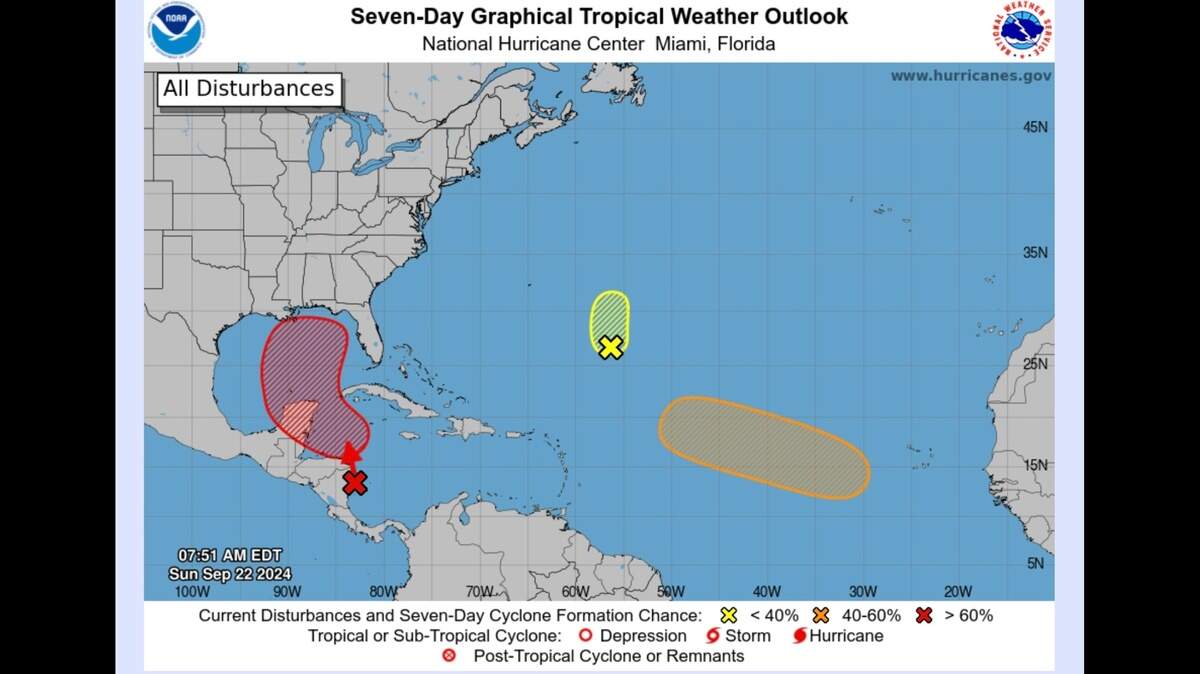
Gulf Coast residents, including those in South Mississippi, should keep an eye on a low pressure system in the Caribbean that has a “high chance” of developing this week into a tropical storm or hurricane, the National Hurricane Center warned Sunday morning.
The system has a 70% chance of formation within the next seven days, the hurricane center forecast says.
“It is recommended that residents in the aforementioned areas stay alert on the latest information from their local meteorological agencies,” according to the hurricane center’s forecast discussion.
The system, called a Central American Gyre — a large, closed cyclonic circulation that happens during the rainy season and is known as a CAG — is developing gradually over central America.
“A broad area of numerous moderate isolated strong convection encompasses much of the SW Caribbean Sea in association with this low,” the hurricane center says. “The low is forecast to drift northwestward across northern Costa Rica, Nicaragua, Honduras, and the Yucatan Peninsula through the middle of next week.”
Caribbean’s warm waters spawn late-season storms
The system is brewing as attention shifts from the Atlantic Ocean to the Caribbean Sea and Gulf of Mexico for hurricane formation.
Hurricanes that form near the Cape Verde islands off the coast of Africa, as Category 5 Hurricane Andrew did in August 1992, are most common in August and September, although they have rarely formed in late July and early October, the National Atmospheric and Oceanic Administration says.
This time of year, Gulf residents begin watching the Caribbean, where record-breaking Hurricane Camille formed in August 1969 and devastated the Mississippi Gulf Coast, also as a Category 5.
An analysis by The Weather Channel of hurricanes from 1995-2023 showed 55 hurricanes making landfall in the United States. Of those, only 10 developed into hurricanes between the Lesser Antilles and Africa.
“The large majority of them first became hurricanes in the Caribbean Sea, Gulf of Mexico or near the Southeast coast,” The Weather Channel story said. “One reason for this is simple geography. The closer to the U.S. it becomes a hurricane, the better chance of a U.S. hurricane landfall.
“A Gulf of Mexico hurricane has nowhere else to go except Mexico or the U.S. if it doesn’t fizzle first.”
Keeping an eye on potential path
Conditions in the Caribbean and Gulf of Mexico, where the water is deep and warm, are conducive to hurricane development after September, The Weather Channel noted.
Forecasters have been watching the Caribbean disturbance for a couple of weeks, with chances of formation growing more likely as time passed.
But a tropical storm or hurricane is still not a given. If a storm does form, it is likely to make landfall anywhere from midday Thursday to Friday morning, Alabama meteorologist James Spann noted in his Sunday morning briefing.
“Without formation,” he cautioned, “it’s still hard to say where any potential hurricane would land.” He noted that models are aligning around a Florida panhandle landfall.
Florida meteorologist Michael Lowry said in an email update Sunday that any cyclone’s eventual path will depend on where “a more defined area of low pressure forms within the broader circulation envelope” of the CAG.
“How quickly it forms early on will influence its future trajectory, with quicker formations favoring a track closer to the west coast of Florida and slower formations favoring a westward path into the central Gulf,” he wrote.
“ . . . Regardless of where the low-pressure center tracks, it’s likely to have a wide reach, which means everyone from southwest Florida to southeast Louisiana will need to keep an eye on the forecast trends in the days ahead.”
The hurricane center also is keeping an eye on two other systems: one in the central subtropical Atlantic that could have a brief life as tropical depression and a tropical wave near the west coast of Africa that has a 40% chance of forming into a tropical depression toward the middle or latter part of next week as it moves westward across the eastern and central tropical Atlantic.
This story was originally published September 22, 2024 at 11:10 AM.