
New technology creates dramatic image of WWII Japanese sub split in half off Hawaii
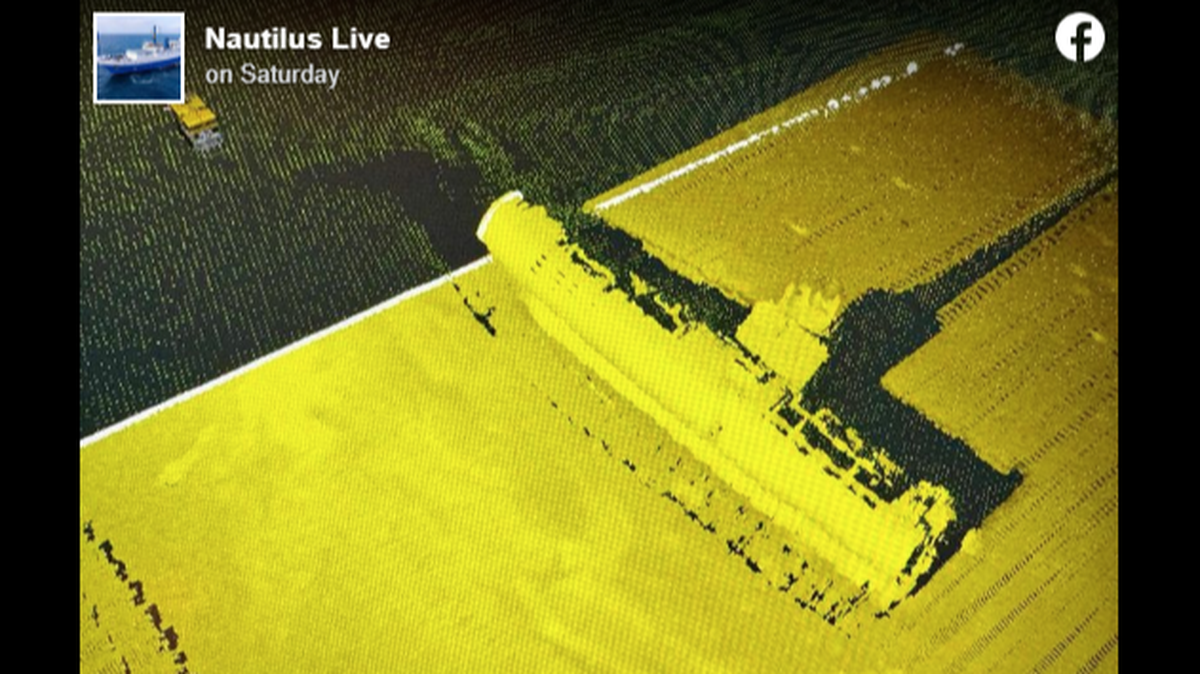
An expedition to test a new seafloor mapping technology has given the world a startlingly clear image of a World War II Japanese submarine that split in half when the U.S. sunk all captured Japanese vessels.
More than just a photo, the resulting image is a three-dimensional depiction of the I-201, showing how it appears after 77 years on the seafloor south of Oahu, Hawaii.
“Namely, broken into two pieces about 200 meters apart,” according to Kristopher Krasnosky, who developed the high-resolution acoustic mapping system with the Ocean Exploration Trust.
“I think the sonar maps and imagery we collected largely confirm the historical story. However, it should add unprecedented detail to the dive site. Additionally, it can serve as a reference for future work as historians monitor the decay of the wreck.”
The Ocean Exploration Trust visited the wreck site Nov. 3, using the K2 High-Resolution Mapping System with the Norbit multibeam echosounder to generate the images.
I-201 sits 2,625 feet down and the site had never been mapped, despite prior visits by other researchers. The only known images were “a few photographic stills” created when the Hawaii Undersea Research Laboratory sent an uncrewed submersible to the area, historians say.
Those images showed the 259-foot wreck retained much of its wooden deck and ornamentation associated with the Japanese Navy.
The wreck is an oddity in a region where thousands of sailors and airmen died in dramatic battles.
“She was completed and commissioned on February 2nd 1945 as the lead unit of the I-201 class,” Worldwarwings.com reports. “However, the war ended before she could see service and would eventually arrive at Pearl Harbor on February 13th 1946 with her sister submarine I-203, where their design was studied by the U.S. Navy.”
When the Soviet Union demanded access to the captured vessels, the U.S. military “issued orders to sink all captured Japanese submarines,” Worldwarwings.com reports.
I-201 went down after being hit by a single torpedo from the USS Queenfish on May 23, 1946, historians say.
The Ocean Exploration Trust says the new imaging technology will be an even greater asset in cases where much less is known about the history of a wreck.
“This provides a greater context not only of their general build, but also allows researchers to better determine the methods in which they sank and how these structures are now forming ecosystems of their own,” according to Madison Dapcevich, communication lead and science reporter.
“Together, these new technologies immerse audiences ... in an entirely new and collaborative way, diving deep and exploring the ocean in real-time with greater clarity and understanding of these deep ocean ecosystems.”
The Ocean Exploration Trust also visited the Japanese sub I-401, which sits at a depth of about 2,742 feet in the same area.
This story was originally published November 9, 2023 at 6:42 AM with the headline "New technology creates dramatic image of WWII Japanese sub split in half off Hawaii."