
A diamondback rattlesnake hides in this photo. Most people can’t find it. Can you?
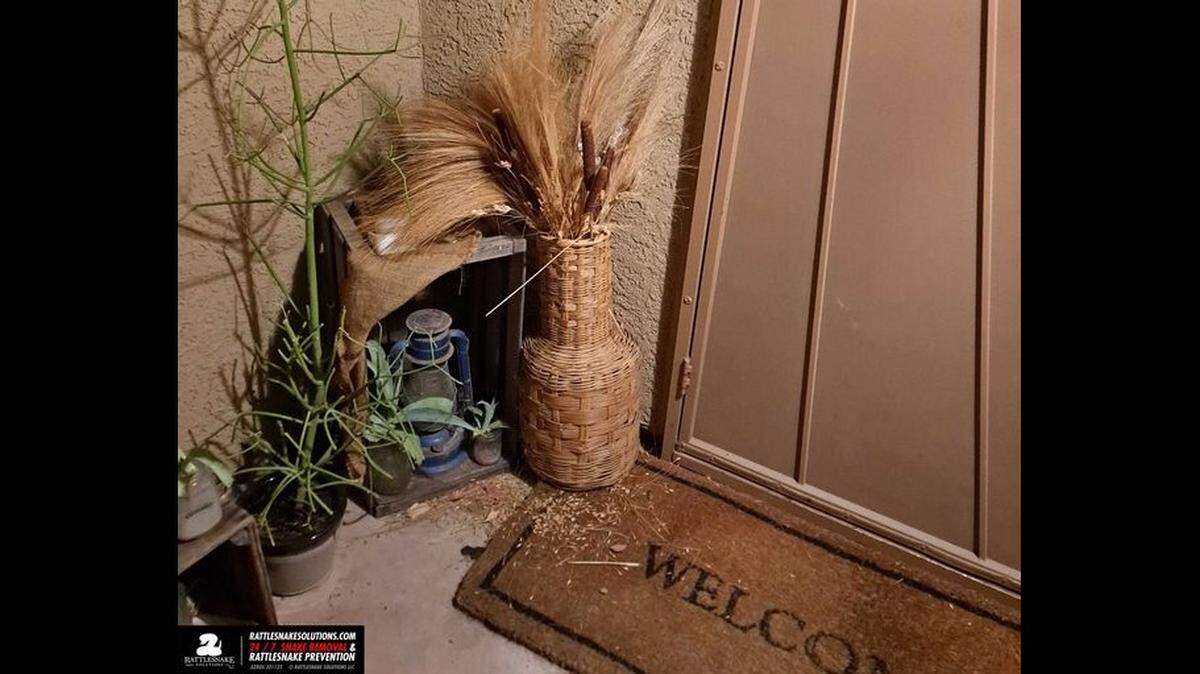
There’s nothing like a well-hidden rattlesnake to prompt a debate over the wisdom of patio decor.
The snake in question is a western diamondback rattlesnake, and it was recently caught outside a home near Tucson, Arizona.
However, photos shared by the snake removal service Rattlesnake Solutions show the snake was all but invisible as it sat coiled by a door.
“Visual context training! Do you see it?” the company asked on Facebook.
Easily seen was a welcome mat, a basket of decorative grasses, some house plants and a vintage lantern on a wooden crate.
The venomous snake was nowhere to be seen, however, giving a perfect illustration of how Arizona’s various rattlesnake species are excellent at blending into their surroundings.
Most people couldn’t find it — until the company posted the photo again, with a red circle drawn around the snake.
“Guessing I have been bitten either on my foot or hand. I do not see it why am I so blind to danger?” Rosemary Wieczorek Lane wrote.
“Yep this is why anything next to our front door is pulled away from the corners so we can see behind it,” Michael Rudy wrote.
“I can’t see it at all, and I’m not embarrassed, it scares me,” Lela Lewis said.
The big reveal showed the snake was coiled a few feet off the ground, atop the decorative basket of dried grasses.
That seemed to freak out a lot of people even more, because it was higher than they expected.
“How did he get up there?!!! I would have NEVER thought a snake could be that high,” one woman posted.
Rattlesnake Solutions captured the snake and released it into a wilderness area. The company is currently getting 10 to 20 calls a day to remove snakes from sites between Phoenix and Tucson. This includes snakes caught in bird netting.
The length of the snake was around two feet. Western diamondback rattlesnakes have been known to live 20 years and grow to 7 feet, according to the Arizona-Sonora Desert Museum.
As for what it was doing in the plant arrangement, it may have been chasing a meal.
“Western Diamondback Rattlesnakes have been known to swim through water or climb a short distance into a tree when necessary to pursue prey,” the National Park Service says.
This story was originally published August 16, 2021 at 9:23 AM with the headline "A diamondback rattlesnake hides in this photo. Most people can’t find it. Can you?."