Video shows deputy shoot, kill man at Biloxi courthouse. ‘We are heartbroken,’ family says
For nearly six months, relatives of Reginald “RJ” Johnson have wondered what exactly happened when he was shot and killed by a Harrison County sheriff’s deputy on Jan. 15, 2021.
Now, they’ve seen the video, and they still have many questions about the four or five shots Deputy Bobby Jackson fired at Johnson outside the Harrison County Courthouse in Biloxi.
“We are heartbroken, horrified that an officer would fire his weapon repeatedly into somebody that was already down,” said Karen Johnson, Reginald’s aunt. “Who does that? Who does that?”
In the weeks after his death, Johnson’s friends, family and other community members called for the release of body camera and surveillance footage of his shooting. It has not been publicly released until now.
The Sun Herald is sharing the video with the public after obtaining the footage through a public records request.
Jackson didn’t have a body camera on at the time of the shooting, Harrison County Sheriff Troy Peterson said.
The surveillance video, taken from a courthouse camera on the west side of the courthouse, shows the shooting occurred over a 12-second span. There is no audio.
The deputy shot Johnson multiple times, including shots at close range as the two men struggled on the ground. The number of shots the deputy fired is not included in the investigative reports also provided to the Sun Herald.
In June, a Harrison County grand jury cleared Jackson.
In a departure from prior MBI practice, the agency then invited Johnson’s family members to review the video footage on June 18.
The agency provided the video to the Sun Herald along with some written reports in response to a public records request.
What does the video show?
Other body camera footage from Biloxi police officers who responded to the scene did not capture the shooting, said Sean Tindell, commissioner of the Mississippi Department of Public Safety.
The surveillance video first shows Johnson visible in the upper right corner of the frame, across the street from the camera. He paces back and forth on the sidewalk, then walks out of the video frame.
The video does not show the beginning of the interaction between Johnson and law enforcement.
Thirty-six seconds after Johnson moves off screen, a Biloxi Police Department cruiser comes into view from the right.
Six seconds after that, the deputy appears in the frame, also from the right. He is running backward, pointing his gun at Johnson, who is running toward him and carrying what investigators said was a knife. His family said Johnson carried a small pen knife.
The deputy is running backward when he trips and falls and shoots at Johnson as he falls.
Johnson then lands on top of the deputy.
The two men struggle on the ground for about 5 seconds. The deputy shoots again, and Johnson stabs the deputy in the leg.
Five seconds after falling, the deputy gets off the ground and pushes down on Johnson’s head. He appears to shoot in the direction of Johnson’s head.
A second later, as he backs away, he fires a final shot at Johnson, who is kneeling on the pavement. Johnson does not move again.
A few seconds later, two and then three other officers come into view, guns drawn. One of them kicks the knife from Johnson’s hand. No one renders aid. They form a semi-circle around Johnson, keeping their guns drawn and pointed.
About 3 minutes after the deputy’s last shot, three men crouch near Johnson’s body and appear to be checking his pulse. When an ambulance arrives a minute later, the officers and paramedics leave Johnson lying on the pavement. He remains there for the duration of the 25-minute video as law enforcement begin taping off the scene and placing evidence markers.
The reports say the deputy had a stab wound to his right inner thigh and a head injury.
Johnson’s family reacts
On June 18, eight of Johnson’s family members, including his mother and sister, viewed the video footage at the MBI office in Biloxi. It was the first time the agency had invited a family to review video evidence after it had completed its investigation, officials said. The Sun Herald attended the meeting with the family’s permission.
Before turning on the video, Tindell addressed the family.
“I’m sorry that you have had to go through this,” he said. “My heart goes out to you.”
The video played in the darkened conference room, without audio and from one angle.
“That’s the definition of excessive force,” one relative exclaimed as the officer fired one of what officials said was “four or five” shots.
After watching, family members were distraught and angry.
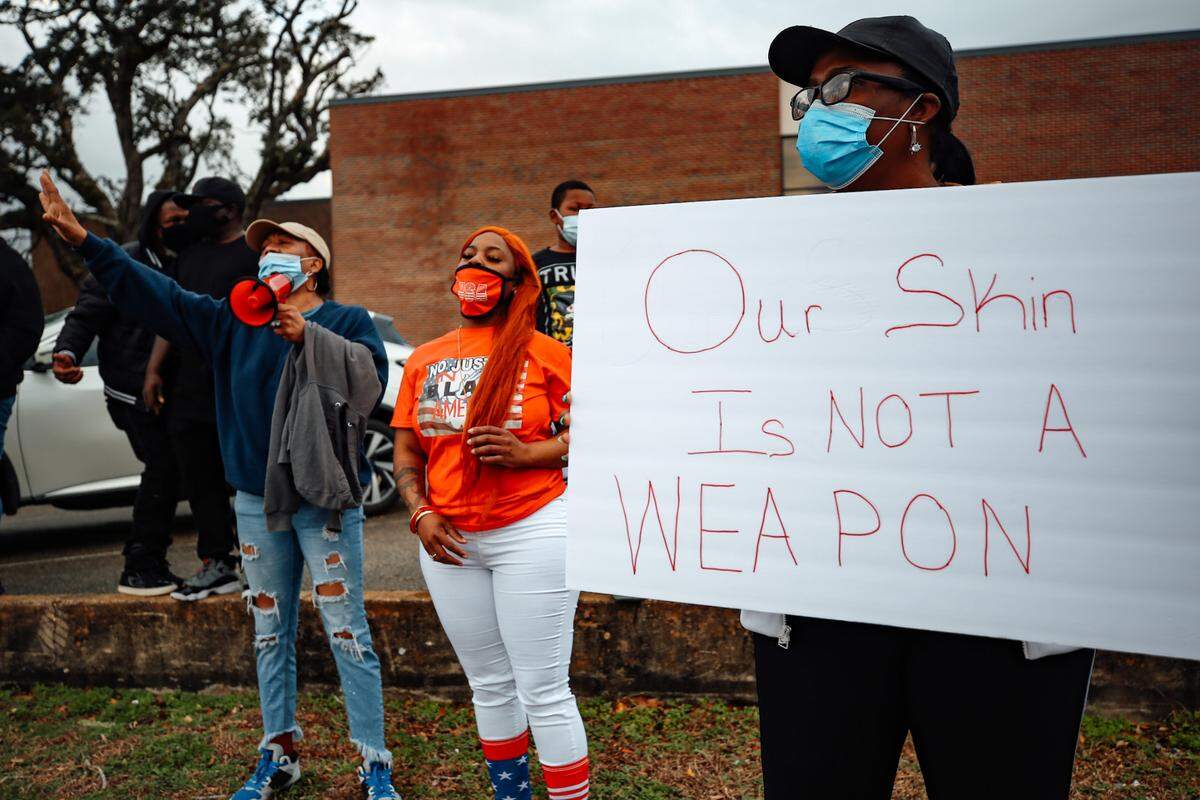
“My heart almost dropped when I saw him hold Reggie’s head and shoot him,” said Patrice Johnson, who had driven in from New Orleans with other family members to watch the footage.
Family members were also frustrated that the video does not show the initial interactions between Johnson and the deputy, and that it has no audio. They said they want to understand how the interaction between the two men began and why it escalated.
Johnson’s sister, Deaundra West, said the video — which showed Johnson stabbing the deputy after he had already been shot once — indicated the stabbing could not have been the reason the deputy fired.
Karen Johnson, Reginald’s aunt, said the later shots were particularly troubling.
She and other family members said they couldn’t understand why the other officers, who come into view seconds after Jackson stops shooting, did not intervene.
“Nobody tried to intervene, to deescalate the situation,” she said. “It’s obvious he wasn’t still a threat after the second shot. And definitely didn’t deserve the third, fourth, fifth shot.”
Investigative reports outline witness accounts
After the shooting, MBI investigators and, in some cases, Biloxi police officers interviewed witnesses in the case.
The witnesses include a man from Biloxi and a man from Ocean Springs who went to the courthouse with his young son, another woman who worked across the street, the deputy who shot Johnson, the Biloxi officer who responded to the scene and others. Their names are redacted.
Below is an account of what the witnesses told authorities in reports MBI provided to the Sun Herald.
The reports are not the full extent of the investigation. One line in the documents describes a “case report” of 480 pages, but the file shared in response to the Sun Herald’s records request contains only 14 pages.
A woman at an office across the street from the courthouse was among the first to have a run-in with Johnson that day.
The woman was expecting a client and saw a man, since identified as Johnson, sitting on the steps outside her office.
“Hi, how are you?” the woman said, thinking it was her client. In response, an angry Johnson with clenched fists said, “F... you, b....”
The woman described Johnson’s behavior as aggressive and said she felt like she needed to get away from him, but he kept harassing her, with his fists clenched at times.
The woman saw a Biloxi police cruiser coming in the direction of the courthouse and flagged down the officer, Brandi Van Fossen. Van Fossen was already headed to the courthouse in response to a report of a suspicious person, identified as Johnson.
A man in a green pickup truck had called police. The driver had first noticed Johnson when he went to pull in at the courthouse and heard Johnson yelling at him from the street.
The driver drove around the block and parked to get away from Johnson.
Once the man parked, he said Johnson came over to his truck and started banging on his truck and spitting on it. The man called Biloxi police to respond.
When Van Fossen got there, she drove up in the parking lot on the west side of the courthouse.
Once she pulled up, Johnson stopped harassing the man in the truck and headed for her police cruiser. Johnson went over the patrol car and repeatedly hit the driver’s side window with a knife until he shattered the glass.
Van Fossen drove up further into the parking to get distance between her and Johnson.
Just minutes later, Deputy Jackson is seen coming out of the courthouse, walking backward with his gun drawn and then shooting.
Jackson told authorities he reacted once a court clerk yelled that someone needed help in the parking lot.
When Jackson got out there, he saw Johnson had shattered the glass on the Biloxi police cruiser and asked, “What in the hell are you doing?”
Johnson turned to Jackson and started charging at him with a knife.
A second deputy, Christopher Moreau, was assigned to work in transport and security that day. When he heard the confrontation, he headed to the west entrance to go out and assist. By then, Johnson had already been shot.
A criminal justice expert’s perspective
Dennis Kenney, a professor of criminal justice at John Jay College in New York and a former police officer, reviewed the video at the Sun Herald’s request.
He said the lack of video of the beginning of the interaction is a limitation when assessing it, but that Jackson’s shooting of Johnson appeared justified.
“[The deputy is] trying to retreat,” Kenney said. “He gets tangled up in trying to retreat and falls. It looks like the individual is trying to stab him. It appears to me that the officer is simply defending himself.”
In the United States, police officers’ use of force is governed by two primary standards: interpretations of the constitution by the U.S. Supreme Court, and by their agencies’ policies. In general, officers are allowed to use deadly force against a person whom they believe could kill or seriously injure the officer or another person.
The court has ruled that an officer’s decision to use lethal force should be evaluated from the perspective of a “reasonable officer at the scene.”
“It appears to me that the deputy believes he’s fighting for his life,” Kenney said. “You’re trained, if you’re going to use your handgun, that the intent is for it to be deadly. The shoot-to-wound stuff doesn’t really work.”
Earlier this year, the Sun Herald requested use of force policies from every law enforcement agency on the Coast. The Harrison County Sheriff’s Department was one of three departments that refused to provide its policy, citing exemptions in the state public records law.
Kenney said the aspect of the video he found possibly “concerning” was that no officer appeared to try to give medical aid to Johnson.
“As soon as he is down and the knife is secured, there’s no reason to believe that he has any other weapon, but the only way to determine that is to check his status,” Kenney said. “So the requirement to render aid becomes pretty urgent at that point, and they did not appear to be treating it that urgently.”
More body cameras for deputies
Since Johnson’s shooting death, Peterson said he has enacted a new policy requiring all deputies working in courthouse security and inmate transport to wear body cameras. The expense so far has tallied up to around $75,000, he said.
When Peterson took over as sheriff in 2016, he instituted the use of body cameras for the deputies.
But prior to new mandate, Peterson felt there was no need for the deputies at the courthouse to wear body cameras. The deputies assigned to courthouse security also transport prisoners to and from court.
“Because it was inside security and there were cameras inside, there really was no reason to do it at that time, but hindsight makes you change things and policies change every day,” Peterson said.
“It’s a tragedy for the deputy who went through this and it’s a tragedy for the family,” Peterson said, “but it’s something we (as law enforcement officers) have to do and live with every day.”
This story was originally published July 8, 2021 at 5:50 AM.