Is Gulfport’s latest plan a ‘money grab’ or a big boost for the Black business community?
The children who visit the playground at Katie Booth Community Center have to drink from a water faucet around the corner and outside the front door of the building, which is locked.
Less than 2 miles away, the children who play in Owen T. Palmer Park can quench their thirst at a water fountain encased in a concrete pedestal.
Katie Booth sits in a predominantly Black neighborhood, while Owen Palmer Park sits on Second Street, a prosperous white neighborhood just off the beach. It may seem a small discrepancy, but its one the residents of Black neighborhoods notice.
The council members from Gulfport’s predominantly Black wards, 1 and 3, have always counted on federal Community Development Block Grant money for lower income neighborhoods to help meet critical needs.
In the past, both wards have received the city’s CDBG funding intended for low- to moderate-income improvements. But CDBG money left from 2016-19, plus funding for 2020 — a total of $1.6 million — would all go to Ward 1 under a city proposal that will be the subject of a public hearing Wednesday evening.
The city proposes spending the money on sidewalks, lighting, landscaping and road paving around the Gulfport Jobs Corps campus. The campus will undergo $33 million in construction and incorporate what is left of the old 33rd Avenue High School, where blacks attended school in the segregated South.
The proposal also extends the city’s street and landscaping improvements from downtown Gulfport to the commercial area to its west, once a prosperous black business hub known as The Quarters.
‘Money grab’ or revitalizing Black commercial district?
Truck Casey, Ward 1’s councilman, long fought for the 33rd Avenue project, which is being funded by the U.S. Department of Labor. He is elated that the city will spend CDBG money to spruce up the neighborhood around it.
“People have been complaining about why downtown gets so much and The Quarters used to be part of downtown a long time ago,” Casey said. “We’re going to be bringing the Black businesses back in The Quarter like it used to be.”
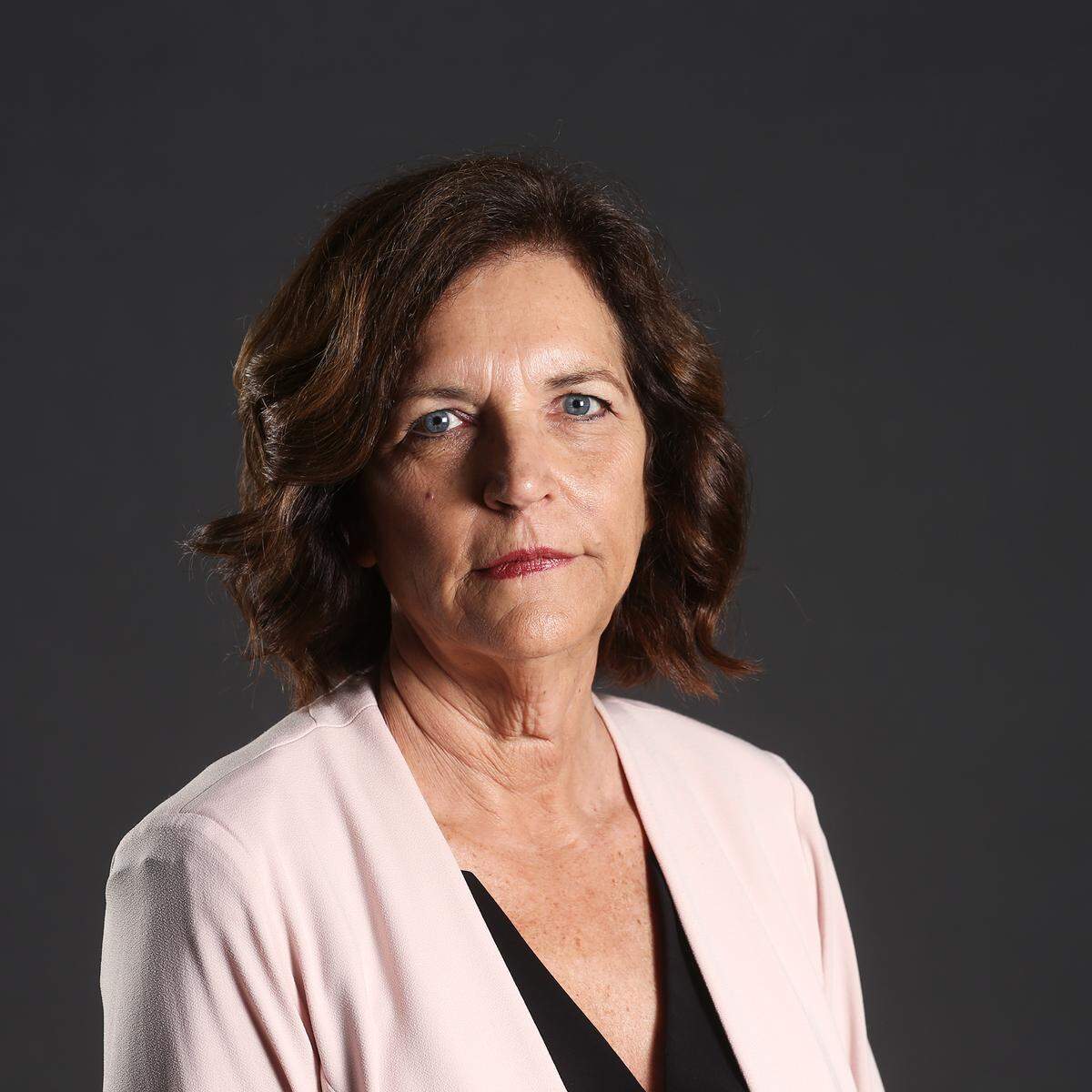
But Gulfport’s longest-serving council member, Ella Holmes-Hines of Ward 3, sees the proposal as “a money grab.” Some of the money that would have gone to needs in her ward would be transferred to the Ward 1 “streetscape” project, as it’s called.
“Poor people’s money doesn’t need to go to your bougie streetscape,” Holmes-Hines said. “If you want to spend the money on bricks and flowers, don’t take it from the poor.”
The list of needs in her ward is long, she said. If it weren’t for Kent Jones, the lone Black Harrison County supervisor, her ward would have even less. He has spent money on playgrounds and other needs in her area. Years ago, she said, the county gave Gulfport a ball field at the Isiah Fredericks Community Center.
But she said that she pushed for the city to give the ball field back to the county within the last year because she simply was unable to get the city to dedicate money for fixing it up and adding a playground.
“I decided, ‘I’m not going to let the kids suffer,’ “ Holmes-Hines said. Jones is getting community input for a big park improvement project.
Gulfport neighborhoods need attention
Parks and community centers in low-income neighborhoods are being neglected, Holmes-Hines and her constituents say. The historic neighborhood of Soria City, where a majority of residents are Black, saw its community center closed and its neighborhood basketball court deteriorate.
“There is nothing for the kids to play with here,” said Nay B. Smith, a resident who advocates for children and the elderly. Since 2017, the community has been trying to turn the basketball court into a park that would include an area for basketball.
Supervisor Jones has the money and plans for a splash pad, but he’s waiting on the city to do much-needed asphalt and other work first. The city instead plans to take $50,000 slated for the project on the Ward 1 streetscape.
Holmes-Hines had been counting on CDBG money for the park.
And she has a list of roads in her ward that are in deplorable condition. “I have plenty of people that’s riding on rocks,” she said.
The Katie Booth Community Center needs a new oven and refrigerator. The oven smokes, Gail Hockenhull said. Hockenhull, past president of Magnolia Grove Concerned Citizens Civic Club, said she can’t even guess the refrigerator’s age. The ice machine constantly breaks down.
The civic club holds meetings in the center and it is opened for rentals, but an after-school tutoring program is long gone.
Children enjoy the playground. But Hockenhull said she’s found rats on the play station with slides because the city does not keep the bank mowed at a nature area that runs along the fence line.
She grew up in Magnolia Grove and said the philosophy has always been for the neighborhood to help itself. But she said Magnolia Grove does needs some city support. Now it looks like the city will be taking $6,285 slated for Katie Booth as part of the money for the streetscape around the Job Corps site.
“This neighborhood has unpaved roads.,” Hockenhull said. “We’re just trying to make it better. We’ve been asking for so long.”
Extending a walkable downtown to historically black district
Holmes-Hines is urging her constituents to attend the public hearing and speak out against putting all the CDBG money in Ward 1.
But other council members support the project. They say it’s a chance to leverage the Department of Labor’s reconstruction at the old 33rd Avenue school in a way that will uplift the entire area.
The city is working with an area bank to provide small business loans in hopes of reviving The Quarters.
“I think it’s a great extension of downtown and a way to revitalize what was a thriving minority business district before,” Ward 4 Councilman Rusty Walker said.
Ward 5 Councilman Myles Sharp examined CDBG spending records for the past seven or so years. Over that period of time, he said, CDBG money has been divided in fairly equal measure between wards 1 and 3. He said there’s been no push-back from the other five council members because the needs are greatest in those two wards.
He also thinks that extending a walkable downtown to the historically Black commercial district is a great idea.
“There’s always an argument that any money we spend in one area could be better spent somewhere else or on another project,” Sharp said, “but that doesn’t mean that what is being proposed isn’t good for Gulfport.”
“There’s been a lot of money spent downtown and in trying to rebuild downtown. We saw this as an opportunity to create a whole district over there to try and do something for that segment of our population.”
How to attend the public hearing
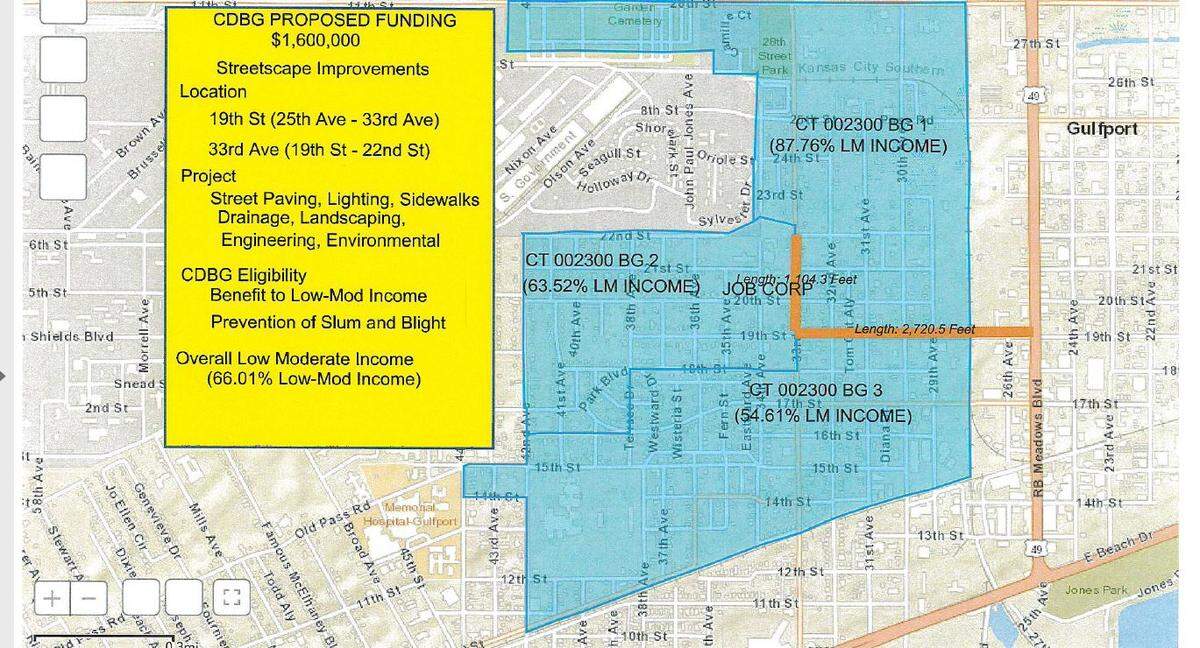
The city will hold a public hearing at 5:30 p.m. Wednesday at City Hall, 2309 15th Street, on reallocating CDBG money from years past and using 2020 CDBG funding to pave roads, build sidewalks, install streetlights and add landscaping around the Gulfport Job Corps Center, which is about to undergo major construction.
The city proposes spending $1.6 million on the project. The improvements would be added on 19th Street between U.S. 49 and 33rd Avenue and on 33rd Avenue from 19th Street to 22nd Street. The Job Corps Center sits at 33rd Avenue and 21st Street.