COVID-19 kills 3 people in one MS Coast family. ‘They pulled our hands apart.’
Someone brought COVID-19 to the home of Robert E. and Sylvia D. Stanton while the elderly couple was in lockdown in a gated community in rural Carriere.
As a result, the Stantons and their son-in-law, Joseph Rice Sr., are dead.
Their family doesn’t know who it was, and it really doesn’t matter. Daughter Cheri Borgstede feels sure the virus arrived with someone who had good intentions, someone who did not realize they were infected.
“I do feel like COVID was lovingly brought to them by someone,” Borgstede said.
This was in April, before the pandemic filled hospitals in Mississippi, before daily cases climbed into the thousands, before the death toll inched toward 5,000 in the state.
The Stantons, both in their 80s, had not left their home in almost a month, said Barbara Rice, who lives 10 doors down. She, her now-deceased husband and another sister who lived nearby delivered groceries to the Stantons’ house and wore masks when they went inside.
“They weren’t leaving the house at all,” Barbara Rice said. “We went out and did everything for them. I didn’t want them getting out and getting exposed to anything.”
Rice and sister Cheri Borgstede of North Biloxi said their mom was a true Southern lady, always hospitable.
“Mom was so sweet and friendly, anybody that came to her door, she would just let them come in,” Rice said. “If someone came to the door, Mom would answer it.”
Borgstede said her parents were in relatively good health before COVID-19 hit. Their six children were all determined to keep their mom and dad safe.
Borgstede, the surgical services business manager for Singing River Health System on the Mississippi Coast, says she has watched with dismay as people continue to reject masks, wear them under their noses, fail to stay 6 feet apart and gather for holiday celebrations.
A few minutes of carelessness will kill, she said, maybe not the asymptomatic carrier but someone in their family, a friend or even a stranger whose family must live with their grief.
“You can’t be careful enough,” Borgstede said. “You just can’t.”
Three family members hospitalized with COVID
Rice and the Stantons fell ill around the same time.
Joe Rice, a Vietnam veteran who suffered from diabetes and COPD, grew short of breath. Sylvia Stanton developed a cough and fever, and Robert Stanton grew ill, too. All three tested positive for COVID-19 and were admitted to Slidell Memorial Hospital in late March, with Rice being hospitalized a few days ahead of his in-laws.
“That was the most awful feeling to drop him off at the hospital,” Barbara Rice said. “We prayed all the way to the hospital. When I was at the door, they told me I couldn’t go in with him, which I didn’t expect.”
“We were holding hands, and they pulled our hands apart. When they pulled our hands apart, I just looked at him and he looked at me. We had tears in our eyes. It just broke my heart that I wouldn’t be able to go in with him and take care of him and be his advocate.”
The Stantons, who had never been apart, shared a room where their beds were pushed together. They were on oxygen but seemed to be doing OK. The family checked in regularly and visited with the couple over FaceTime on Easter.
Joe Rice was transferred to the Intensive Care Unit within a few days of admission and spent the last week of his life on a ventilator.
Robert Stanton, 88, grew weak. The former air traffic controller knew he was dying and wanted to go home, so the family arranged it. At the house, medical technicians lifted him from an ambulance.
“When I reached for his hand, he just squeezed it ever so lightly,” said Barbara Rice, who was never tested for COVID but said she also did not develop any symptoms. “At least I got to touch my daddy for the last time and let him die in peace.
“Daddy died within an hour or two.”
Husband taken off ventilator, dies in hospital
Less than an hour later, the hospital called Barbara Rice.
Her husband wasn’t going to make it, they said. The doctors were preparing to remove him from the ventilator. She was told that she could not come to the hospital. She went anyway.
“When I got in there and saw my husband, I won’t even discuss it,” she said. “They pronounced him dead within hours of Daddy.”
Sylvia Stanton, an artist who had taught classes in a home studio before lockdown, was still using oxygen but had been feeling better.
Her condition worsened after her husband’s death. She was admitted to Singing River Hospital in Pascagoula, where she suffered a massive, coronavirus-induced stroke and died a week later, on April 28.
The Stantons had celebrated their 67th wedding anniversary in January. Their ashes were placed together in a single urn and entombed in her family’s monument in Thibodaux, Louisiana.
“She was ready to be with him,” Borgstede said. “It was terrible when it happened, but I don’t know what they would have done without each other. It’s a blessing that they’re together.”
Family lives with grief from coronavirus spread
Although she washes her hands frequently and always wears a mask, Borgstede caught COVID-19 in July.
She quarantined on the second floor of her house, and her husband left meals on the landing. Even so, he, too, caught the virus.
The couple, 60 and 61 years old, have both recovered. For the first time this Christmas, they observed the holiday without any of their children or grandchildren present. It was a family decision.
“We want to have a good Christmas next Christmas and for everybody to be here,” she said.
She wants people to know what happened to her family. If their story saves one life, she will be satisfied.
“At the end of the day, it’s selfish not to wear a mask,” Borgstede said. “Even if you are around people who are healthy, you don’t know who they are taking care of or who they could come into contact with and pass it on.
“It’s not just about you and your friends. It’s about your community.”
Barbara Rice and her husband would have celebrated their 30th wedding anniversary in November. Instead, she is left with an urn filled with his ashes, awaiting a funeral with military honors.
“That’s what’s so sad about this whole situation,” she said. “People think they’re invincible and you lose your loved ones. People have to live with this grief for a long, long time.”
How COVID-19 spreads
The Centers for Disease Control says that, based on current scientific studies, people are more likely to become infected the longer and closer they are to a person with COVID-19.
COVID-19 spreads mainly through respiratory droplets that travel into the air when you cough, sneeze, talk, shout or sing. The droplets are often so small they are invisible to the eye.
It can also spread through people who never develop symptoms, and those who are not yet showing symptoms.
Masks help keep those droplets from reaching others.
It is especially important to wear a mask when you are indoors with people you do not live with and when you are unable to stay at least 6 feet apart.
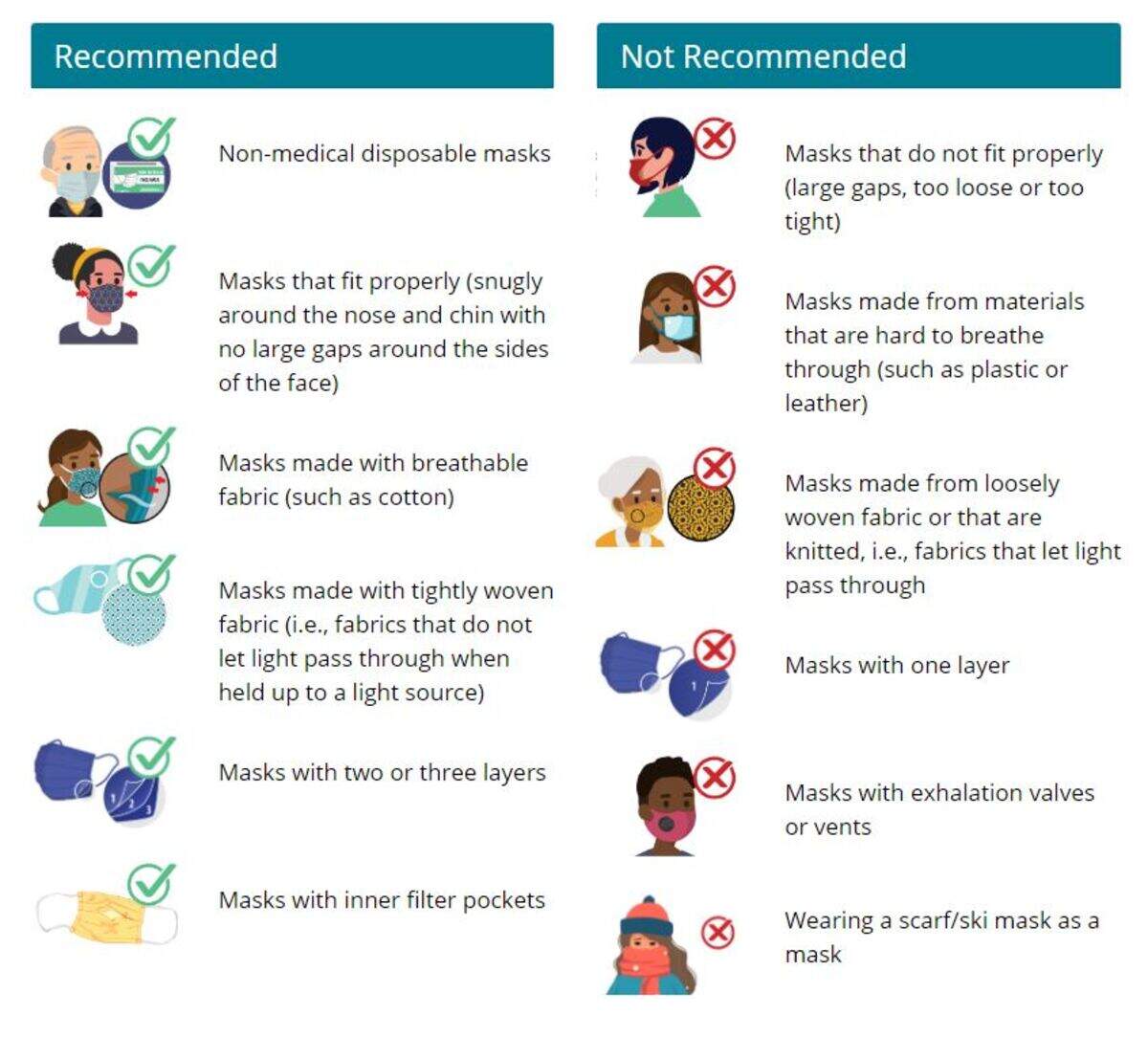
Some types of masks work better than others.
Not recommended masks:
- Masks that do not fit properly (large gaps, too loose or too tight)
- Masks made from materials that are hard to breathe through (such as plastic or leather)
- Masks made from loosely woven fabric or that are knitted, i.e., fabrics that let light pass through
- Masks with one layer
- Masks with exhalation valves or vents
- Wearing a scarf/ski mask as a mask
Recommended masks:
- Non-medical disposable masks
- Masks that fit properly (snugly around the nose and chin with no large gaps around the sides of the face)
- Masks made with breathable fabric (such as cotton)
- Masks made with tightly woven fabric (i.e., fabrics that do not let light pass through when held up to a light source)
- Masks with two or three layers
- Masks with inner filter pockets
— CDC
This story was originally published January 3, 2021 at 5:40 AM.