
Origins of mystery object revealed, sorta!
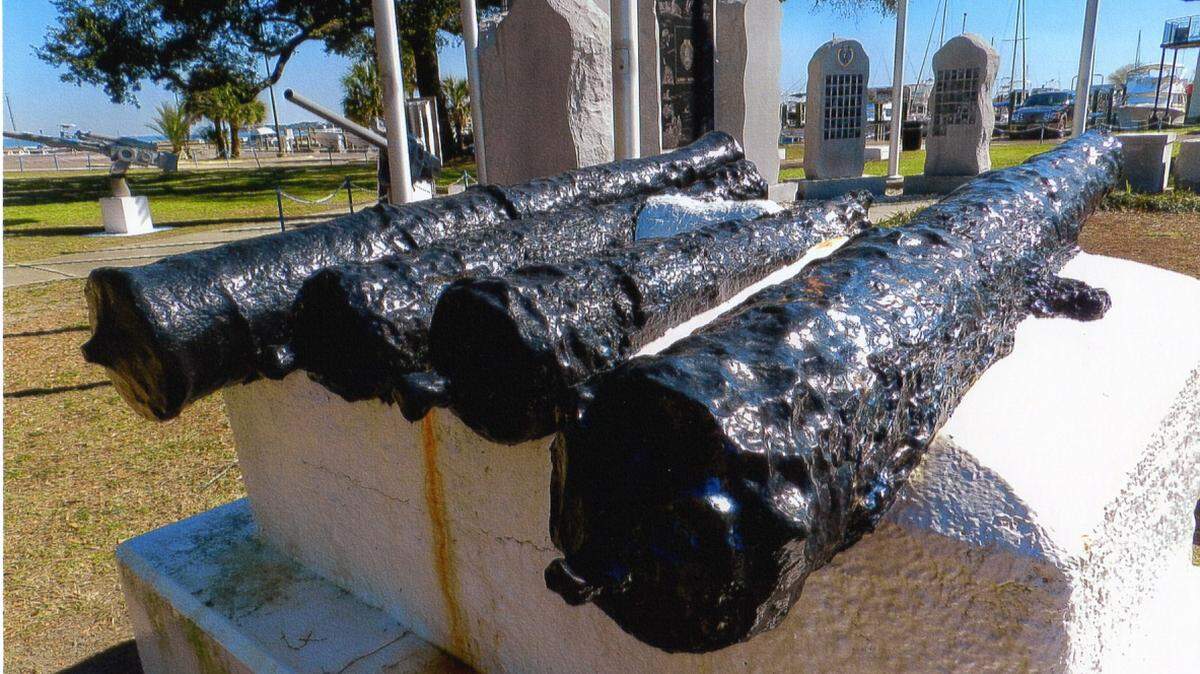
Ta da! The mystery object is revealed.
But I offer one last hint, as if the photographs on this page haven't already stolen my thunder. Lenny Bruce, that late, great counter-culture comedian, once quipped, "I hate small towns because once you've seen the cannon in the park there's nothing else to do."
The mystery object is a very, very old cannon.
The original photograph and the question, "What is this?" first appeared in this space two weeks ago, along with 10 hints. The last hint was that several chapters of this mystery object's history symbolize disaster. That was a reference to a half dozen hurricanes, ranging from 1722 to 2005, that played havoc with the cannon's very existence.
One of four cannons
This is one of four cannons discovered in 1892 by a young oysterman on a sediment-buried shipwreck in Biloxi Bay. In the last 90 years, the mystery cannon and its three relatives have been on public display at three different Biloxi locations.
The cannons, described in good condition in 1892, are the worse for wear, and we could easily argue that such historic treasures should have long ago been conserved and placed inside a museum.
No other known object so blatantly represents the history of the founding, development and struggles of the Mississippi Gulf Coast from colonial times to the 21st century. Even the Tiblier family, credited with discovering the four cannons and other artifacts, indicated that in the first news story:
"It is intended to call the attention of the United States government to this find with a view of having those unknown relics placed in the Smithsonian Institute at Washington." That was reported Sept. 24, 1892, in this newspaper then known as The Biloxi Herald.
If the cannons were squirreled away in a national museum away from here, they would be preserved for posterity but the Coast would miss out on a great local curiosity.
Mixed modern history
In the 123 years since their resurrection, the four cannons have survived both spotlights and obscurity. Is their recognition mixed because no one yet knows the history of the sunken ship that brought them to the New World?
Speculation began with that first 1892 Herald article, double headlined: "A Mysterious Find. The Wreck of Ancient Man-Of-War Found Under the 'Rock Pile' in Biloxi Bay -- Old Style Cannon and Munitions of War Recovered -- Supposed to Have Laid Under the Water for Nearly Two Centuries."
For a small-town newspaper of the late 19th century, the report was unusually long, descriptive and marked "special." Finding the cannon was A Big Deal.
Today, the four are displayed at Guice Park in front of Biloxi Small Craft Harbor, sharing space with World War II-era guns and superstructure from the USS Biloxi. Thousands drive by the U.S. 90 park each week, oblivious to the slice of colonial history they pass.
A plaque on the cement stand holding the eroded cannon barrels speculates:
"Ancient cannon from an old French or Spanish Ship sunk in the Bay of Biloxi shortly after the establishment of the first capitol of the vast province of French Louisiana..." The plaque credits the Tiblier family for discovering and donating the cannon but oddly lists the wrong year of discovery.
Speculation from the beginning
"It's a pirate ship," some said at the time, but generations of locals have referred to them as the "D'Iberville Cannon(s)." That's based on speculation that the ship was associated with Iberville or Bienville, the two LeMoyne brothers who carved out the vast American La Louisiane for France.
Iberville first landed and explored present-day Biloxi and Ocean Springs in February 1699. At his death his brother continued exploration, building and settlement of the French region later bought by America and carved into states.
These cannons may be part of that story, for in 1722 a hurricane ravaged New Biloxi and sunk ships, including one where the Rock Pile is thought to be. That storm convinced the French to abandon storm-ravaged New Biloxi as the capitol and to develop New Orleans.
The Biloxi Bay Rock Pile and what was found by oysterman Eugene Tiblier Jr. will be explored next week, but for today, we are into generalities and the pursuit of history mysteries.
Modern guessing game
Happily, a few readers shared their "What is this?" sleuthing with me. All guessed "cannon" but not everyone guessed the right location. After all, as Lenny Bruce suggests, there are lots of cannons in small-town parks, and we are a region drenched in colonial and Civil War history.
One of the more interesting responses came from Mike Skrmetti, who traced his interest in the cannon to his days as an observant Scout attending meetings on the grounds of the beachfront Biloxi Community Center in the 1950s and '60s.
"If the cannons are the correct answer, they were right by the building where our Boy Scout meetings were held, so I recognized them right away," he said. "The cannon(s) were in front of the old USO, by Highway 90."
In the mid-1920s, after several attempts to get the city to buy the cannon, the Tibliers loaned them to the city.
All these years later, we still don't know their provenance.
For two brief periods in the 1980s and 1990s the Mississippi Department of Archives and History approved exploration of the suspected -- and protected -- site with magnetometers and sonar. Wood samples from the findings point to an early 1700s ship, but no further exploration has been done.
That is as it should be, at least until the time is right, the public money is allotted and the technology is top-notch to preserve, interpret and solve this history mystery.
Until then, we know the cannons are colonial, probably French and the survivors of several hurricanes.
Kat Bergeron, a veteran feature writer specializing in Gulf Coast history and sense of place, is retired from the Sun Herald. She writes the Coast Chronicles column as a freelance correspondent. Reach her at BergeronKat@gmail.com or c/o Sun Herald Newsroom, P.O. Box 4567, Biloxi, MS 39535-4567.
This story was originally published March 12, 2016 at 6:50 PM.