
TIM LOCKLEY: Mistletoe is a challenge to control
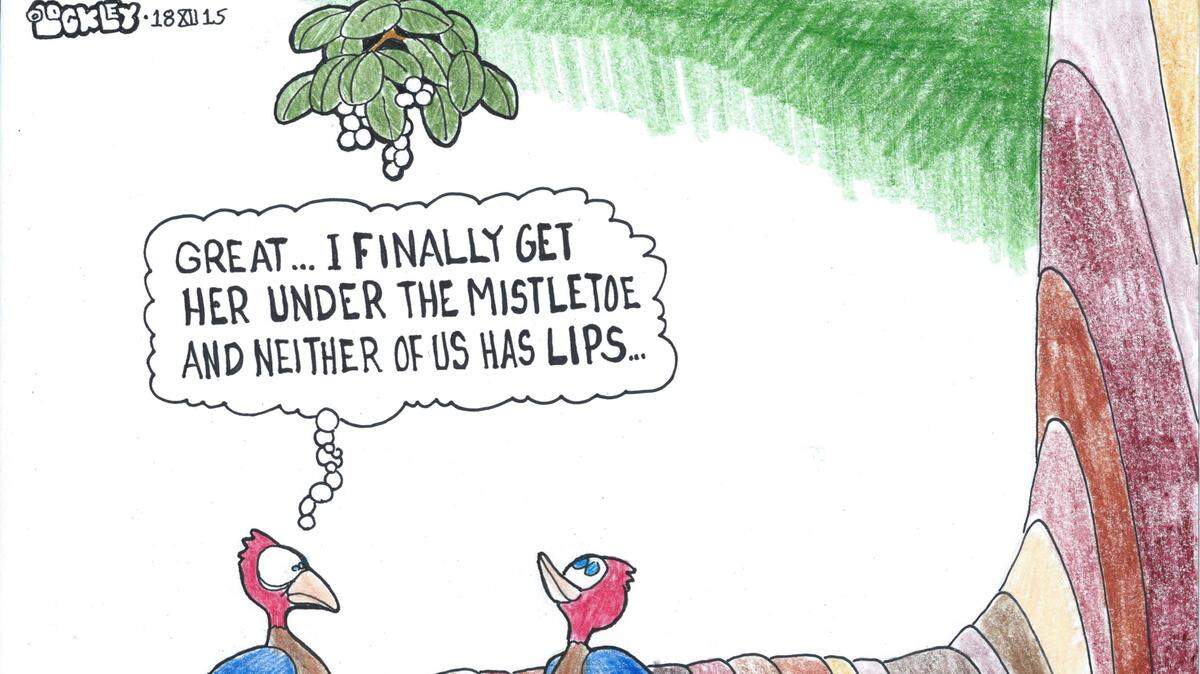
Translated from the original Saxon language, mistletoe means "dung on a stick." Makes you wonder why people hang it in their house this time of year and will then stand expectantly under it for a considerable amount of time. Must be the spirit of the season -- or, at least, a tradition that we've adapted from the ancient Celts.
Back when they held sway over the British Isles and most of northwestern Europe, the Druids believed that anything growing on, under or even close by their revered oak trees had magical powers. To the Celts, mistletoe seemed to thrive without any means of receiving sustenance. Because of that, they believed that it was a ward against evil. They would hang cuttings of mistletoe above entranceways as an indication that former hatreds and grievances had been forgiven. Today, mistletoe is so popular in North America and western Europe that it is grown and harvested commercially.
Mistletoe is an evergreen parasite that grows on the branches of trees. Over time, our North American species can grow to a diameter of over 1.5 meters. The leaves are oval, thick and have a leathery texture. The flowers are small and inconspicuous. The white, sticky berries appear in the fall.
Unlike most plants, mistletoe gets everything it needs from its host. It attaches itself to its host through its roots. They penetrate the host's conductive tissues (think plant arteries), drawing food and water as needed. A mistletoe plant can live up to 10 years and grows quite quickly. If enough of these parasites attach themselves to a tree, over time they will weaken the tree's ability to withstand droughts and diseases.
Controlling mistletoe is problematic at best. They tend to be hard to reach and their roots are well established in the host. Just breaking it off won't do much good in the long run. The roots will quickly regrow a new plant. To successfully remove a mistletoe, the section of branch to which it is attached must be severed as well. If you find it on a small limb, prune the branch at a point at least 30 centimeters toward the trunk from where the mistletoe is situated.
Fortunately, there's another method available. It's a plant growth regulator called Florel. Florel can be sprayed directly on the mistletoe without harming the host. It kills the exposed part of the parasite but doesn't kill the roots. This means you'll need to make multiple applications every time a new plant tries to show up. Exceptionally heavy infestations could take up to four years to get under control. With the exception of the amount of time involved, Florel has significant advantages over pruning. For one, it's less labor intensive. Secondly, it stops the production of seeds, thus restricting the further spread of the parasite.
One final note. Before I let you go to stand with lips puckered under your mistletoe, I need to warn you that the berries are poisonous and should be kept away from curious pets and children.
Now, go and have a salubrious solsticial season.
Tim Lockley, a specialist in entomology, is retired from a 30-year career as a research scientist for the U.S. Department of Agriculture. For answers to individual questions, please send a stamped, self-addressed envelope to Tim Lockley, c/o Sun Herald, P.O. Box 4567, Biloxi, MS 39535.