
TIM LOCKLEY: Teenage chiggers have an itch to find us
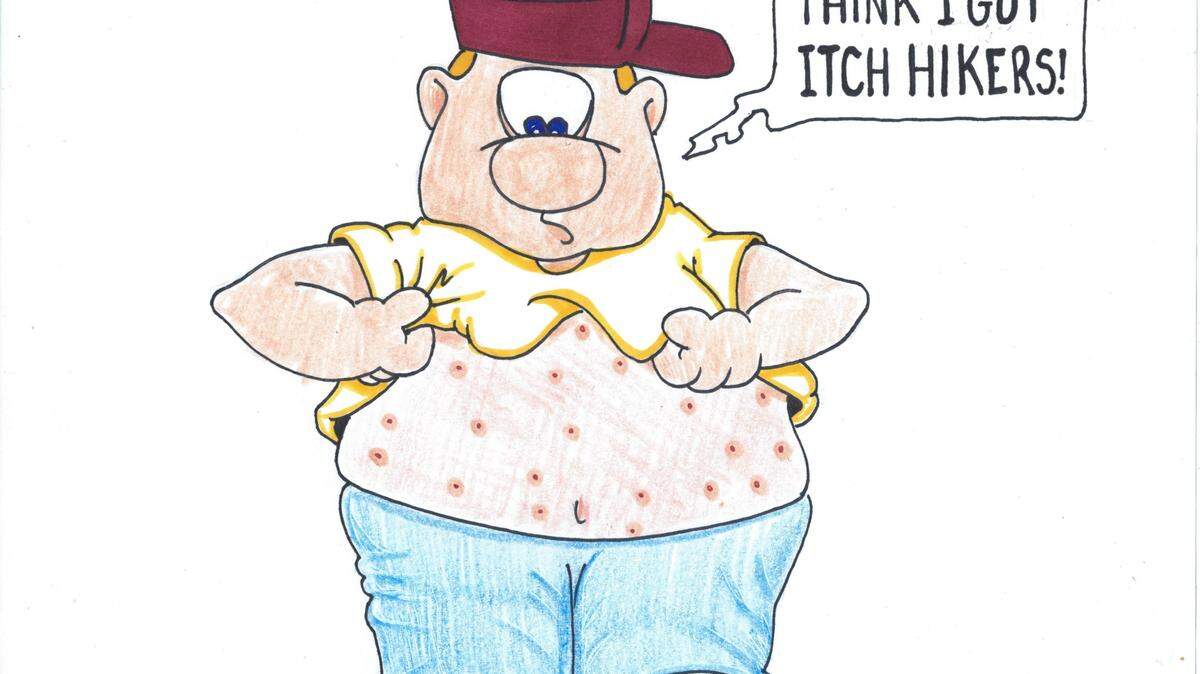
"Oh, why can't a chigger
Be a tad bigger?
So tiny a mite,
With such a big bite,
Makes welts with such vigor."
Immediately after hatching and again in the adult stage, chiggers (known as harvest mites at those stages) are beneficial predators of other mites. It's in the teenage equivalent of their life cycle where they cause us so much consternation. In their pestiferous stage, the six-legged nymphs run around on the ground looking for a warm-blooded host. They'll either climb up the leg of their potential meal or crawl onto vegetation where they'll drop onto an unsuspecting mammal.
Like their cousins the ticks, chiggers have serrated mouthparts that they use to slice into our skin. Unlike ticks, they don't feed on blood (they're actually too small to reach the capillaries under our epidermis). They're so small that a half dozen could fit onto the period at the end of this sentence. Instead of blood, they feed on fluid they take from our skin cells. To get to that fluid, they attach themselves to a hair follicle or skin pore and inject an enzyme that ruptures the cell. Once the cell is ruptured, another enzyme causes the tissue around the cell to harden, forming a kind of "straw" that the mite uses to suck out the fluid.
Chemicals in the chigger's "spit" cause the itching sensation that we associate with their presence. However, this itching sensation usually doesn't start for 24 to 48 hours after the bite. Chiggers feed quickly and drop off of their host. By the time you start itching, the chigger is long gone. It's this delay that fools us into thinking that we have a chigger problem in our own back yard when the infestation may be somewhere else entirely.
You might encounter chiggers almost anywhere, but they tend to concentrate in moist areas with a lot of vegetation. They like the moist bits on us as well. That's why they wind up near the groin and armpits as well as under tight clothing such as socks, underwear and belt lines. The skin at these sights is also thinner, not being thickened or roughened by wear or exposure to the sun. Besides moisture, chiggers prefer shade and thick vegetation. Maintaining good weed control, judicious mowing and elimination of excess shade can reduce the number of chiggers.
If you want to locate if and where the chiggers are the thickest, there's a simple technique you can use. Set a piece of black paper about the size of the palm of your hand vertically in the grass. In 30 minutes, if they're there, the paper will have tiny red mites on it. Once you've confirmed the presence of chiggers, you can use any one of the insecticides labeled for use on your lawn. You'll need to treat your whole yard and you'll need to treat at least two times a month apart. If you can't treat or want to avoid using pesticides, insect repellants are fairly effective. To get the best effect, the repellant should be applied to your shoes, socks, pant's cuffs, ankles, legs and around your waist.
If, after all of this, you still manage to get bit, over-the-counter lotions and creams containing antihistamines or hydrocortisone will help relieve the itching. Painting a chigger bite with nail polish to suffocate the mite doesn't work. Remember, it ain't there no more. All the nail polish does is seal off the sore from air, which keeps the wound from itching as badly.
Tim Lockley, a specialist in entomology, is retired from a 30-year career as a research scientist for the U.S. Department of Agriculture. For answers to individual questions, please send a stamped, self-addressed envelope to Tim Lockley, c/o Sun Herald, P.O. Box 4567, Biloxi, MS 39535.
This story was originally published December 10, 2015 at 7:19 PM.