
TIM LOCKLEY: Rainy days brought fire ants to the fore
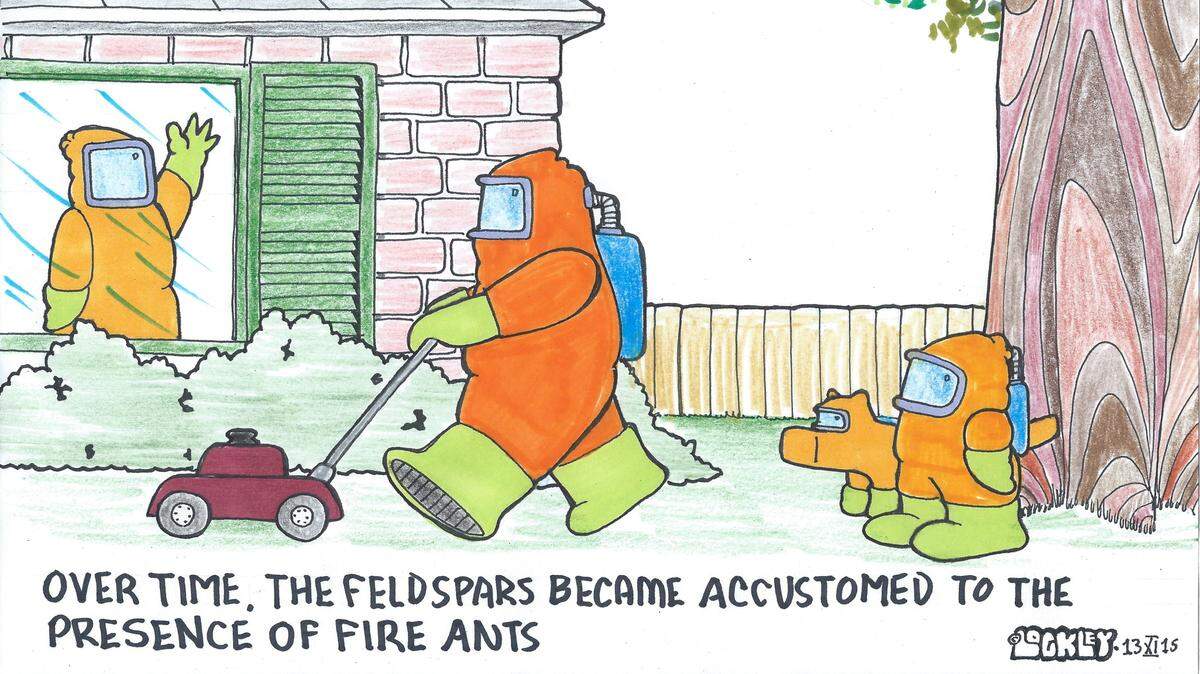
You might think that the fall of the year is an odd time to be writing about fire ants. Many of you had become complacent about these little stingers. Throughout the hottest months, fire ants didn't seem to be about, but with the recent rains, they proved they were still around. Mounds began popping up like mushrooms. I drove to Starkville the other day and saw hundreds of dark red mounds every kilometer along the side of the highway.
We had fire ants before we got fire ants. That is to say, we had native species already here, but they weren't much of a problem. The first species of imported fire ant arrived here through the Port of Mobile around the end of World War I. That was the black imported fire ant. It wasn't much of a competitor and now is found only in northern Alabama and northeastern Mississippi. There are a few isolated colonies immediately across the border in southern Tennessee.
The next pest to come ashore two decades later, the red imported fire ant, also chose Mobile Bay. This ant, unlike its cousin, hit the beaches like the U.S. Marines on Iwo Jima, taking the high ground and keeping on going. Red imported fire ants can now be found from Maryland to Florida and west to California. Odds are they will continue to spread and may eventually (at least in urban areas) infest most of the United States.
As to our native species, they weren't able to compete against the newcomers and can be found only in isolated pockets here and there. Oddly enough, we started exporting our native fire ants to other places throughout the world. I have a monograph written in 1803 that bemoans the arrival of our fire ant in Madras India. What imported fire ants did here, our fire ants managed to do around the world. They now can be found in Hawaii (which, prior to their arrival, had never had any ants), Australia, southeast Asia, south Asia and the Mideast.
When it actually comes to controlling fire ants, there are a number of excellent options available to us. To begin with, the simplest but the most labor intensive method is to drench the mound. Mix the minimum amount of insecticide concentrate and water in a bucket and pour an amount sufficient to saturate the mound. Fire ants evolved in a river flood plain in the Pantanal in South America and, as a result, the mound is built to channel water. Because of that, the liquid drench will quickly reach through out the basketball size tumulus and kill every ant it touches. With the exception of the 10 percent or so that are generally foraging outside the mound for food, the entire colony is instantly eradicated. The drawback to this method is that it's labor intensive. You also are restricted to treating only the mounds you can find. Since mounds are built to get the colony out of saturated soil and to act as a passive solar collector, this time of year is a good time to go hunting.
The second method is less labor intensive but may require from three weeks to three months to take effect. Baits, like Amdro, are designed to let the ants do almost all of the work. You broadcast the material, sit back and relax and wait for the ants to die.
There are four drawbacks to this method. You can't put it out if the ground is wet. The granules will dissolve and be useless. The bait has to be carried back to the colony for it to work. The ants won't pick up a granule if it's contaminated. So, use a clean spreader.
Second, the colder the temperature, the longer it will take to kill off the colony. I've treated in January and February on bright, sunshiny days and managed to get over 85 percent control, but the results took three months. Conversely, treatments I've done in June and July have achieved 100 percent mortality in under three weeks.
Third, the bait is, for the most part, designed to cover an acre with as little as 1- 1/2 pounds. That is a difficult amount to put out. Most spreaders are designed to put out granular material at much higher rates.
Finally, baits kill only the colonies that are active the day you put it out. It has no residual activity.
A third method involves the use of a granular insecticide. Like the baits, you broadcast it. Unlike the baits, it must be watered in to initiate the chemical. A single treatment with most granular insecticides will continue to kill fire ants for three or more months.
We never will completely eliminate fire ants. All we hopefully can expect to do is reduce their numbers to a level we can tolerate. For some of you, that may mean zero ants. Diligently applying the methods above, you may very well be able to reach that point.
Tim Lockley, a specialist in entomology, is retired from a 30-year career as a research scientist for the U.S. Department of Agriculture. For answers to individual questions, please send a stamped, self-addressed envelope to Tim Lockley, c/o Sun Herald, P.O. Box 4567, Biloxi, MS 39535.
This story was originally published November 12, 2015 at 7:50 PM.