The Southern Miss defense was a disaster last season. Here’s what’s new in 2025
AI-generated summary reviewed by our newsroom.
- Southern Miss hired Jason Semore to overhaul a defense that ranked near bottom.
- Semore’s 4-2-5 scheme prioritizes nickel and edge roles with advanced tackling skills.
- USM opens against Mississippi State on Aug. 30 in first ESPN home game since 2010.
Southern Miss is days away from putting its 1-11 season and historically dreadful defense in the rearview mirror.
The regime shift to Charles Huff came with the appointment of the fourth defensive coordinator in four years for the Golden Eagles’ program. Jason Semore followed Huff from Marshall and has installed his 4-2-5 defense that wreaked havoc during the Thundering Herd’s conference championship campaign a year ago.
It’s the very same defense USM deployed under Clay Bignell. Except that version was gutted for over 5,300 yards in less than 12 games. Factoring in the merciful early end to the Kentucky opener, USM gave its opponents 117.2 yards and 9.8 points per quarter of football.
Southern Miss and Marshall were separated by a full two touchdowns in average scoring allowed. The Herd would have had to play six more games to reach the total points given up by the Eagles.
The stark contrast of the same alignment begs the questions: what was the difference in how the two defenses were executed, and how will it work in USM’s favor this season?
‘Actually learning football’
Those were the words of linebacker Chris Jones before spring practice even began. They were the product of nearly three months spent in the Lab of Semore, where Jones said he learned more about football than he had in every prior season of college and high school ball combined.
Jones’ first college defensive coordinator came with one season of experience at the position and it was spent at Eastern Illinois. His new DC comes in with eight years already logged.
The difference in teaching is evident when Jones speaks.
“Not just going out there and playing, but knowing what’s going on before the play,” Jones said about the difference in coaching. “How to read certain plays and certain formations. It’s a lot of thinking, but they simplify it for you.”
The 4-2-5 is a bit more complicated than your father’s 3-4 base and much faster than your grandfather’s 4-3. It’s a 90’s-baby adaptation popularized by Gary Patterson that leans on disguise and disruptiveness to counteract spread offenses.
A fair amount of athleticism and intelligence is required across the board with the regular deployment of split coverages and the often glaringly obvious weakside presented.
The Southern Miss secondary was often out of position or unprepared in many moments last season, as evident by the team defensive back negative play rate, or “DB Havoc,” of 4.7 percent. That was second-worst in the Sun Belt. On the opposite end of the spectrum, at second-best in the league, was Marshall’s 7.2 percent rate.
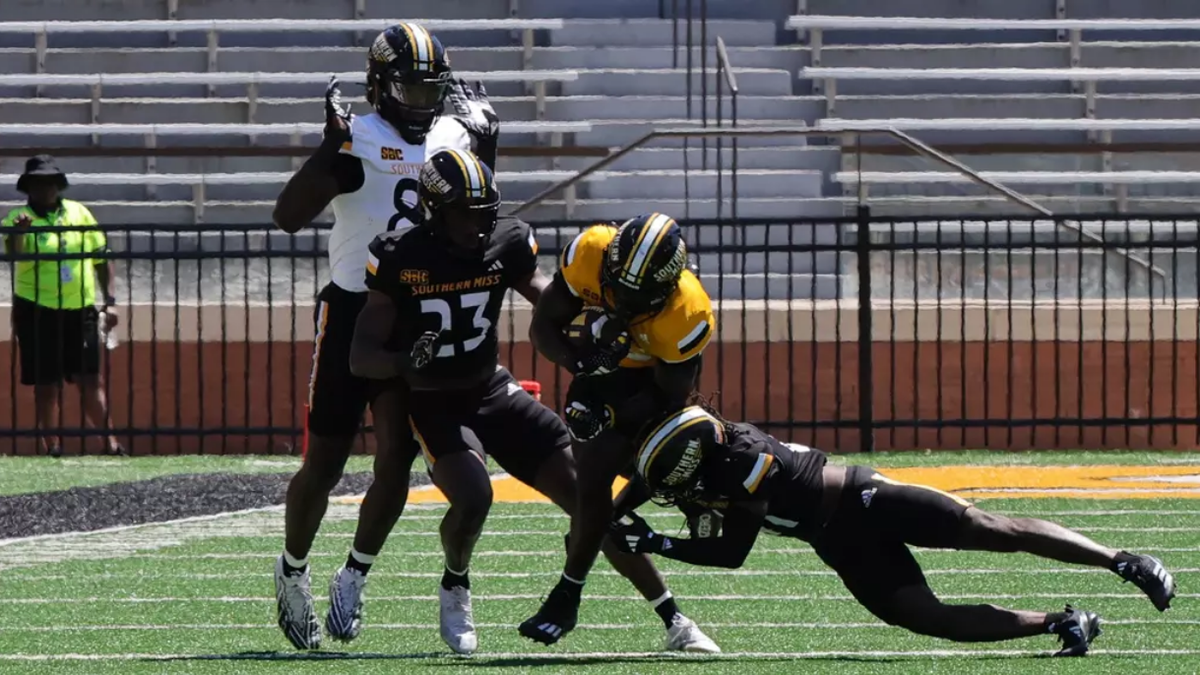
Proper run fit discipline is also crucial, with more open space to be had within the interior of the second level. That was a critical weak point for USM, which allowed the third-highest average yards per open field carry in the country.
Both the C gap and interior A and B gaps were a struggle to fill. Ryan Johnson, who was effective as a pass rushing edge, posted a 29.1 tackling grade while lining up over offensive tackles. Mike linebacker Ja’Len Sims, responsible for the interior gaps, played 368 snaps with a 44.4 tackle grade.
Semore had three players log at least 400 snaps on the edge of the Herd’s defensive line. The average tackling grade among them was 70.1. His interior gap fit at mike, Jaden Yates, turned in a 72.1 tackling grade.
Poor tackling is often a sign of lack of fundamental preparation. That was hinted at earlier this year when Huff referred to one of the returnees as “Superman” because of the way he lunged at ball carriers and gave up his lower body leverage in the process.
That player was Jones. Despite the NFL size and speed Semore attributes to him, his freshman year tackling grade was 54.
Who will make this version click
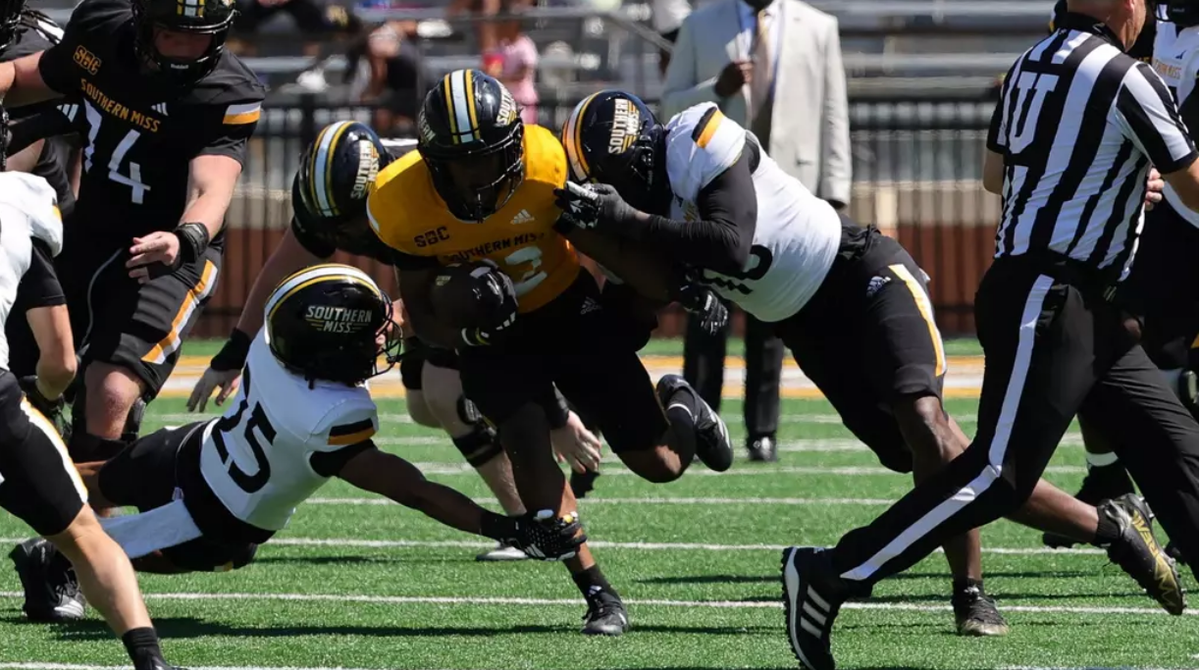
The biggest piece of Semore’s defense is the nickel. Referred to as a star, bandit, jack or stinger, the player filling the role must be a three-level defender.
Technically the fifth defensive back, the nickel occupies an overhang position and is charged with coverage, both man and zone, setting the edge on outside runs and getting to the quarterback.
Dylan Lawrence and Kolbe Cage both manned the position a year ago. The two combined for 70 tackles, two tackles for loss and no sacks. Marshall also rotated two players, who together made 86 stops, six in the backfield with one sack, one interception and seven pass breakups.
One of those players was a redshirt freshman and is now the leading candidate for the full-time role, except now as a Golden Eagle.
“The 4-2-5 only works if you have a nickel, it’s the hardest position for us to recruit,” Semore said ahead of fall camp. “It’s the hardest position for us to find. We have a really good one in Ian Foster.”
The name may be familiar. Foster registered eight tackles, two tackles for loss and two pass breakups in his last game in Hattiesburg — a 37-3 win over the Golden Eagles.
After the nickel, Semore points to the boundary defensive end as a high-priority position. The edge rusher differs from the opposite defensive end as a pass-game specialist. He’s used to rush the passer on most downs, but is athletic enough to drop into zone in a disguised blitz.
This was Mike Green for Marshall in ‘24. Green would be a second round pick in April’s draft, but Semore had another pass rusher he would either spell Green with or place on the opposite end in rush packages. That was Jabari Ishmael, who Semore still has under his tutelage and is looking at as his primary edge specialist.
Ismael dealt with nagging injuries that limited his role last year. Now beefed up to 270 lbs. from 259 a year ago, Semore said the 6-foot-6 former four star recruit and Miami Hurricane was a full go heading into camp.
“He’s very, very talented,” Semore said. “We’re excited to have him back and see what he is going to bring to us in camp.”
The nickel and edge positions are the two most critical to the success of the defense, per Semore. Beyond them, he’s looking for an athletic linebacker to man the Will position and a bigger, run-fit focused backer to handle the Mike.
Semore believes he has them in Jones and Mike Montgomery. The former is sliding out from the Mike where USM hopes to utilize his speed and instincts in a broader open field role. Montgomery will take up the middle of the field with a 6-foot-4, 250 lb. frame.
Montgomery was an All-Freshman FCS player at Portland State, but was heavily recruited by Semore while serving as linebackers coach at Georgia Tech. Montgomery also had offers from Oregon, South Carolina and Arkansas, but was rerouted to the FCS after suffering a broken leg his senior year of high school.
“(Montgomery) was a kid I always kept in touch with and kept my eye on and I knew what kind of player he was,” Semore said. “I knew what kind of player he was... More importantly, especially in the era of the transfer portal where you don’t have the extended time to get to know the intangibles of a young man, I knew who Mike was. That’s more important than all the physical attributes... I know who Mike is as a man and what all he brings to our football team in terms of the intangibles that we need out of a Mike linebacker.”
Box play from Semore’s nickel, edge and linebackers are going to be the make-or-break points for the Eagles defense.
The cohesion, depth and execution of the unit as a whole will be tested straight away with Mississippi State arriving in Hattiesburg for a middle-of-the-day season-opener.
That game will broadcast on ESPN Aug. 30 at 11 a.m. It will be the first USM home game aired on ESPN since Sept. 17, 2010 when the Golden Eagles defeated Kansas, 31-16.
This story was originally published August 20, 2025 at 5:00 AM.