MS Coast watches the tropics as Saharan dust clears, door opens for hurricane activity
A few calm weeks in the Atlantic, after a record-breaking start to hurricane season, is about to come to an end, weather forecasters say.
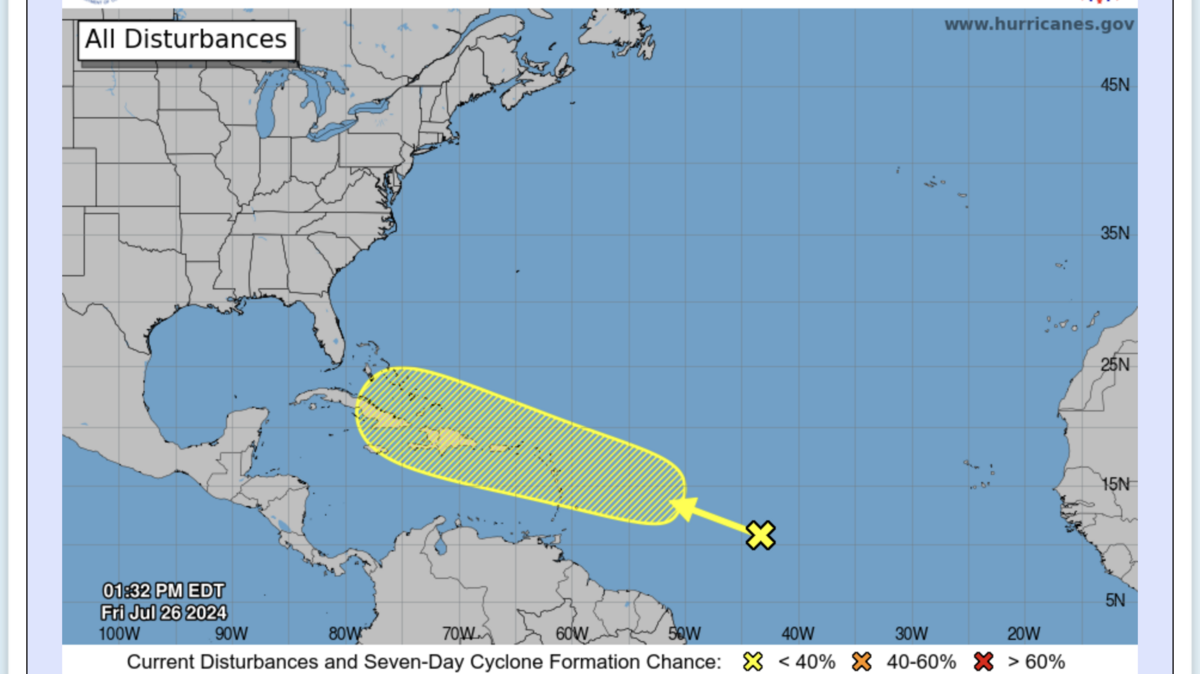
In fact, the National Hurricane Center is, for the first time in awhile, showing an area of disturbed weather that will bear watching and is now over the central tropical Atlantic. The disturbance has a 20% chance of development over the next seven days.
“We have seen a dry spell the last few weeks since Hurricane Beryl,” Harrison County Emergency Management Director Matt Stratton said Friday. “The dry spell looks like it could be coming to an end.”
Numerous rounds of Saharan dust are settling down and sinking air is giving way to rising air, improving conditions for tropical activity.
“By late next week, we’ll begin to see a shift in the large-scale environment that will encourage stormier conditions for August,” Michael Lowry, a meteorologist who specializes in hurricanes, wrote in his newsletter Friday.
“This means dry disturbances – ripples in the winds at 5,000 or 10,000 feet known as tropical waves that aren’t immediately obvious because of a scarcity of thunderstorms – may need to be watched a little more closely as the calendar turns and they move into a less hostile environment.”
Hurricane models show tropical development
While hurricane season runs from June 1 to Nov. 30, peak activity runs from mid-August to mid-October, according to NHC.
The 2024 season got off to a record-breaking start with Hurricane Beryl, which on July 2 became the earliest Category 5 hurricane on record observed in the Atlantic, the NHC reported.
The National Oceanographic and Atmospheric Administration in May forecast an 85% chance of an above-average hurricane season for the Atlantic, with only a 10% chance of a near-normal season.
NOAA’s outlook for the 2024 Atlantic hurricane season, which runs from June 1 to November 30, predicts an 85% chance of an above-normal season, a 10% chance of a near-normal season and a 5% chance of a below-normal season.
NOAA predicts eight to 13 hurricanes, which have winds of at least 74 mph. The Atlantic could produce four to seven hurricanes that reach Category 3 or higher. Category 3 winds start at 111 mph. Near record-breaking ocean temperatures and other factors led to the forecast.
Stratton said hurricane models are indicating a tropical disturbance could form within 10 days.
“What the models are indicating lines up historically with what we expect,” he said. “It’s something that we’re monitoring and we want to remind folks that we need to maintain our preparedness as we enter the height of hurricane season.”
Hurricane Hunters ready for August
The Hurricane Hunters, a Biloxi-based Air Force squadron that flies into hurricanes to collect data, has been running training missions during the lull. But Lt. Col. Mark Withee, a navigator with what is officially known as the 53rd Weather Reconnaissance Squadron, expects things to pick up.
The forecast for a busy season and Hurricane Beryl had Gulf residents primed for heightened activity, he said. Once Beryl passed, the season settled back into its familiar pattern of low activity in June.
“Whether this particular yellow blob develops or not, traditionally, as we enter August, we would expect things to ramp up,” he said. “In the next few weeks, that’s when we’re going to start getting busy.”
This story was originally published July 26, 2024 at 2:06 PM.