Big change shows Army Corps hears Mississippi’s alarm over Bonnet Carré flooding
If the U.S. Army Corps of Engineers opens the Bonnet Carré Spillway later this week to relieve the threat of Mississippi River flooding in and around New Orleans, at least one aspect of a century-old flood protocol will be different.
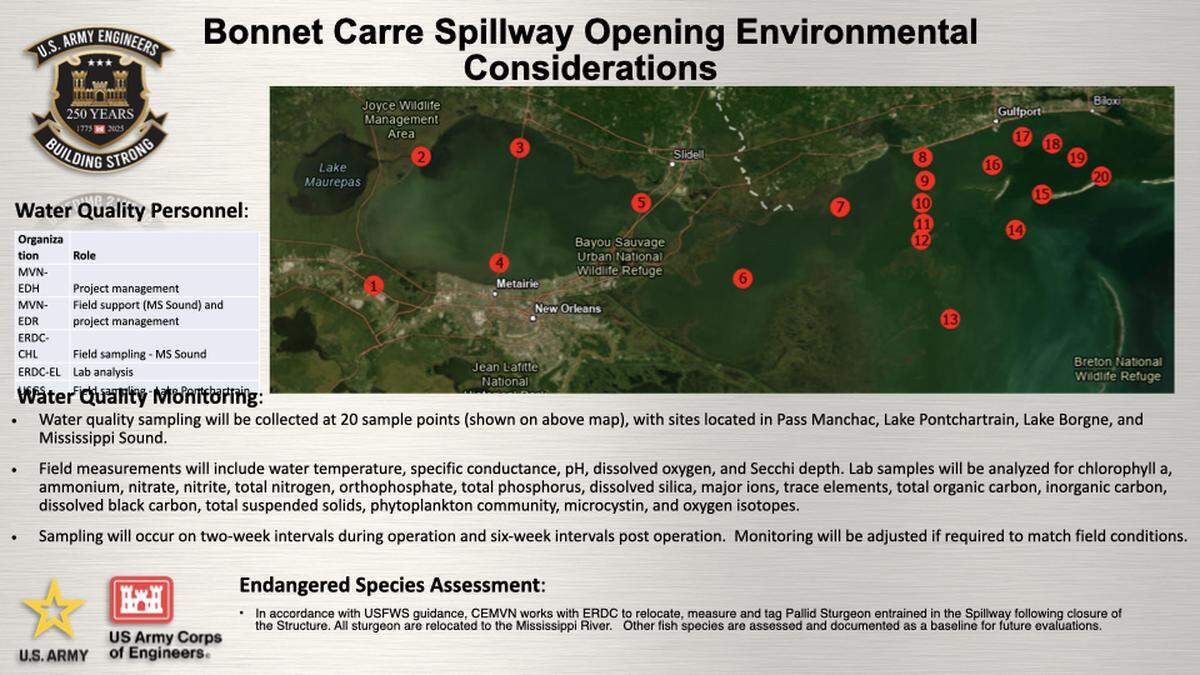
The Army Corps will, for the first time, measure the river water’s impact on areas of the Mississippi Sound east of Pass Christian all the way to Biloxi, with 11 water quality stations added. The change comes after records were set for the length and number of spillway openings from 2018-2020, causing major damage in the Sound.
Mississippi’s productive oyster beds were decimated, as was the brown shrimp population. Dolphins and sea turtles died in record numbers. Algae blooms from the fertilizer-laden river water closed the Mississippi Sound to fishing and swimming in 2019, and frightened off seafood lovers.
Political and environmental leaders have since pressured the Corps to consider the harm the polluted river water creates beyond Lake Pontchartrain, where it is released from the spillway before flowing into Lake Borgne, then the Mississippi Sound.
“After 2020, it was appropriate for us to start looking beyond the lake, simply because of the comments and information we have received from Mississippi,” said Ricky Boyett, public affairs chief for the Army Corps’ New Orleans District, which operates the spillway.
The Corps is in the second year of a five-year study of flood control on the lower Mississippi, which could change how the corps manages flooding along a river that drains 41% of the contiguous United States. Flood protocols the Corps uses today were established under the 1928 Flood Control Act.
Brief spillway opening expected
The Bonnet Carré is one of many flood control structures built on the Mississippi River after the Great Flood of 1927. The spillway opened an average of once every 10 years until the 2000s. The structure had to be opened each year, for the first time, from 2018-2020. The 2019 openings were the longest in history — 123 days total — and also the first time the spillway opened twice in one year.
The corps has opened the Bonnet Carré more frequently as rainfall increases with climate change in the eastern U.S.
Scientists and environmental advocates in South Mississippi hope any 2025 spillway opening is limited and brief, as the Corps has indicated.
“If it opens, what we would expect is a minor opening with minimal, if any, damage to the Mississippi Sound,” said Joe Spraggins, executive director of the Mississippi Department of Marine Resources.
Studying MS River, oyster mortality
Oysters, juvenile shrimp, dolphins and other aquatic life thrive in the Sound’s balance of fresh and salt water. They can even adjust to surges of fresh water over short time periods. Oysters, for example, will close up when the Pearl River floods into the Sound.
But Pearl River floods are short-lived when compared to flooding from the massive Mississippi, said Paul Mickle, co-director of the Northern Gulf Institute at Mississippi State University.
Opening the Bonnet Carré is like turning on a fire hose, Mickle said.
“They turn that thing on and it just hits (the oysters) so hard and fast with fresh water, they’ve never evolved to deal with that,” he said.
Mickle and scientists from the University of Southern Mississippi are working through the institute to study just how much Mississippi River water the Sound’s oysters and shrimp can tolerate. The Mississippi Sound Coalition of local governments and interested groups has been instrumental in advocating this study and others to quantify the impact of Mississippi River flooding on the Sound.
“We want to identify those tipping points where oyster mortality goes above normal levels,” Mickle said. “We want to work with the corps. They have a mission they have to follow.”
Mickle said the corps has operated the Bonnet Carré to save lives and property.
In addition to the stations the Corps is adding in Mississippi waters, the study should give the agency another tool to also look at the ecological impacts of flood control.