
Then and now: Coast nicknames are telling
AI-generated summary reviewed by our newsroom.
- Coastal MS rebrands region with ‘Coastal Mississippi’ and ‘The Secret Coast’ nicknames.
- Early 20th-century ads and railroads promoted the area as the ‘Riviera of America.’
- Historic nicknames—Emerald, Green, Gold Coasts—shape local identity and tourism.
The 150+ miles of scenic roadways, sand and 12 friendly, laid-back but agile cities located between the Louisiana and Alabama borders is now officially called Coastal Mississippi
“Play Coastal Mississippi!” modern promotions for the south end of the state say.
This is the latest designation promoted by the three-county bureau that for decades, under assorted names and boards, has been responsible for luring tourists and new residents to Mississippi’s historically under-recognized slice of the Gulf Coast.
I prefer the “Mississippi Gulf Coast” designation because there’s no mistaking its location, but I do admit that Coastal Mississippi has a shorter punchiness to it. As I have traveled this and other countries, I’ve learned that many people have images of Mississippi that includes no coastal paradise, instead only images of dripping Southernese.
That’s why I smiled when I learned the current visitor’s bureau also touts the nickname, “The Secret Coast.” Natural beauty, culture, friendliness and coastal amenities are packed behind that secret name.
But are you aware of some of the Coast’s earlier nicknames? Acknowledging them is important to our sense of place as we rebuild and refashion ourselves after the most recent hurricane has sent Coast designers back to their drawing boards.
The Riviera of America. The Golden Coast. The Gold Coast. The Emerald Coast. The Green Coast.
These are the most common nicknames I have found deep diving into Mississippi Coast history. You might recognize that these names have both historically and currently hung on other regions of the United States and other countries.
In fact, parts of Florida openly carry some of these nicknames today. An interesting note of history is that Mississippi’s Coast had wide recognition by these names before the Sunshine State claimed some of them. The Sunshine State didn’t become a year-round, mass-marketed tourism destination until after World War II, with a growth spurt following Walt Disney World opening.
A side note that I’ve not been able to confirm is that Walt Disney considered putting his second theme park on the Mississippi Coast instead of Florida. The only tidbit I’ve found that might make this something more than a made-up rumor is that a Roy Disney stayed on the Coast around the same time the company was scouting for a site. Roy was the name of Walt’s brother and nephew.
Is it reasonable to think our smaller coastline was actually considered? When you’ve done as much history digging as I have, you will at least say, hmmm. In the 1920s when the Disney brothers were first forming their entertainment empire this coastal slice of Mississippi was a popular destination, more widely recognized as a winter resort than Florida.
This was the era of grand dame hotels such as the Buena Vista, Markham, Edgewater Gulf and Pine Hills. Biloxi was the Seafood Capital of the World. Mild weather beckoned the snow birds wanting to escape icy winter cities.
Fishing and hunting possibilities were extraordinary. Gambling wasn’t legal, but it happened. Drinking alcohol wasn’t legal, but it happened. The 1920s really did roar here. This region was a playground for people from nearby Southern states and far away Northern states.
A big reason for this early 20th Century tourism boom was railroads. The Gilded Age of the late 1800s gave birth to convenient railroad travel until the Great Depression of the 1930s when wallets were too empty to consider Gulf escapes.
The Depression’s financial morass slowed this Coast’s advancement as a destination, and during recovery other regions like Florida sped ahead. Until then this Coast was on a roll.
As early as 1905, a Washington, D.C. newspaper stated, “...the Riviera of America, as we may call the coast of Alabama and Mississippi, has its own quiet picturesqueness and one of these days will be as much frequented and admired as the resorts along the Mediterranean coast of France.”
The riviera name did catch on.
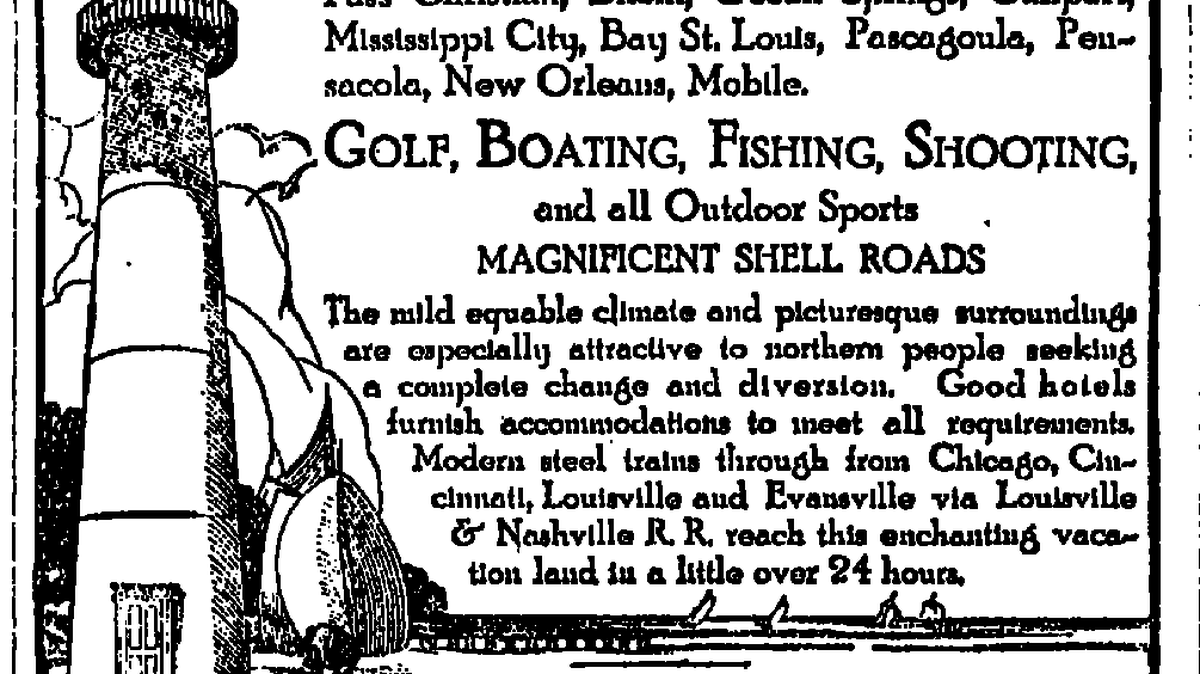
“Gulf Coast: The Riviera of America” declared national newspaper advertisements for the L&N Railroad through the 19-teens and 1920s. This was before TVs and radios when newspapers were the main information spreaders.
Those same L&N newspaper ads continued with specifics: “Pass Christian, Biloxi, Ocean Springs, Gulfport, Mississippi City, Bay St. Louis, Pascagoula, Pensacola, New Orleans, Mobile.” Note that our Coast cities are listed before Pensacola, New Orleans and Mobile.
“Golf, Boating, Fishing, Shooting and all outdoor sports. Magnificent shell roads,” the national ads continued. “The mild equable climate and picturesque surroundings are especially attractive to northern people seeking a complete change and diversion. Good hotels furnish accommodations to meet all requirements. Reach this enchanting vacation land in a little over 24 hours.”
One advertisement I found suggests catching the Louisville & Nashville Railroad in Chicago, Cincinnati, Louisville or Evansville. Connections with other railroads were possible.
Passenger trains were not the only ones calling this the American Riviera. The name stuck as late as 1941, verified by this ad in the Times-Picayune of New Orleans: “Go to the beautiful Mississippi Gulf Coast. The Riviera of America is the Playground of the South.”
Other nicknames sprang up in the early 20th Century. In April 1927, for example, this newspaper headlined “’The Emerald Coast’ Name Given Mississippi Coast.” What followed was an interview with a noted Brazilian world traveler named Jules Verelst, who insisted:
“ I do not understand why anyone here should use the name ‘American Riviera’ when this coast is so radically different from the Italian and European Riviera. No other sea coast in the world is quite like that of the state of Mississippi; nowhere else have I found the luxuriant abundance of magnificent evergreen trees--live oaks, pines, magnolias and plants in endless varieties growing to the water’s edge.
“I would urge you to advertise your coast for what it is. Just let people know what you have here and they will come from everywhere to visit you.”
Before and after Verelst, the Emerald Coast nickname pops up, as does the Green Coast.
Even with the hurricanes and bulldozers of progress that have since taken away some of this greenness, enough remains for self-defense. I had to smile in 2000 when the popular Sound-Off column of readers opinions published in this newspaper spent several days arguing over saving oaks.
Defended one reader: “For the individuals confused about our reverence for trees: the Live Oaks that remain on our beautiful Coast are what makes this the most unique coast on the Gulf of Mexico. Each tree is a symbol of endurance and strength. They gave us the ‘Emerald Coast.’”
The Gold Coast is yet another nickname that pops up in books, ads, poems and newspapers of old. Is this a reference to spectacular sunsets, a natural richness of beauty, a plethora of coastal amenities? I don’t know because the earliest uses I found give no explanation.
Then in 1970, when I was in school and not yet a reporter, Biloxians Colleen and Joe Scholtes published a pamphlet titled “The Gold Coast.” It is filled with history and coastal things to see and do, despite monumental losses from the devastating Hurricane Camille a year earlier.
The Scholtes, who ran a seafood tour boat and wrote local history pictorial books, later became my history mentors. In their honor I try to keep the Gold Coast designation unforgotten.
As they observed in the 1970 tourist pamphlet, “You are about to take a journey through one of the most interesting sections of our country.”
Kat Bergeron, an award-winning veteran reporter and feature writer who specializes in Gulf Coast history and sense of place, is retired from the Sun Herald. She writes this Gulf Coast Chronicles column as a freelance correspondent. Reach her at:
BergeronKat@gmail.com
Or, at Southern Possum Tales, P.O. Box 33, Barboursville, VA 22923