Tired of ‘Big Brother,’ Coast conservatives are flocking to Parler after 2020 election
Faced with increasingly aggressive fact-checking efforts by Facebook and Twitter during the 2020 presidential election, conservatives in Mississippi are flocking to alternative social media platforms, especially Parler.
Parler calls itself a “free speech social network.” Many of its new users are supporters of President Donald Trump who say that Facebook and Twitter are censoring conservative content, especially recent claims about fraud in the election. (Lawsuits and investigations by the Trump campaign in several states have so far failed to produce evidence of widespread fraud.)
In the week after the election, Parler gained about 3.5 million new users. On the Mississippi Coast, people started asking about it in Facebook posts and community groups.
Paula Westbrook, a 53-year-old Long Beach resident, is one of them. On Sunday, she posted her new Parler username on Facebook, in search of friends also on the new app. They weren’t hard to find: Parler is spreading “like wildfire,” Westbrook said.
Westbrook said that in the days after the election, she tried to post an article about a state where there were more voters than people registered. (That was a common claim about the state of Wisconsin, but the AP reported that the state had about 3.7 million active registered voters as of Nov. 1, and 3.3 million votes counted by the day after Election Day.)
She got a message from Facebook flagging the article as possibly inaccurate.
“People are tired of being told everything that they post has to be fact-checked, or [labeled] not true, or all of this,” Westbrook said. “We’re tired of Big Brother basically scrutinizing every single thing that we post. And it’s censorship. I mean, people aren’t even allowed to have an opinion anymore.”
A recent analysis by Politico found that Facebook, Twitter and Instagram users actually share right-wing social media content about 10 times as often as liberal content. Every day, most of the most popular Facebook posts in the United States come from conservative pages, including Fox, Newsmax, Dan Bongino (a partial owner of Parler), and the president himself.
Some experts say that ideologically divided social media platforms could drive further polarization, reducing contact between people of different views. Americans are increasingly geographically divided, too, with rural areas more conservative and urban areas more liberal. One study found that the country is more polarized along geographic lines than at any point since the Civil War.
“Whenever you get a group of like-minded people together, they tend to exhibit this group polarization effect, that they can get more extreme,” said Colleen Sinclair, an associate professor of psychology at Mississippi State University who studies online information and influence.
Some Parler users enthusiastically embrace it as a space for conservatives. But others aren’t sure that’s what they want from social media, even if they always vote Republican.
What’s next for Parler?
Parler was founded in 2018 by a pair of software engineers in Nevada. Their goal was to create a platform with far fewer restrictions on speech than on mainstream social media platforms. QAnon posts, for example, thrive on Parler, after Facebook banned QAnon content and groups.
On Parler, posts that other platforms might deem hateful or violent are allowed to stay. White supremacist and anti-Semitic content abounds on some corners of the site.
Parler is far from the first social media site to boast of its free-wheeling approach to content moderation. Gab, another “free speech” alternative to Twitter, was founded in 2016 and quickly became home to anti-Semitic, anti-Black and conspiracist content. That burst into public view in 2018, when the man accused of killing 11 people at a Pittsburgh synagogue was found to have a history of posting anti-Semitic, violent messages on Gab.
If Parler ends up being publicly associated with real-world violence, as Gab was with the Pittsburgh synagogue shooting, the company may decide to tighten content restrictions, Sinclair said.
“They find out they have to institute more regulations in order to not be held responsible or chastised publicly,” Sinclair said. “Ultimately to continue making profit, which is what businesses want to do, you have to try to branch into mainstream audiences.”
If Parler continues to attract a range of users, from white nationalists to mainstream Republicans frustrated by Facebook and Twitter’s handling of 2020 election content, it’s likely that people with more moderate views will be exposed to more extreme messages, Sinclair said. Then, they may share that content on other platforms, like Facebook, where it will reach even more people.
There are already rules even on Parler. The current user agreement says that Parler can remove content and block accounts “at any time.”
The company also has an unusually strict verification process. In order to send direct messages to other users, a Parler user has to upload a government-issued identification card as well as a selfie.
Parler in politics
At least one Mississippi state representative is already on the app. State Rep. Dana Criswell (R-Olive Branch) said he got his Parler account a few months ago because constituents kept asking if they could connect with him that way. He already uses Twitter and Facebook, plus email.
“Honestly, there are times that people contact me and then I can’t go back and figure out which way they did to answer them,” he said. “I read it, don’t answer right away, and then I have to remember whether it was Facebook, email, Twitter, or text, and I’m a little bit concerned about adding other ways. But I’ve decided just to give it a shot and see how it works.”
Criswell said a number of his colleagues have asked him about Parler and are considering joining as well.
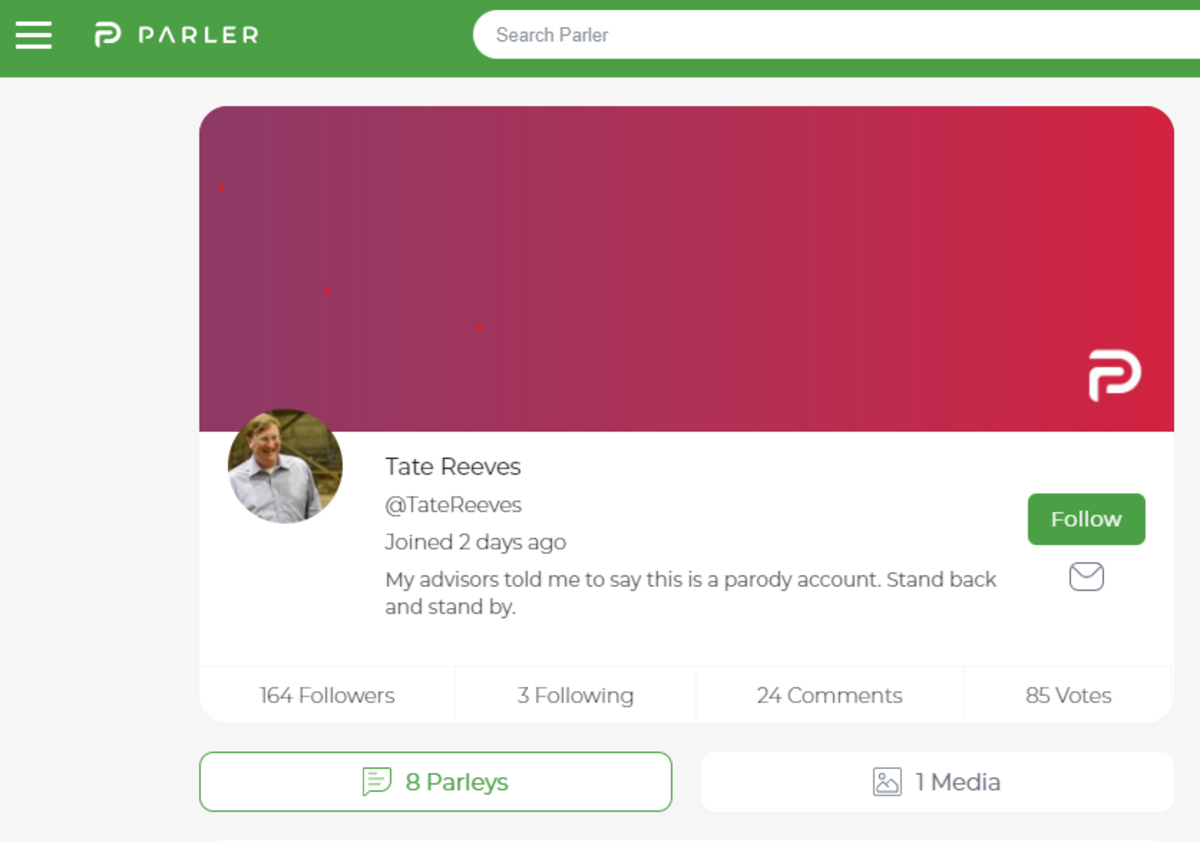
On Thursday morning, a screenshot of a post on Parler by a user named @TateReeves made the rounds on Facebook.
“Glad to be here, away from the fake news media,” @TateReeves wrote. “It’s time conservative Christians had a place of our own to worship God and President Trump. Welcome, friends!”
Within a few hours, Gov. Tate Reeves confirmed that he was not, in fact, @TateReeves. The account was fake.
“We do encourage everyone to follow Governor Reeves on his Facebook and Twitter on his verified accounts,” Reeves spokesperson Bailey Martin said.
Martin said Reeves has no plans to create a Parler account.
Meanwhile, @TateReeves had updated his description on Parler: “My advisors told me to say this is a parody account.”
A ‘MASS EXODUS’ coming?
Parler is still ironing out some kinks, especially as the number of users has skyrocketed in recent days.
At first, Westbrook said, she couldn’t post anything. And now that she’s able to use it, she’s not sure how much she’ll like it. So far, it seems more like Twitter than Facebook, and Westbrook was “never a Twitter user anyway.”
Although Parler users have planned a “MASS EXODUS” from Facebook (organized via a Facebook event) for Friday, Nov. 13, Westbrook isn’t likely to be among them.
“Many of us have our families and friends still on there,” she said. “Our elderly family and all. They’re not probably going to be ones that are going to switch over. They’re just now getting used to Facebook. We’ll probably have to keep all of our accounts still just to be able to keep up with everybody.”
This story was originally published November 13, 2020 at 1:43 PM.