Confused about Initiative 65 and 65A? Here’s a breakdown of medical marijuana in MS
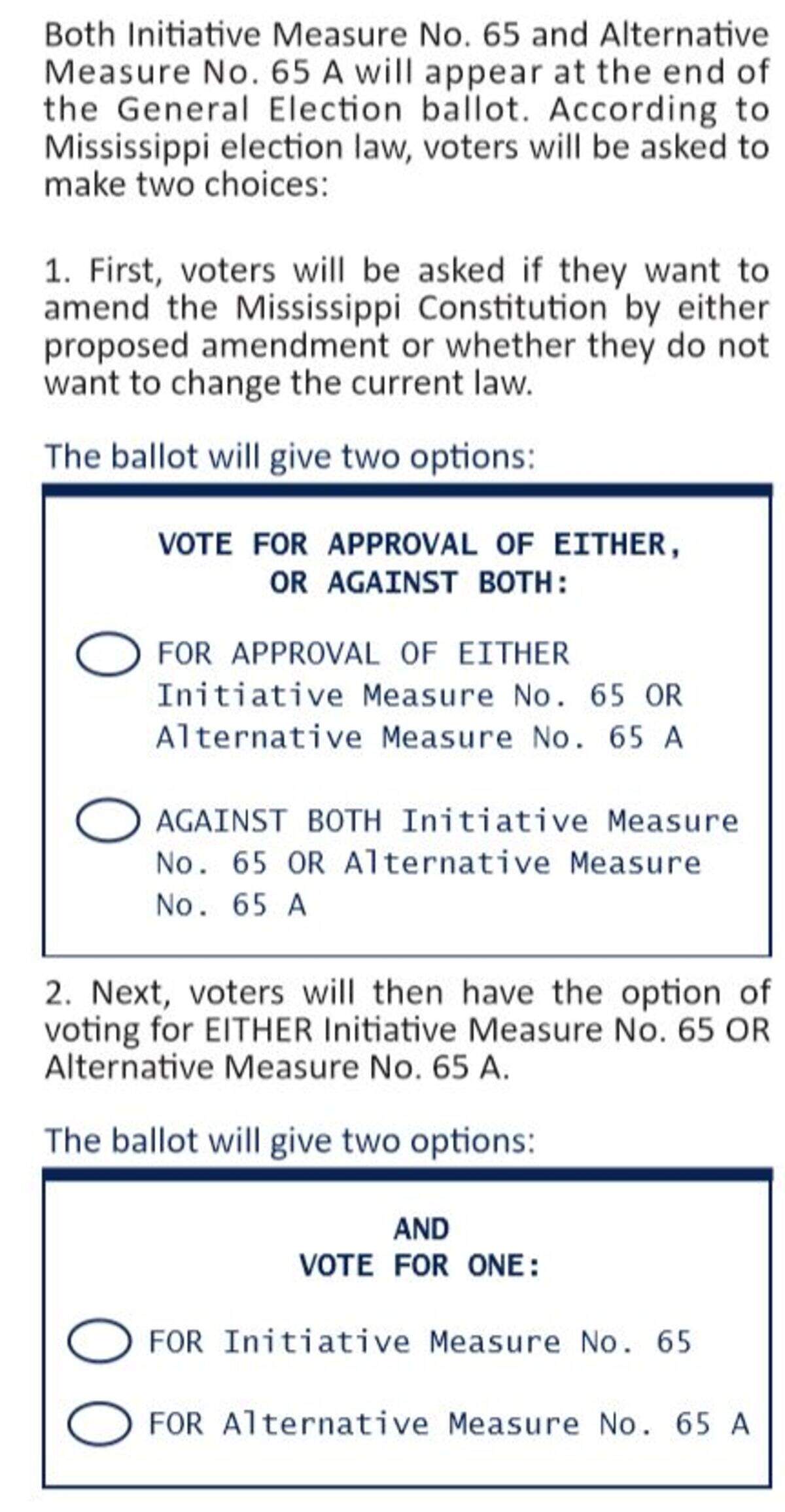
Mississippi voters will find two questions about medical marijuana on the bottom of the Nov. 3 ballot.
The first question asks voters if they approve changing the state constitution to allow medical marijuana.
They can vote “neither” against legalizing medical marijuana or “either” to allow it to become legal.
The second question asks all voters to choose between initiative 65 or 65A.
Those voters who selected “neither” should still choose between initiative 65 or 65A in the event medical marijuana is approved by the majority of voters.
Initiative 65 is sponsored by Medical Marijuana 2020, which gathered enough signatures to have it placed on the Nov. 3 ballot.
Initiative 65A is the state Legislature’s alternative to provisions in 65 under HCR39.
Both would change Mississippi’s constitution to allow for the dispensing of medical marijuana, but would not legalize it for recreational use.
Here is a summary of 65 and 65A, from supporting documentation for both initiatives and an informational brochure released by Secretary of State Michael Watson, who oversees elections in Mississippi:
Initiative 65
- Medical marijuana could be prescribed by physicians for 22 specified diseases and conditions such as cancer, chronic pain, seizures, tremors and post-traumatic stress disorder.
- Possession would be limited to 2.5 ounces every 14 days.
- That limit does not apply to ingredients used to prepare edible products, topical products, ointments, oils, tinctures or other products.
- A medical marijuana ID card would be required at a cost up to $50.
- Medical marijuana could be provided only at licensed treatment centers.
- The treatment centers can’t be located within 500 feet of a school, church or licensed child care center.
- Public smoking of medical marijuana is banned, as is driving under the influence.
Initiative 65A
- The “appropriate” state agency would consult with medical professionals to develop a program.
- No medical conditions are specified, other than medical marijuana would be limited to “qualified persons with debilitating medical conditions.”
- Licensed physicians, nurses and pharmacists would provide treatment to qualified persons.
- Only terminal patients would be allowed to smoke marijuana. Those who aren’t terminal would use other forms like pills.
- Limits would be set on the number of state-licensed medical marijuana manufacturers.
- Allows only pharmaceutical-quality marijuana.
- Requires tracking patients to determine the effectiveness of marijuana treatment.
Among the more controversial differences between the initiatives are:
Program start date
Initiative 65 — August 2021
Initiative 65A — No date specified
Competition/licenses
65 — Free market
65A — Limited license cap
Costs and revenue
65 — Mississippi Legislative Budget Office estimates the first-year cost of $11 million. Anticipated expenses for the first year are $24 million, with $5 million for the plants from seeds to sale, $16 million for licensing, monitoring and inspection and $3 million for the cost to collect revenue. Revenues would be deposited into a separate fund, rather than the state’s General Fund, to administer the program.
65A — The Legislative Budget Office says the cost and revenue is “undeterminable.” The program would be set up if voters approve this initiative.
Sales tax
65 — Capped at 7%. Local communities where the centers are located would not receive any sales tax revenue.
65A — Allows Legislature to set sales tax rate, potentially at a higher level like the tax on alcohol and tobacco.
Regulation
65 — Mississippi State Department of Health would be responsible for administering and monitoring.
65A — The program will be administered by a state agency to be named if 65A passes.
What does MS health department say?
The health department released a resolution in opposition to Initiative 65. State Health Officer Dr. Thomas Dobbs explained at a public hearing on medical marijuana in Jackson.
Medical marijuana has potential health benefits. “We know it’s true,” he said. It also has clear disadvantages, he said, particularly for teens and babies born to women who abuse marijuana.
Oklahoma is the state with regulations most like what is proposed under Initiative 65, he said. Oklahoma has more than 2,000 medical marijuana dispensaries and 1 in 12 residents with a medical marijuana card.
“So I am concerned that the way this is written is going to be way too open,” he said.
“Its a little bit terrifying that we’re gonna enshrine rules written by the marijuana industry,” he said.
Proponents said at the hearing that Initiative 65 is for patients, and 65A for politicians.