
Removal firm backs out of moving Confederate statues after death threats
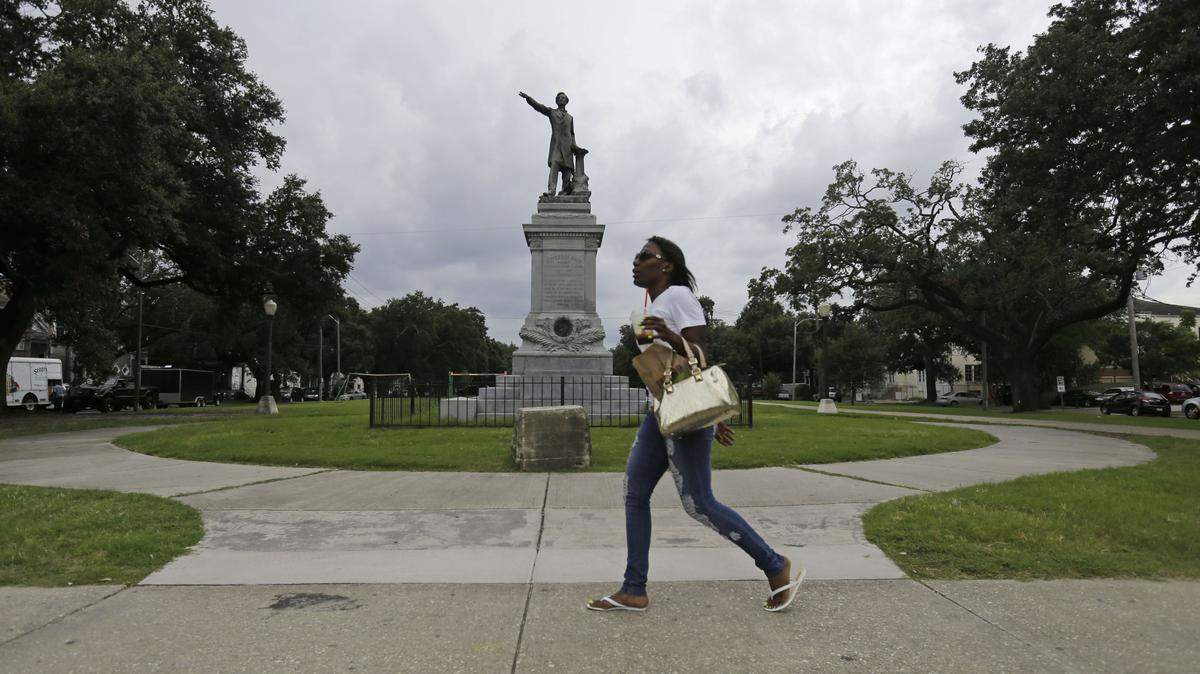
NEW ORLEANS -- A federal judge expressed skepticism Thursday about the legal arguments made by groups seeking to stop New Orleans from removing prominent Confederate monuments from the city, including a towering statue of Gen. Robert E. Lee.
U.S. District Judge Carl Barbier heard the pleas of lawyers for preservationists and a local chapter of the Sons of Confederate Veterans seeking to halt the city from moving ahead with plans to take down statues of Confederate leaders.
Throughout the hearing, Barbier appeared to question the merit of legal arguments brought by the plaintiffs' lawyers. Those attorneys had argued federal laws and constitutional rights would be violated by the removal.
Among a multitude of claims, the plaintiffs argued the Confederate statues should be evaluated as part of the city's streetcar lines, which were paid for in large part with federal dollars.
Barbier seemed baffled because the streetcar work took place years ago.
"We don't have a streetcar project or road project causing these monuments to be moved," he said. "I went back and read your legal memorandum at least five times," the judge said. "I really don't understand your argument."
Franklin Jones III, a plaintiffs' lawyer, also urged Barbier to halt the removal until the legal case, including appeals, plays out in court. Jones said there was a "high risk" the statues could be damaged by being removed.
"These are priceless works of art," Jones said. "These are not just monuments or statues that you strap a sling around and move from one place to another."
Barbier, though, pointed out the Statue of Freedom atop the U.S. Capitol was removed without problems in 1993.
"Doesn't the city as the owner of the property have an inherent right to do what it wants with its property?" he said.
Barbier asked Adam Swensek, a city attorney, to explain what protection two of the statues get from being on the National Register of Historic Places. Swensek said that designation has "certain rhetorical appeal" but "does not render that property sacrosanct." The plaintiffs did not challenge that.
Jones also tried to make the case the plaintiffs had a "property interest" in the monuments, pointing out one plaintiff group, the Monumental Task Committee Inc., has dedicated a lot of money and volunteer time in maintaining them.
Barbier shot down that claim too, and said a neighbor who cut the grass and boarded up a property of a neighbor absent in the wake of Hurricane Katrina could not assert a property interest in the neighbor's house.
Barbier said issuing an injunction is a major legal step. "It's an extraordinary remedy to preclude a state or a city from enforcing its own laws," he said. He took the case under advisement but said he would rule soon.
In December, the City Council voted 6-1 to remove the monuments. The removal of the statues has been a contentious and passionate subject in New Orleans and public meetings on the proposal were raucous.
On Thursday, Rebecca Dietz, a city attorney, said a contractor hired to oversee the removal of the monuments backed out of doing the work after it received death threats. In a letter to the city, the contractor, H&O Investments LLC of Baton Rouge, said death threats had been received at its office and the wife of the company's owner had gotten threatening phone calls at home. The letter also said other businesses had threatened to cancel contracts with H&O.
The monuments slated for removal include a 60-foot-tall marble column and statue dedicated to Lee and a large equestrian statue of P.G.T. Beauregard, a Louisiana-born Confederate general. Also up for removal are a statue of Confederate President Jefferson Davis and an obelisk dedicated to a group of white supremacists who sought to topple a biracial Reconstruction government in New Orleans. The location of the obelisk is subject to a federal consent order and the city's lawyers said they will reopen that matter in their effort to remove the monument.
The plaintiffs are the Louisiana Landmarks Society, the Foundation for Historical Louisiana, the Monumental Task Committee Inc. and the Beauregard Camp No. 130.