
Louisiana Democrat overcame big obstacles to win governor's race
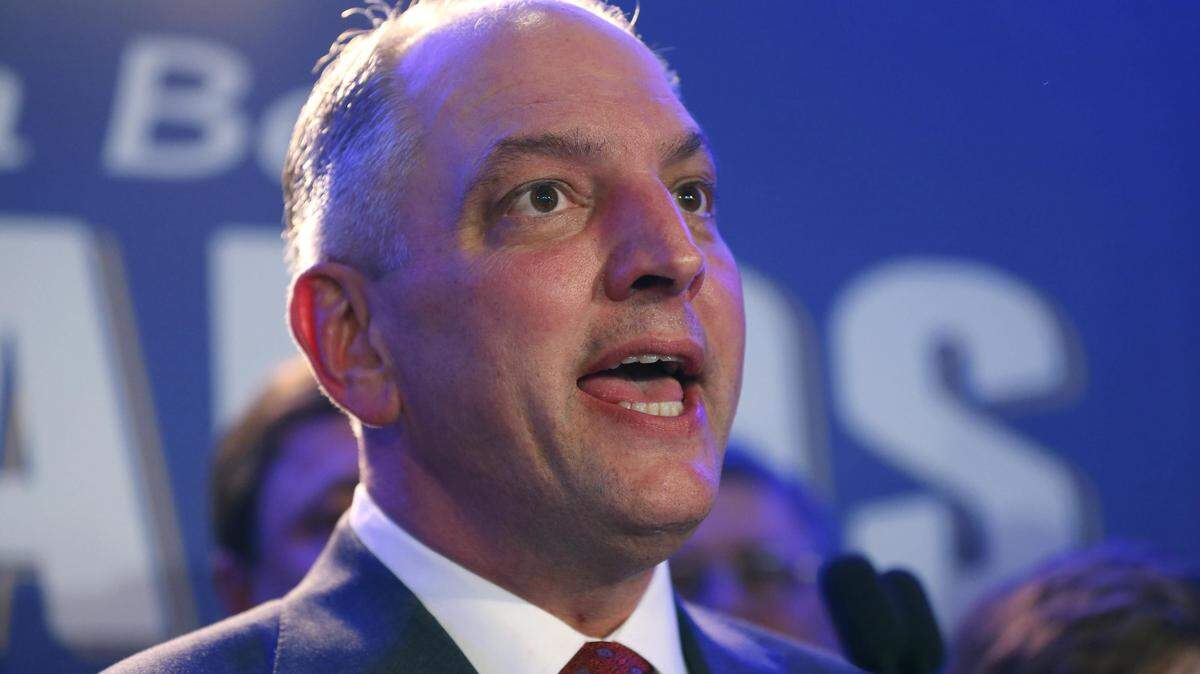
NEW ORLEANS -- One evening in 2013, two weary Democratic legislators sat at their desks in the state Capitol, stared across the emptying House chamber and considered another unsuccessful day of fighting the governor. "Sam," said one of the men, Rep. John Bel Edwards, "I'm not staying in the House. I'm not doing this anymore." Rep. Sam Jones, who recalled the exchange recently, asked Edwards if that meant he was going to return to his small-town law practice in Amite.
"He said, 'I'm either going to go home or go big,'" Jones recalled. "'I think I'm going to run for governor.'" On Saturday night, Edwards celebrated one of the most astonishing victories in Southern politics in years, turning a widely overlooked campaign into a big win over David Vitter, Louisiana's senior U.S. senator and the most influential Republican in the state. Vitter was considered such a safe bet that many state Democrats figured the race was a lost cause and paid little notice to the Edwards campaign, which for most of its life consisted of the candidate and his wife, some other relatives, a single staff member and a few informal advisers.
Yet Edwards, a Catholic with a Boy Scout earnestness who comes from a family of sheriffs, won by a larger margin, 56 to 44 percent, than any Louisiana Democrat running for governor since Edwin Edwards reclaimed the office after a four-year absence by beating David Duke in 1991. Edwin Edwards and John Bel Edwards are not related.
The result was unexpected even considering a 2007 scandal linking Vitter to a prostitution ring. In his concession speech, Vitter announced that he will leave the Senate when his term ends next year.
"I never thought that he was going to be this juggernaut," a confident Edwards said of Vitter one night during the primary season. "That's what he tried to make people believe. It's a good strategy if you can get away with it." It is questionable whether this election holds any lessons for Democrats in other states in the South, where Republicans hold every governor's office except those in Virginia and Kentucky. (In Kentucky, a Republican just won the job for the next term.) Louisiana is distinctive, with a long tradition of personality-based coalitions running against the grain of pure partisanship. But even by those standards, the circumstances were unusual, with a highly unpopular Republican incumbent, Gov. Bobby Jindal, and an election so full of Louisiana twists it would have made Huey Long whistle into his Ramos gin fizz.
"Democrats couldn't have a better candidate," Edwin Edwards said at the Democrats' lively election night party here at the Hotel Monteleone. "Republicans couldn't have had a worse candidate. It don't happen like that very often." Louisiana Republicans agree and say this race gives them no cause for worry about their party's brand.
"Louisiana is a red state, period," said Lance Harris, the Republican majority leader in the state House, who described the election as "a perfect storm." While an unpopular governor and a fractured Republican Party proved too much for Vitter, Harris said, Republicans easily won other statewide offices and picked up two seats in the House. And, he pointed out, Edwards "had to run to the right as a conservative, so I think the ideas themselves still won." Vitter's Senate seat is likely to remain in Republican hands. There is no shortage of those who are seen as interested, including U.S. Reps. John Fleming and Charles Boustany Jr.
Scott Angelle, a Republican public service commissioner who came in a close third behind Vitter in the Oct. 24 primary and who declined to make an endorsement in the runoff, has said nothing, though "Angelle for Senate" stickers have appeared in Cajun country.
Meanwhile, Mitch Landrieu, the mayor of New Orleans and the most well-known Democrat now in office in the state, has not ruled out a run for the Senate.
Many state Democrats had hoped that Landrieu would bring his marquee name to the governor's election, but the race appeared a bad bet for a Democrat as recently as this summer. But Edwards turned out to be more than the party place holder many assumed him to be.
He is a social conservative, but an old-school Democrat on bread-and-butter issues who champions public schools and is less enamored of charter schools and vouchers. The most immediate consequence of his election might be the state's acceptance of Medicaid expansion, which Edwards pledged to carry out right away.
Social issues, in any case, will be far down his to-do list. All of the attention for now will be on the state's dire fiscal situation, with a structural budget deficit, little left to cut and minimal appetite among businesses for chipping in more revenue.
Edwards, the House minority leader, in recent years became one of the fiercest legislative critics of Jindal's budgetary policy, lodging objections from his post in the rear of the chamber. As fruitless as that effort often was, it seemed to clarify what his pitch would be in a governor's race.
"Jindal has been a disaster, and he is a Republican, so the shine is off of that apple," Edwards said. "People are looking at the individual." His resume seems almost laboratory-made for a red-state Democrat, starting with a family that has been in law enforcement for generations, an education at West Point and eight years as an Army Ranger.
"I thought he was going to be a career Army officer," said his sophomore-year roommate at West Point, Murray Starkel, now an engineer in Dallas. Starkel said Edwards had been particularly adept at stealth assault drills.
In addition to his military background, Edwards emphasized his Catholic conservatism on social issues. The Edwards campaign put up an early ad in which his wife, Donna, a public-school teacher, recounted how he had refused to consider an abortion upon learning that the first of their three children was going to be born with spina bifida. (The child, a daughter, is now engaged to be married.) The strong anti-abortion stance neutralized a line of attack that had been effectively used in this state against Sen. Mary L. Landrieu, who was soundly beaten in a re-election attempt last year.
In the primary, Edwards knew enough to stay out of the way as the Republicans fought themselves. In the runoff, as money began pouring into the race, Edwards proved adept on offense, hitting Vitter hard on the prostitution scandal and keeping the focus on personality over party.
Still, his colleague Jones said, he never quite learned to land a punch line.
"The man cannot tell a joke," Jones said. "So we took it out of the repertoire and said, 'You can just go back to being serious.'"