
Top U.S. envoy in Caracas steps down as stabilization plan moves forward
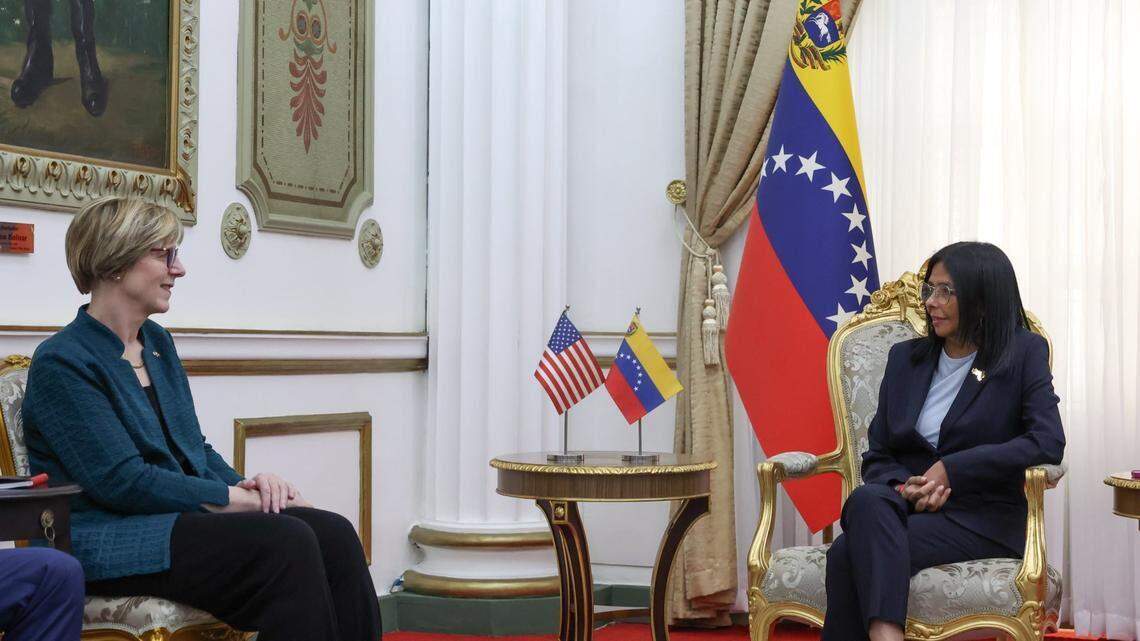
The top U.S. diplomat in Caracas announced she will step down from her post, marking a new transition point in Washington’s fast-evolving strategy toward Venezuela just weeks after taking on one of the most complex diplomatic assignments in Latin America.
In a statement released Wednesday, Chargé d’Affaires Laura F. Dogu said her temporary assignment is coming to an end and that she would return to her previous role as a foreign policy adviser to the chairman of the U.S. Joint Chiefs of Staff.
Dogu, who arrived in Venezuela in late January following the capture of strongman Nicolás Maduro by U.S. forces and the installation of an interim government led by Delcy Rodríguez, said she was “deeply grateful” to President Donald Trump and Secretary of State Marco Rubio for entrusting her with implementing Washington’s plan during what she described as a “historic moment” in bilateral relations.
She also announced that veteran diplomat John Barrett will soon take over as chargé d’affaires at the U.S. Embassy in Caracas, signaling continuity in the Trump administration’s three-phase plan aimed at stabilizing, rebuilding and ultimately transitioning Venezuela’s political system.
Barrett, a career member of the Senior Foreign Service with extensive experience across Latin America and beyond, has been serving as chargé d’affaires at the U.S. Embassy in Guatemala since January 2026 and previously was deputy chief of mission in Panama.
His previous assignments include counselor for economic affairs in Peru and El Salvador, as well as consul general in Recife, Brazil, where he oversaw U.S. engagement across eight northeastern states. Earlier in his career, he served in Washington as the State Department’s senior officer for the Philippines and held postings in China, Afghanistan and Guatemala.
Before joining the Foreign Service, Barrett worked in business and strategic planning roles with PepsiCo, the Walt Disney Company and L.E.K. Consulting. He holds a bachelor’s degree from Middlebury College and an MBA from the Wharton School of the University of Pennsylvania, and speaks Spanish and Portuguese.
“It is a very positive development that Secretary Rubio has designated another trusted and experienced diplomat to implement the policy in Caracas,” said Roger Noriega, a former assistant secretary of state for Western Hemisphere Affairs under George W. Bush. “John Barrett has earned the Trump team’s confidence.”
Noriega added that Rubio’s hands-on management of the transition signals urgency in pushing institutional change, reactivating the economy and placing Venezuela’s future in the hands of its citizens.
Dogu’s tenure, though brief, coincided with a pivotal moment in U.S.-Venezuela relations. Her arrival on Jan. 31 marked the reopening of the U.S. Embassy in Caracas after nearly seven years, underscoring a dramatic shift following Maduro’s removal and the thaw in ties between Washington and Caracas.
A career diplomat with decades of experience in Latin America and conflict-prone environments, Dogu was seen as a steady hand tasked with managing what U.S. officials describe as an unprecedented geopolitical experiment: guiding Venezuela through stabilization while preserving U.S. strategic interests, particularly in energy and regional security.
“This is not a ceremonial posting,” a former U.S. diplomat familiar with her career said at the time of her appointment. “It’s crisis management, statecraft and economic strategy rolled into one.”
Her role quickly became central to communication between Washington and the interim government. Within days of arriving, Dogu met with Rodríguez at the Miraflores Palace to begin shaping a new bilateral agenda, as both sides sought to balance immediate stability with longer-term political change.
That balancing act has proven delicate. While the Trump administration has moved rapidly to ease sanctions and reengage economically, critics warn that prioritizing stability risks entrenching elements of the old regime under new leadership.
Despite the leadership change, Dogu stressed that the broader strategy will remain intact.
“The team in Caracas will continue to advance the President and the Secretary’s three-phase plan during this new stage of relations,” she said, emphasizing continuity as both countries navigate uncharted territory.
The announcement also appears to resolve days of uncertainty over leadership at the newly reopened mission. On Tuesday, the State Department pushed back against reports that Dogu had already been replaced, insisting she remained in charge and continued to oversee implementation of Washington’s strategy.
“Ambassador Dogu continues to serve as the interim chargé d’affaires at the U.S. Embassy in Caracas and continues her work to advance the Trump administration’s three-phase plan for a stable, prosperous, and democratic Venezuela,” a spokesperson said.
This story was originally published April 15, 2026 at 11:13 AM with the headline "Top U.S. envoy in Caracas steps down as stabilization plan moves forward."
