Epstein moved millions through mysterious Virgin Islands bank right before arrest

In the months leading up to Jeffrey Epstein’s arrest on federal sex trafficking charges on July 6, 2019, a small U.S. Virgin Islands bank he owned that had employed no one and laid dormant for years suddenly came alive.
A flurry of transactions totaling more than $20 million passed through the bank named Southern Country International from April to early July that year, according to a Miami Herald investigation based on the recently released documents by the U.S. Justice Department.
And months after the disgraced financier was found dead in a Manhattan detention facility on Aug. 10, an additional $25 million was moved through Southern Country, with roughly a quarter of that amount coming from unspecified sources.
Southern Country ended 2019 with less than $500,000, leading Virgin Islands prosecutors who later sued Epstein’s estate to question in court where nearly $13 million the bank held in mid-December 2019 went in two weeks, according to the New York Times.
U.S. federal and local Virgin Islands investigators had also jointly opened a wire fraud probe in 2020 into the mysterious transfer of $15 million to Southern Country from an Epstein account at Deutsche Bank in New York the day after the convicted sex offender died.
But the investigation was closed four years later, a Federal Bureau of Investigation memo says. The memo does not state any findings or the reason for closure.
The Herald sent detailed questions to the U.S. Justice Department but did not receive any response. The Virgin Islands’ prosecutor’s office also did not answer the Herald’s questions.
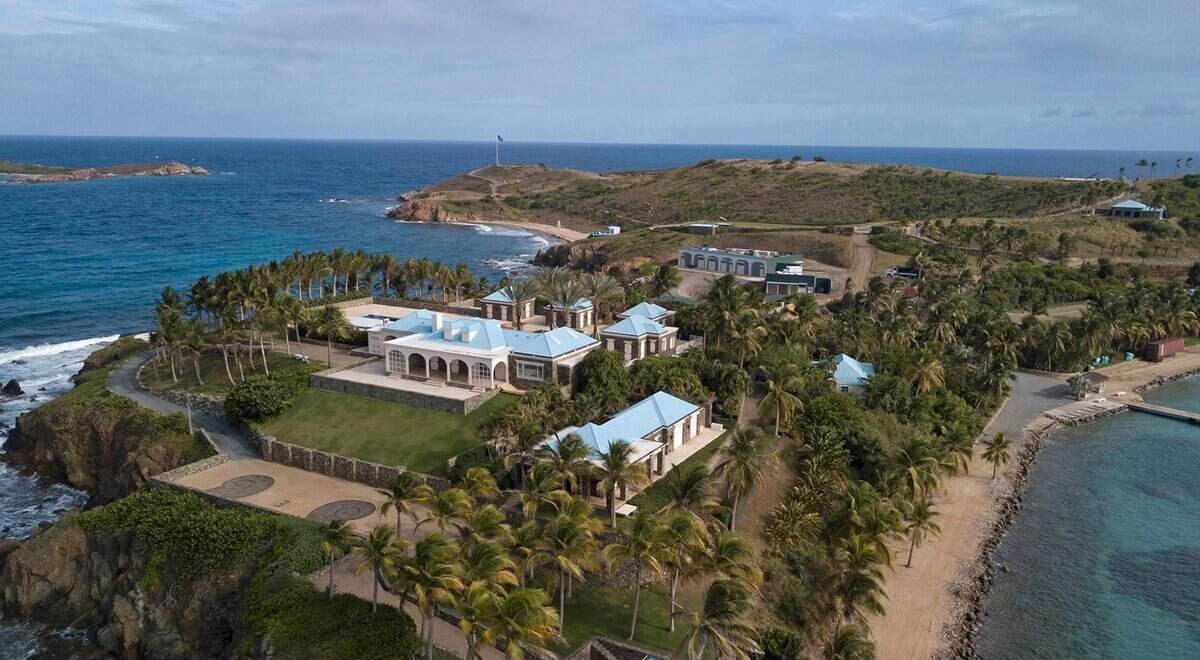
The Herald’s reporting provides the first full accounting of how Epstein used his obscure financial institution in the Caribbean — likely the first of its kind in the U.S. territory.
A bank in the Caribbean
In 2012, the U.S. Virgin Islands, where Epstein had established many of his businesses, was moving to allow the creation of “international banking entities.” The specialized banks typically offer favorable tax incentives but are not allowed to have customers in the territories in which they are established.
The idea behind these financial institutions — effectively offshore banks on U.S. soil — is that they encourage foreign investment and generate revenue and employment. But federal authorities have more recently warned that they generally do not have the rigorous background checks of traditional banks and are “high-risk institutions” that threaten the integrity of the American financial system.
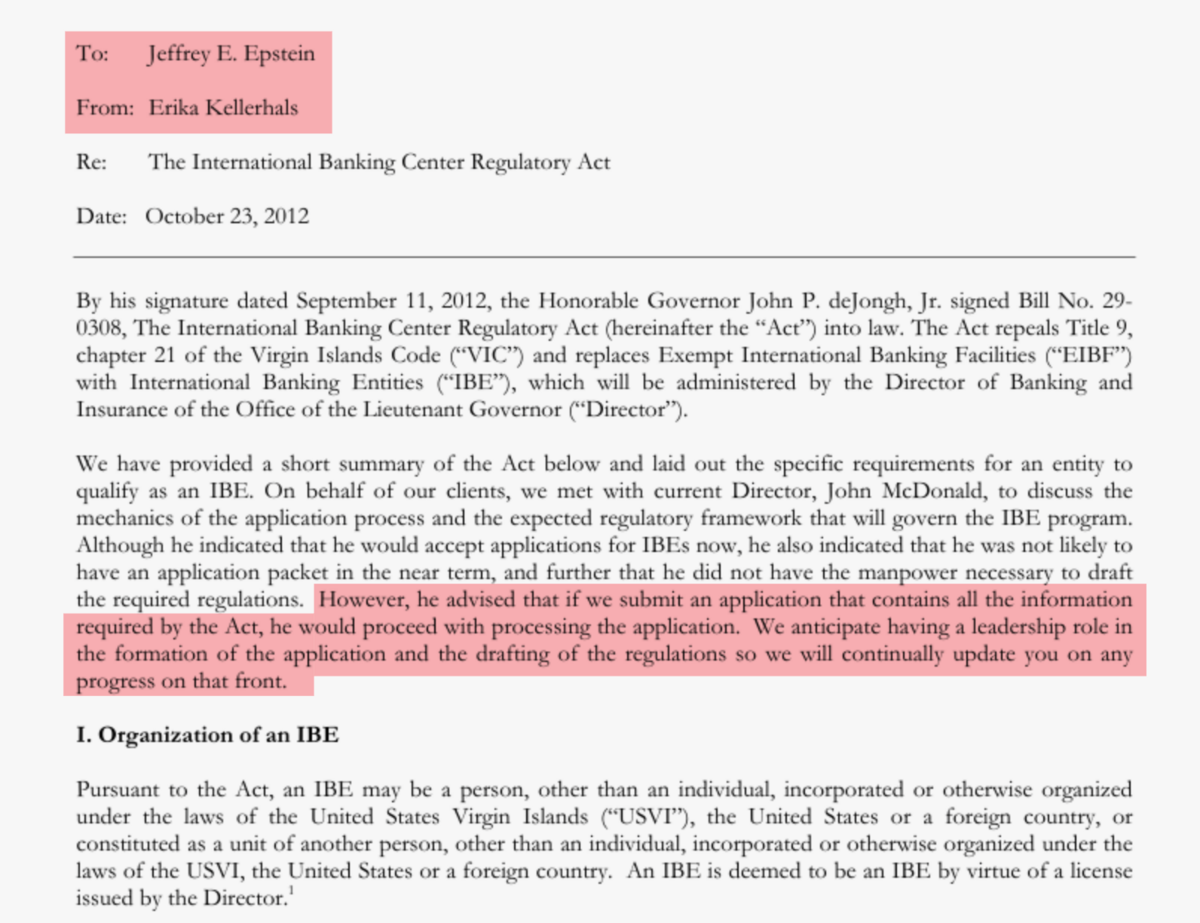
Just a month after John de Jongh, then-governor of the U.S. Virgin Islands, signed the law in September 2012, Epstein’s longtime tax attorney Erika Kellerhals wrote Epstein a memo about the advantages of having an offshore bank.
She noted that the islands’ banking and insurance office did not yet have the manpower to finalize the rules that would govern the application process but that the agency’s then-head, John McDonald, had promised to proceed with their application if they got all of their paperwork in order.
“We anticipate having a leadership role in the formation of the application and the drafting of the regulations,” Kellerhals wrote to Epstein in the Oct. 23, 2012, memo.
Epstein’s bank would be the “first existing IBE [International Banking Entity] in the United States Virgin Islands,” an executive summary read.
Kellerhals did not respond to the Herald’s requests for comment.
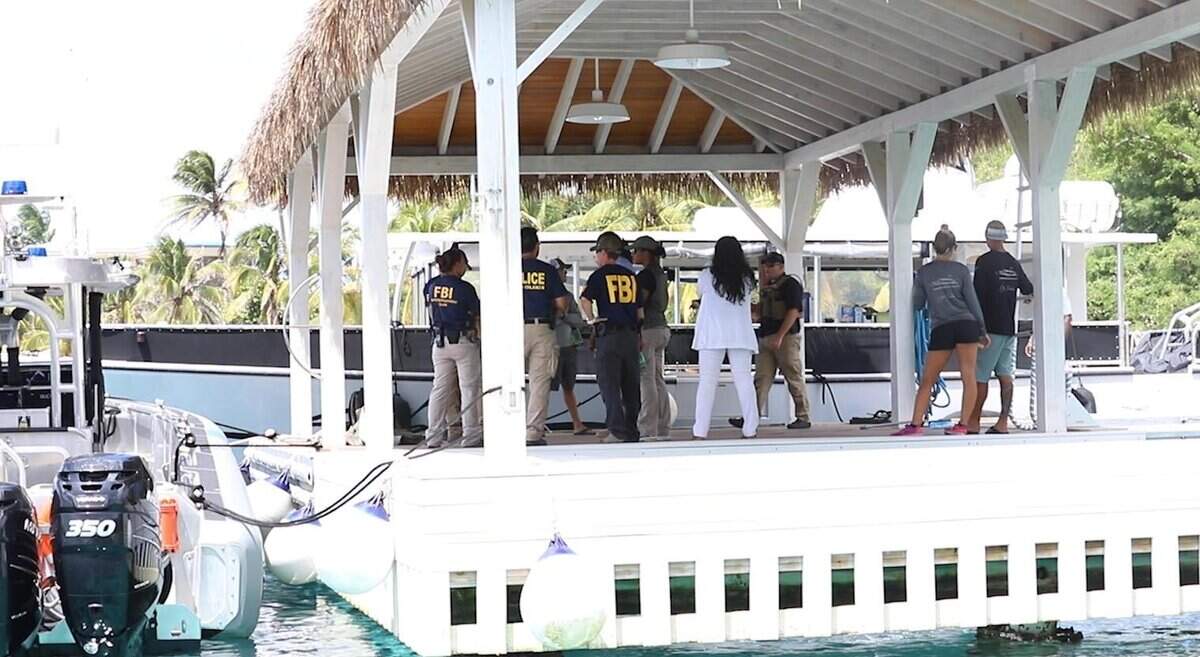
Epstein applied for a banking license in March 2013. He called it Financial Strategy Group, Ltd.
Roughly a year later, in January 2014, Epstein was scheduled to meet with McDonald in St. Thomas. Another meeting was scheduled in October that year. The agendas for the meetings are unclear from the emails.
McDonald granted Epstein a banking license on Dec. 19, 2014, a month after the island’s government finalized the regulations governing offshore banks on its territory. McDonald also used his discretionary power to waive the requirement that USVI’s international banking entities employ at least three people. The Herald was unable to find current contact details for McDonald.
Epstein later changed the name of the bank to Southern Country International, Ltd. in 2015.
That Epstein, a registered sex offender, was able to obtain his license at all is unusual.
Traditional bank operators and owners in the United States are subject to rigorous background checks and fall under the oversight of the U.S. Treasury Department and typically, the Federal Reserve system.
But this was not the first time Epstein — who employed Cecile de Jongh, the governor’s wife, as the office manager for several of his businesses — had received preferential treatment by the government in the Virgin Islands.
While defending itself in court against the Virgin Islands’ accusation that JPMorgan had enabled Epstein, the bank alleged that Gov. de Jongh had approved a tax break for Epstein’s similarly named firm, Southern Trust Company, that helped Epstein generate around $300 million in profit over six years.
The bank also alleged that Epstein in 2011 had sent Cecile de Jongh proposed legislation to ease travel restrictions for sex offenders under the territorial laws. Cecile de Jongh, the records show, later apologized to Epstein because the law had passed without his suggested amendments.
Danny Cevallos, John de Jongh’s attorney, told the Herald that de Jongh had not extended any personal favor to Epstein and had not had any conversations with McDonald about Southern Country International.
“Governor de Jongh had no role in the operations of Southern Country International,” Cevallos said. “He had no involvement in its banking-license application or in any subsequent review of its operations.”
De Jongh declined to discuss his wife’s relationship and employment with Epstein.
The Herald sent questions to attorneys of Cecile de Jongh but did not receive any response. The islands’ banking and financial regulations agency, which issued the license and has oversight over the territory’s offshore banks, also did not respond.
The bank comes alive
Why exactly Epstein created an offshore bank is unclear.
Besides paying for occasional operating expenses, Southern Country International remained dormant for years, business and accounting records show. The bank held a little less than $500,000 in its checking account at First Bank in San Juan, Puerto Rico, and by December 2017 had yet to hire a single employee.
But in 2019, it suddenly came alive with a dizzying series of transactions worth tens of millions of dollars.
Epstein wired $2.6 million in three installments in April of that year to Southern Country.
In June and July, he deposited $17.7 million after cashing out an investment portfolio. Those funds were then debited to Southern Trust Company, the similarly named firm he owned. Why he did not send the funds directly to Southern Trust after selling his investments is unclear.
On July 31, less than two weeks before he was found dead, Epstein’s Southern Country bank wired $2 million to a third firm he owned and paid $1.6 million to Richard Kahn, Epstein’s longtime accountant.
The transactions continued after Epstein’s death.
In November 2019, around $9.3 million — $4.6 million from a trust controlled by his longtime business counsel Darren Indyke, and the rest from unknown sources — was deposited to Southern Country.
And two days before Christmas, Southern Country received $15.5 million from Epstein’s estate and sent back $2.6 million. Khan and Indyke, who together manage his estate, told a Virgin Islands court that it was for a loan Southern Country had issued to Epstein to pay for his legal defense. Local prosecutors did not find any loan agreement.
That same day, Dec. 23, 2019, Epstein’s Southern Country bank also paid out a $24 million check to his Southern Trust Company.
Southern Country’s ending balance, according to legal documents at the end of the year, returned to its initial value of less than $500,000.
Some of the transactions may have been improper.
Under the territorial law, Southern Country was only allowed to do business with people or companies that were not from the Virgin Islands. But the similarly named Southern Trust Company was incorporated in and operated out of the islands.
Indyke did not answer the Herald’s questions about the transactions. The Herald could not find current contact information for accountant Kahn.
Southern Country’s activities raised eyebrows among compliance officers at traditional banks where it maintained checking and brokerage accounts — but only after Epstein’s death.
“A majority of the affected accounts were opened in 2019 and the subsequent funding of those accounts appears to have been conducted in a willfully deceitful manner intended to disguise the sources of funds as originating with Jeffrey Epstein,” TD Bank noted in a report to the U.S. Treasury Department after conducting a review a month after Epstein’s death.
That report, known as a Suspicious Activity Report, and another filed by the bank Charles Schwab were initially released by the U.S. Justice Department as part of the “Epstein Files” but have since been completely redacted.
The U.S. Justice Department did not respond when the Herald asked why the reports had been redacted.
The Virgin Islands settled its lawsuit with Epstein’s estate in 2022 for $105 million.
This story was originally published July 6, 2026 at 4:00 AM with the headline "Epstein moved millions through mysterious Virgin Islands bank right before arrest."