
Hunter bags rare white turkey in Kentucky. What causes the ‘unusual’ condition?
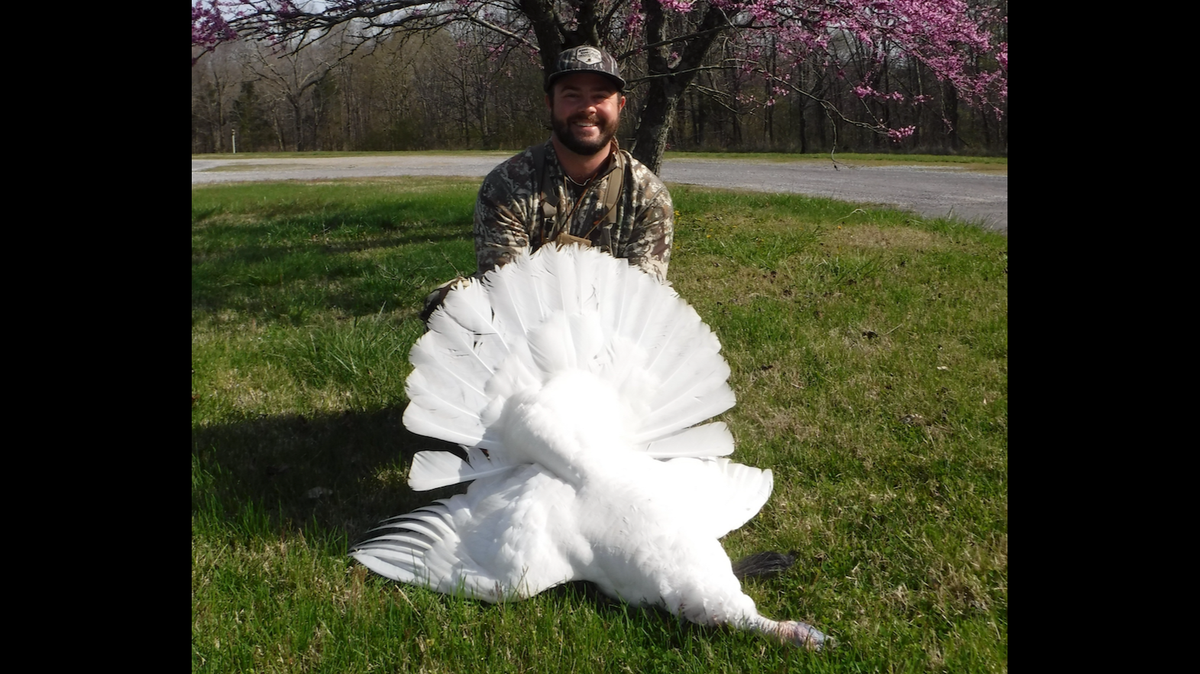
Referred to as “the turkey of a lifetime,” a wild bird bagged in Kentucky is being lauded not only for its size, but for its color.
Officials at Land Between the Lakes in Western Kentucky say a hunter recently killed an elusive white turkey.
“Nature comes in all colors and that was proven last week,” officials said.
But what causes the feathers to be white? It’s due to leucism, which Land Between the Lakes calls “a condition ... which causes a partial loss of pigmentation.”
White turkeys can be found in various places, including Texas, where Parks & Wildlife officials refer to leucism as “a very unusual condition.”
“In birds, leucism affects only the bird’s feathers. This means they do not have the normal, classic plumage colors listed in field guides,” Texas Parks & Wildlife said. “They may have white patches where the bird should not have any, or their overall plumage may look pale or bleached out.”
Troy Cornett, a hunter from North Carolina, had his eyes on a separate leucistic wild turkey for nearly two years until he harvested it this month.
“This is where the story of this magnificent, beautiful, once in a lifetime, fully albino, North Carolina long beard ends,” Cornett said. “I am so blessed and fortunate to have had a chance to pursue a bird of this rarity, let alone harvest him.”
The turkey is actually leucistic, not albinic, Mark Hatfield, the National Director of Conservation Services for the National Wild Turkey Federation, told Field and Stream. But what’s the difference?
If the eyes are a normal color for that species, the bird has leucism. But if the eyes are pink or red, it is an albino, BirdObserver.org said.
Though one was harvested in Kentucky and another in North Carolina this month, it’s still “pretty rare to see a turkey like this,” Hatfield said.
“How rare leucistic turkeys are is a question we get all the time,” Hatfield said. “We see photos of these show up once or twice a year. If you think about how many birds are harvested each year — three quarter (of a) million to a million — it kind of summarizes how rare harvesting one is.”
It’s estimated “only one in 100,000 turkeys” will have leucism, the Wide Open Spaces hunting and wildlife blog said.
This story was originally published April 20, 2022 at 8:17 AM with the headline "Hunter bags rare white turkey in Kentucky. What causes the ‘unusual’ condition?."