
Fossil of prehistoric lobster likened to beef jerky after discovery in Alabama creek
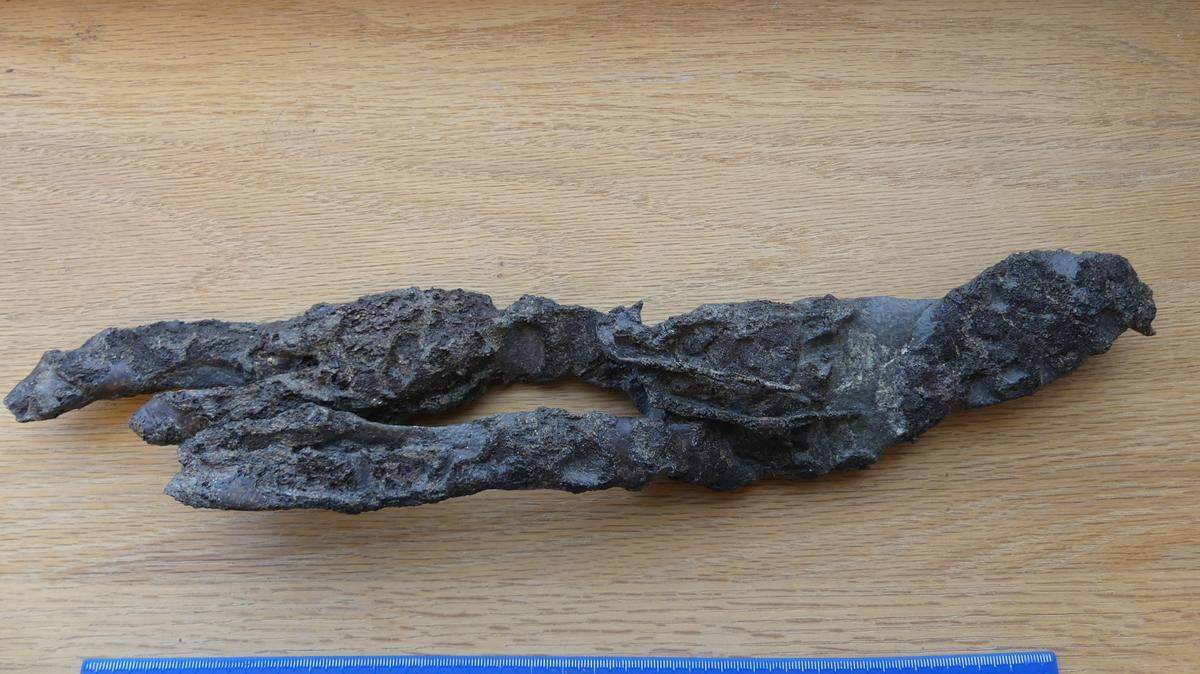
The remains of a 70-million-year-old carnivorous lobster have been found in Alabama, and the fossil is so well preserved it resembles well-cooked bacon.
Not only are the large claws still attached — the biggest of which is 6.5 inches — but the creature also retained its delicate antennae, based on photos shared by the Alabama Museum of Natural History.
“Looks like some beef jerky to me,” one commenter wrote on the museum’s Facebook page.
The 13.5-inch crustacean lived during the Late Cretaceous period and was known as Hoploparia, a genus that did not survive to the present day.
Its resemblance to anything tasty is misleading, according to Adiel A. Klompmaker, curator of paleontology with the Department of Museum Research and Collections and the Alabama Museum of Natural History.
“This (appearance) is caused by the preservation of the fossil in the rock, giving it a mixture of brownish tints with some gray. Although it may look like beef jerky, my teeth would suffer greatly if I were to give it a bite here in my office. This lobster is literally rock-hard!” Klompmaker told McClatchy News.
“I was amazed to see the antennae were preserved. ... They really stand out from the rock.”
The fossil is the first-reported Cretaceous example of Hoploparia in Alabama, which the museum says is surprising, given “Alabama has lots of Cretaceous-aged rocks.”
Such lobsters thrived when sea level was about 295 feet higher, leading to the southern portion of Alabama being covered by shallow seas, according to the Encyclopedia of Alabama. “The waters over west and central Alabama were deeper than 90 meters,” the site reports.
Hoploparia would have been living on the bottom of this ocean “waiting or actively hunting for yummy prey items such as mollusks and perhaps even fish,” Klompmaker says.
George Martin, a museum research associate, discovered the fossil southwest of Montgomery in August. However, it was still deeply embedded in rock, so Martin could only guess he’d found something important.
“I was searching for fossils in a creek bed during a low water period in Lowndes County and noticed a cylindrical rock on a gravel bar,” Martin told McClatchy News.
“The shape was unusual, so I picked it up for a closer look and noticed a darker color on the end of the rock where it had broken. This confirmed the presence of a fossil of some kind. I suspected that it was a large lobster or large crab claw because of the shape, so I put it in my backpack.”
Martin, a retired soil scientist, invested more than 100 hours in removing the surrounding stone. He finished March 25, then donated it to the museum’s fossil collection.
He was also amazed the antennae survived but laments the carapace (mid section) was not preserved enough “so we could identify it to species.”
“Overall, though, it turned out to be a really nice specimen and worth all the effort,” Martin says.
This story was originally published April 6, 2022 at 2:40 PM with the headline "Fossil of prehistoric lobster likened to beef jerky after discovery in Alabama creek."