
Saber-toothed cat-like species identified in fossils found decades ago in California
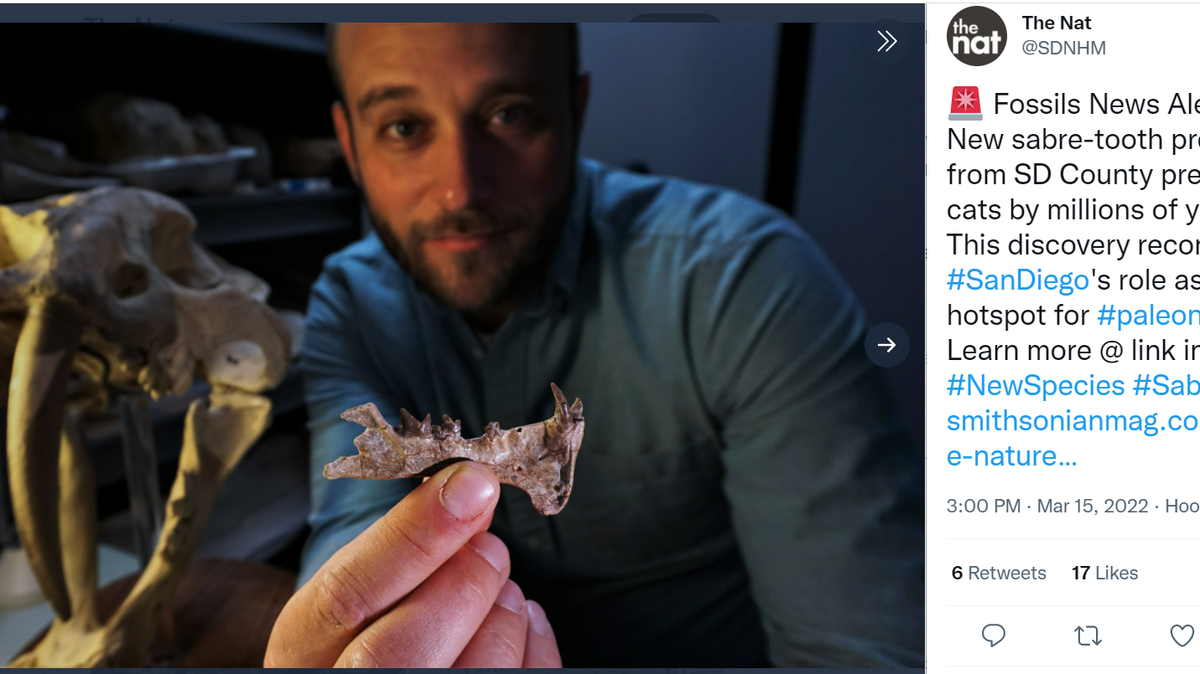
A fossil first found in 1988 belongs to a saber-toothed animal that precedes modern cats by millions of years, the San Diego Natural History Museum announced on March 15.
The species, recently identified by paleontologists, was named Diegoaelurus vanvalkenburghae. The first part of the species’ name means “San Diego’s cat,” The San Diego Union-Tribune reported, while the second part is in honor of paleontologist Blaire Van Valkenburgh, researchers wrote in PeerJ, an international open-access science journal.
The predator is “one of the earliest known animals to evolve saber-teeth, a characteristic of some hyper-carnivores “taken to the extreme,” the museum said in a Facebook post. There are no surviving saber-toothed animals today, but some famous hyper-carnivores, or animals that eat mostly meat, include lions, polar bears and house cats, according to the museum.
Diegoaelurus is the oldest-known saber-toothed carnivore and lived in the forests of ancient San Diego about 42 million years ago, according to Smithsonian Magazine. The animals were part of an early group of carnivores that evolved following “the mass extinction that ended the Age of Dinosaurs,” the outlet reported.
San Diego was a “wetter, warmer world” back then, during the Eocene period, the museum said on Facebook.
“There were tiny rhinos, early tapirs, and strange sheep-like, herbivorous oreodonts that grazed under trees while unusual primates and marsupials clung to the canopy above,” the museum said. “This richness of prey species would have been a smorgasbord for Diegoaelurus, allowing it to live the life of a specialized hunter before most other mammals.”
Instead of having flattened molars to mash plants, seeds or bugs, Diegoaelurus had only saber-toothed fangs and “serrated scissor-like teeth” in the back of its mouth, the The San Diego Union-Tribune reported.
“Today the ability to eat an all-meat diet ... isn’t uncommon. Tigers do it, polar bears can do it. If you have a house cat, you may even have a hypercarnivore at home,” museum paleontologist Ashley Poust told the outlet. “But 42 million years ago, mammals were only just figuring out how to survive on meat alone. One big advance was to evolve specialized teeth for slicing flesh, which is something we see in this newly described specimen.”
The fossils of the animal’s lower jaw and several of its teeth were first uncovered in Oceanside in 1988, The San Diego Union-Tribune and Scientific American reported.
The bones were part of the Natural History Museum’s collection but had not been identified, Smithsonian Magazine reported.
The fossil is part of a “rare group of early mammalian carnivores,” and there aren’t many fossils from the species to evaluate, making it difficult for researchers to fully understand how the animals relate to other species, they wrote in the research paper.
“Numerous important questions concerning the evolution, ecology, and extinction of this enigmatic clade remain,” the researchers wrote.
This story was originally published March 17, 2022 at 5:11 PM with the headline "Saber-toothed cat-like species identified in fossils found decades ago in California."