
Interstellar disc that blasted by Earth was not alien technology. Here’s what it was
It took four years, but two Arizona astrophysicists have come up with an explanation for the interstellar “pancake-shaped disk” that ignited fears of alien technology in 2017.
The object — which resembled the Millennium Falcon from “Star Wars” — hurtled past Earth at 196,000 miles an hour and was confirmed to be from another solar system, according to The School of Earth and Space Exploration at Arizona State University.
Scientists named the bject Oumuamua, Hawaiian for “scout,” and conceded it was unlike anything previously seen.
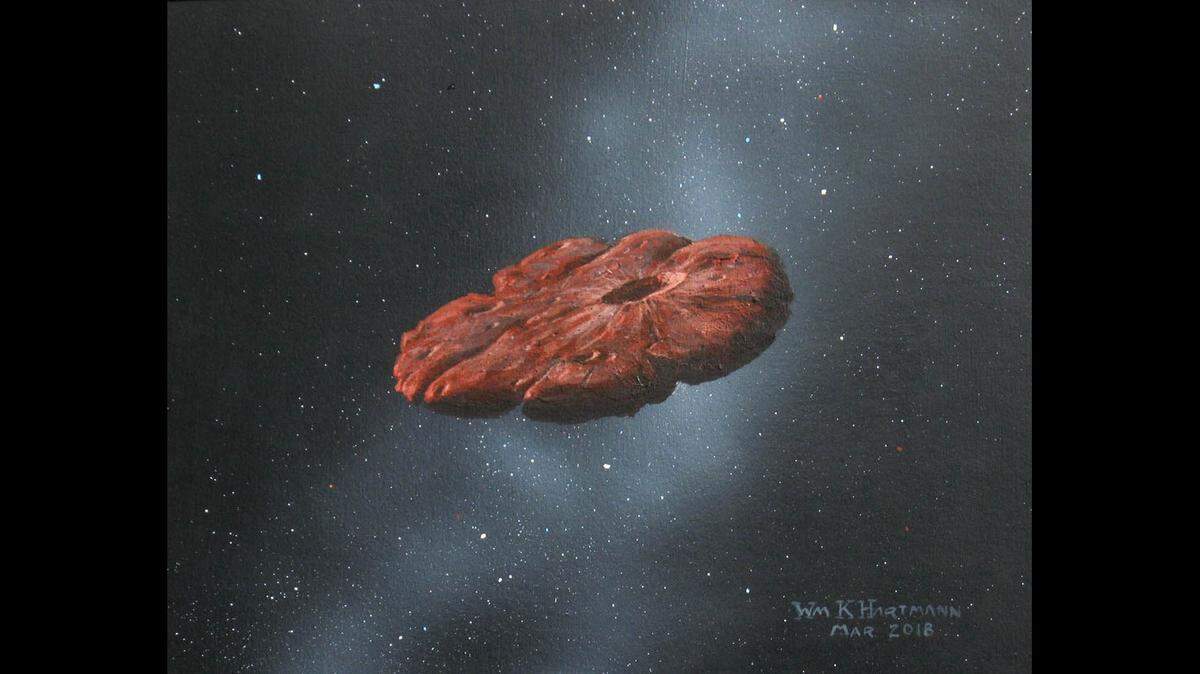
The lack of certainty quickly led to speculation it was “a piece of alien technology,” but the new research proves otherwise, according to a news release from the American Geophysical Union and Arizona State University.
“Everybody is interested in aliens, and it was inevitable that this first object outside the solar system would make people think of aliens,” Steven Desch, an astrophysicist at ASU, said in the release. “But it’s important in science not to jump to conclusions. It took two or three years to figure out a natural explanation.”
So what was it?
A massive chunk of ice, or more specifically, frozen nitrogen, scientists say.
However, that’s just one of the surprises discovered by Desch and astrophysicist Alan Jackson, who co-authored two papers on the object in the American Geophysical Union’s Journal of Geophysical Research.
“Oumuamua was small, about half as long as a city block and only as thick as a three story building, but it was very shiny,” the scientists wrote.
“The shininess is about the same as the surfaces of Pluto and Triton, which are also covered in nitrogen ice. We suggest Oumuamua was probably thrown out of a young star system about half a billion years ago. Bodies like Oumuamua may allow us to see what the surfaces of a so far unknown type of exoplanet ... are made of.”
It was spotted in 2017 by an astronomical observatory in Hawaii and quickly labeled “the first known interstellar object to pass through our solar system,” the report says.
Oumuamua was believed at first to be comet, but experts then noted “features that were just odd enough to defy classification,” the scientists said. The object didn’t have a tail, which is created when gases evaporate off comets.
Their research contends “orbital instabilities” caused giant planets to collide, which resulted in “large numbers of small pieces of nitrogen ice like Oumuamua” to break off and shoot into space.
“It was likely knocked off the surface by an impact about half a billion years ago and thrown out of its parent system,” Jackson said in the news release.
This revelation is important, because it means other solar systems have at least some planets like those in our own solar system, Desch said.
“Until now, we’ve had no way to know if other solar systems have Pluto-like planets, but now we have seen a chunk of one pass by Earth,” he said.
Oumuamua changed shape as it traveled, the report notes. It “likely wasn’t flat when it entered our solar system, but melted away to a sliver,” as it got closer to the sun. It eventually lost “more than 95% of its mass.”
This story was originally published March 17, 2021 at 12:02 PM with the headline "Interstellar disc that blasted by Earth was not alien technology. Here’s what it was."