
Two-headed rattlesnake found near Arizona golf course. ‘I lost my mind a little.’
Greyson Getty says he was following a western diamondback rattlesnake through a bush when he found himself suddenly staring down 11 rattlesnakes.
But things got even stranger for the professional snake catcher when he noticed a peculiar snake coiled by itself in one corner of the den.
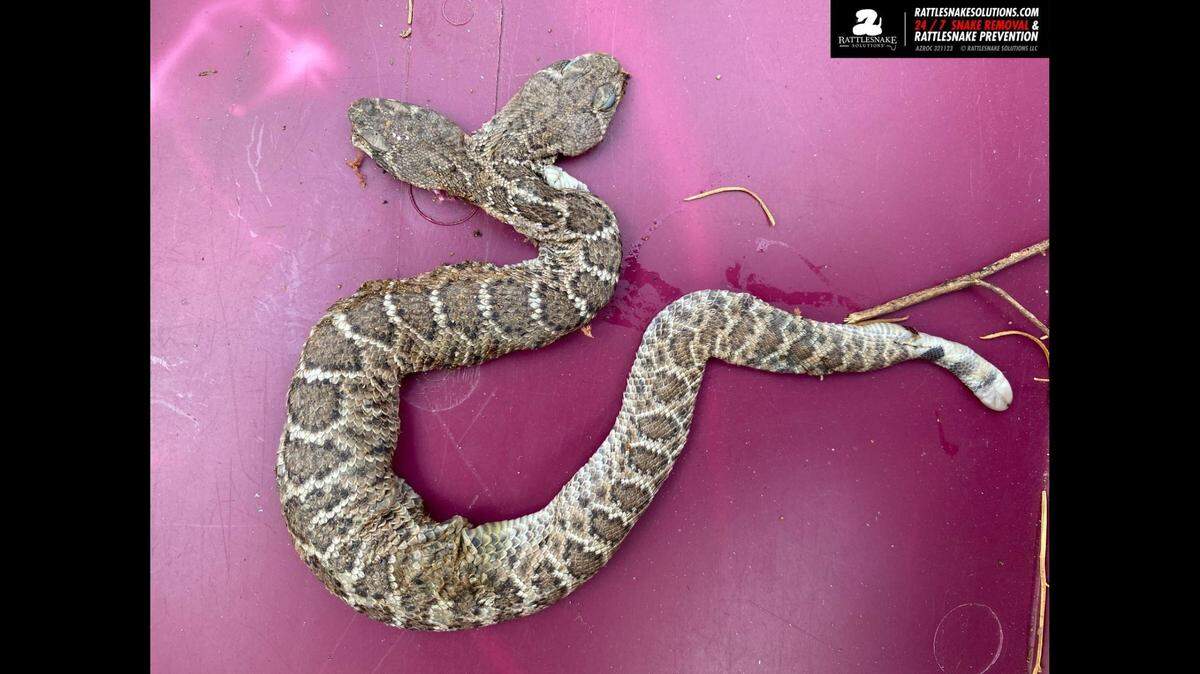
It was a very large “baby” with two heads. And it appeared to have just died, he said.
“Once I pull it out of the hole, honestly, I lost my mind a little,” Getty told McClatchy News. “The body of the snake seemed to be quite large and disproportionate compared to its siblings. It was just over double the size of a normal baby rattlesnake.”
Western diamondback rattlesnakes are one of the nation’s 10 most dangerous snakes, with a venom that causes “massive internal bleeding,” Reptiles Magazine reports.
The two-headed snake was dead, but it has shaken social media in the week since Getty’s employer, Rattlesnake Solutions, posted a photo. The disconcerting image shows a short, but very puffy young rattlesnake with two fully developed heads.
Among those sharing the photo have been Facebook groups devoted to snake research, UFOs and even dinosaurs.
“HOLY HELLLLLL, NO,” Stephanie Tassone commented on the photo.
“2020 strikes again,” Stacey Mantle wrote.
“Stuff of nightmares!” Sandy Compton Farmer posted.
Experts say there’s not enough research to say exactly how rare it is to find a two-headed western diamondback in the wild, but multi-headed creatures of any kind are the stuff of mythology. (Think the many-headed Hydra or Cerberus, hell’s guard dog.)
A 2019 article in The Guardian put the odds of any animal being born in the wild with multiple heads at around one in 100,000 live births.
Getty said he found the snake the morning of Aug. 16, as he searched for a rattlesnake den adjacent to a golf course. He found the den next to an irrigation drain and used a hook to pull out four adults and seven healthy babies. (One of the adults later gave birth in the bucket, so the total grew to 14.) All are being released back into the wild, he said.
Two-headed snakes of any species don’t often survive in the wild, in part because they have trouble defending themselves and the heads fight over which one gets to swallow the food, National Geographic reports.
“They also have a great deal of difficulty deciding which direction to go,” University of Tennessee herpetologist Gordon Burghardt told National Geographic.
Getty isn’t sure what killed his two-headed snake, but he believes it had to do with the deformities. Rattlesnake Solutions specializes in “safe, humane snake removal and relocation” and tries to catch them alive and unharmed.
“The body of the snake seemed to be quite large and disproportionate compared to its siblings,” he said. “It’s just over double the size of a normal baby rattlesnake, leading me to believe that having two snakes worth of organs probably didn’t work very well.
”I can deduce, however, that the animal was able to live for at least a little bit after birth. It took its first breaths and then coiled itself (clear indentation in the soil) and likely passed away shortly thereafter.”
Rattlesnake Solutions says this is the second time the company has dealt with a two-headed rattlesnake in the past few years. The other involved an Arizona black rattlesnake born at the company’s Arizona facility with one head and three-fourths of another head. It lived about a year and a half, the company said.
So where is Getty’s two-headed snake now? Rattlesnake Solutions said on Facebook it decided not to donate the snake to researchers, because it was partially decomposed.
“Being a snake nerd, I think finding some way to preserve it is an idea that’s crossed my mind,” Getty said. “I have a lot of crazy stories from years of doing this, so for one as outlandish as this, I think it’d certainly be beneficial to keep some physical ‘proof’ around.”
This story was originally published August 24, 2020 at 6:22 AM with the headline "Two-headed rattlesnake found near Arizona golf course. ‘I lost my mind a little.’ ."