
Little known cookie-cutter shark bites, spins and takes perfectly round chunk of meat
The fact that there is such a thing as a cookie-cutter shark — shaped like a cigar, no less — is not nearly as unnerving as the idea that its name is fitting.
They are among the world’s “lesser-known shark species” and also one of the strangest, the Sulikowski Shark and Fish Conservation Lab in Arizona reported this month.
Most sharks take big, savage bites when they eat something or somebody. But cookie-cutter sharks nibble in a way that is almost sinister, according to a post shared by the lab
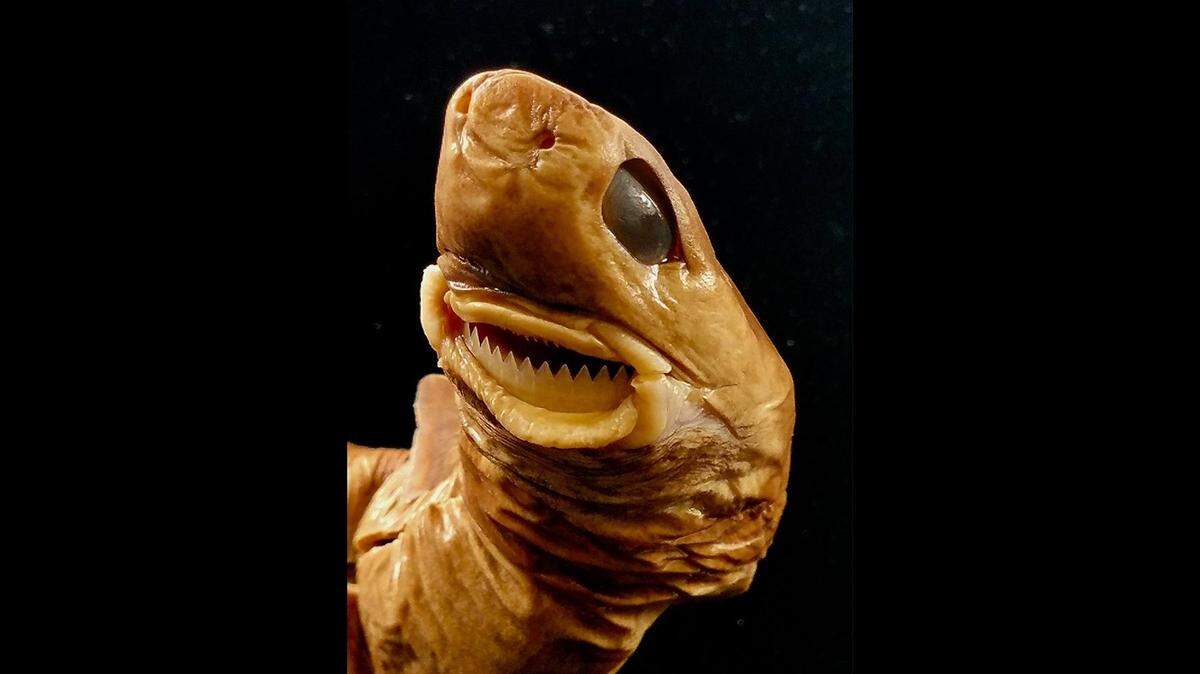
“Cookie-cutter attaches itself to the victim, such as tuna, marlin or other sharks, using strong, suckling lips. Afterwards, in a can-opener style, it sticks the teeth out, twists around and cuts out the perfectly circular piece of meat!” the post explains.
Their small size — about a foot and a half in length — has kept the species out of the limelight for centuries, but things changed in the past year.
For reasons unknown, cookie-cutter sharks stepped up their attacks on people.
“In a historic first, the elusive, foot-long cookie cutter shark was responsible for three of 2019’s attacks,” the Florida Museum reported in January. “All three bites were on long-distance swimmers training in Hawaii’s Kaiwi Channel at night.”
Prior to 2019, only two cookie-cutter attacks were known: One in 2009 (Hawaii) and another in 2017 (Australia), the museum reports.
Their painful bite leaves “neat, cookie-shaped round scars” on victims, including other sharks, the Smithsonian National Museum of Natural History reports. They have even been known to leave “crater-like marks on the sonar domes of nuclear submarines,” Dive Magazine reports.
Experts long believed the species was not a threat to humans because of their small size and tendency to hide at depths of 3,200 to 9,800 feet during the day — when people are likely to be in the water, according to Fresh ‘n Salty, an environmental conservation organization.
Cookie-cutter sharks prefer to feed at night, something they’re good at due to having “the biggest teeth to body ratio of all sharks,” Fresh ‘n Salty reports. They also “glow in the dark” as a way to lure in prey, the site reports.
“They’re quite mysterious animals,” Gavin Naylor, director of the Florida Museum’s shark research program, said in a release. “While they’re found all over the world, we don’t know how many of them there are, or how exactly they create this seemingly perfect circle. They can look pretty pathetic, like a lazy sausage, but they can do a lot of damage.”
This story was originally published July 16, 2020 at 3:05 PM with the headline "Little known cookie-cutter shark bites, spins and takes perfectly round chunk of meat."