Are there any targets in MS if there’s nuclear war? See what data shows and if you’re at risk
As global tensions rise and arms control weakens, the risk of nuclear war is once again climbing.
The Doomsday Clock is set at 85 seconds to midnight as of Jan. 27 — the closest it’s ever been to disaster, according to the Bulletin of the Atomic Scientists, which cites multiple global conflicts, including the Russia-Ukraine war and the Iran war.
Earlier this month unauthorized drones flew over Barksdale Air Force Base in Louisiana raising further concern, Air & Space Forces Magazine and ABC News reported.
Although a nuclear war is still unlikely, it’s valuable to know the potential nuclear risks Mississippians could face.
Should Mississippians be worried?
If nuclear weapons are fired at the U.S., most people across the country will be negatively impacted, a World Population Review analysis states.
However, certain states include sites that are strategic targets for nuclear assaults and could be hit first in attempts to wipe out the country’s nuclear weapons, according to the analysis.
Mississippi does not have any sites on World Population Review’s list of strategic nuclear targets, but the state does have large training bases and key military installations that could become targets later on.
Many of those potential targets are located on or near the Mississippi Coast, including the following:
- Keesler Air Force Base in Biloxi
- Naval Construction Battalion Center in Gulfport
- Stennis Space Center in Bay. St. Louis
- Ingalls Shipbuilding in Pascagoula
What makes a site a strategic target?
Factors that make sites a target for nuclear assaults include the following, according to the World Population Review:
- Large population centers with significant cultural impact
- Bases that have nuclear missiles in them
- Command and control centers responsible for communication
- Places that hold submarines or planes that carry nuclear missiles
- Depots and storage centers for nuclear munitions
What are the biggest targets in the South?
Some of the biggest potential nuclear targets in the South include the following, according to the World Population Review analysis:
- Naval Station Norfolk in Virginia
- The Pentagon in Virginia
- Miami, Florida
- Kings Bay Naval Base in Georgia
- Dallas, Texas
- Houston, Texas
- Pantex Plant in Texas
- Barksdale Air Force Base in Louisiana
Where are the safest spots in the US?
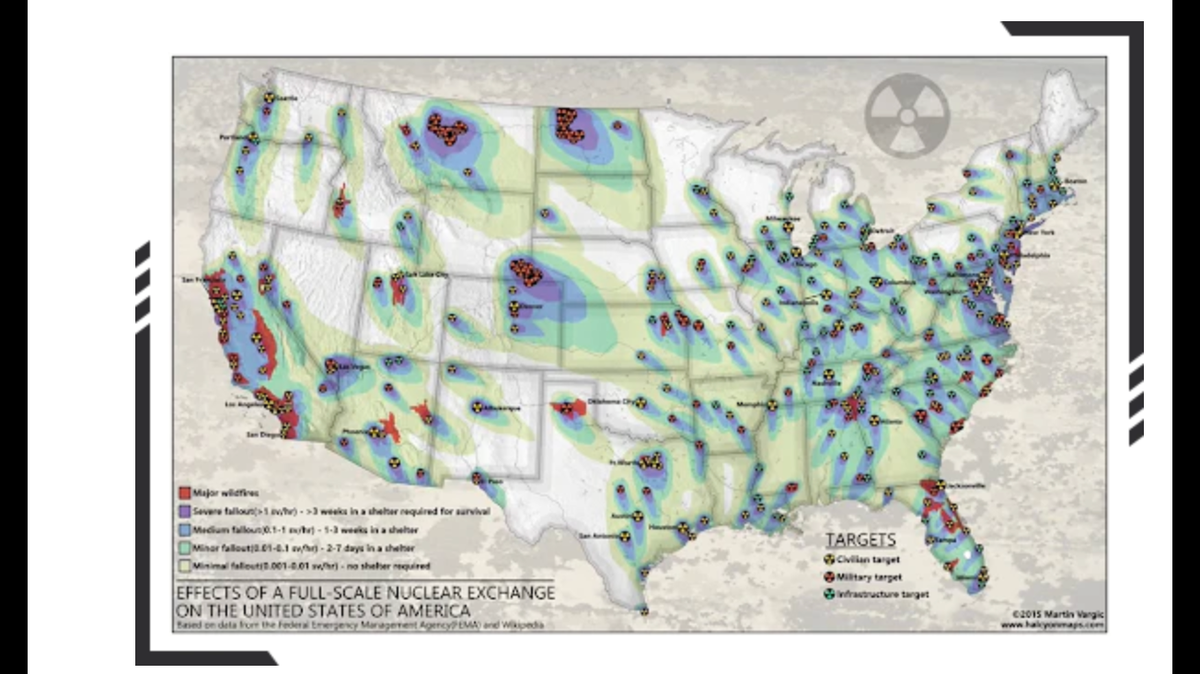
Apart from mapping out potential targets, it’s difficult to predict where exactly a nuclear attack might happen. A recently updated map by MIRA Safety, a Texas-based company selling personal protective equipment, predicts the following states as the safest spots in the U.S.:
- Western Texas
- Most of Nevada
- Wisconsin
MIRA Safety’s estimation is based on a map showing the cities most at risk and how the fallout would spread. The map was created from data provided by the Federal Emergency Management Agency.
Despite remaining safe during initial strikes, Michigan and Wisconsin would become “uninhabitable” in the nuclear winter that would follow, according to MIRA Safety experts.
What to do in an emergency?
Here’s what to do in case of a nuclear explosion, according to FEMA:
- Get inside the nearest building. Shelter that’s brick or concrete best protects against radiation
- Remove any contaminated clothing and wash or wipe off unprotected skin
- Find your way to the basement or the middle of the building
- Stay inside
- Tune into any media available to learn next steps
These are some recommended items to have on hand in case of an emergency:
- Shelter
- Nonperishable food
- Portable, handheld radio