
Biloxi was once the ‘Seafood Capital of the World.’ So why isn’t it any longer?
In the late 1800s, Biloxi was just a modest town along the shores of the Mississippi Coast. Soon, though, it would become the “Seafood Capital of the World.”
In the decades after the Civil War, Biloxi was home to only around 1,500 people, most of whom were fishermen who worked tirelessly to feed their families.
Biloxi soon found itself at the center of the new Louisville and Nashville rail-line which connected New Orleans and Mobile, attracting new businesses and visitors.
Meanwhile, several waves of immigrants seeking refuge from the troubled Austro-Hungarian empire began settling along Biloxi’s shores. This included thousands of Croatians from the Dalmatian Coast, Austrians, Hungarians, Bohemians from what is now the Czech Republic, and Poles.
These diverse groups, most of whom came from coastal fishing settlements, brought their skills and traditions with them, transforming Biloxi into a melting pot of cultures that would later inspire its seafood persona. Some notable coastal names first appeared during this time, including Skrmetta, Mavar, and dozens of others that can still be seen today.
The Seafood Industry
In addition to these immigrants, several new inventions and technologies would shape not only Biloxi’s culture, but its landscape and horizon, as well.
Artificial ice was invented in the mid-1800s, allowing for the preservation and transportation of seafood over longer distances. The advent of modern canning techniques also allowed for the quick production and storage of seafood.
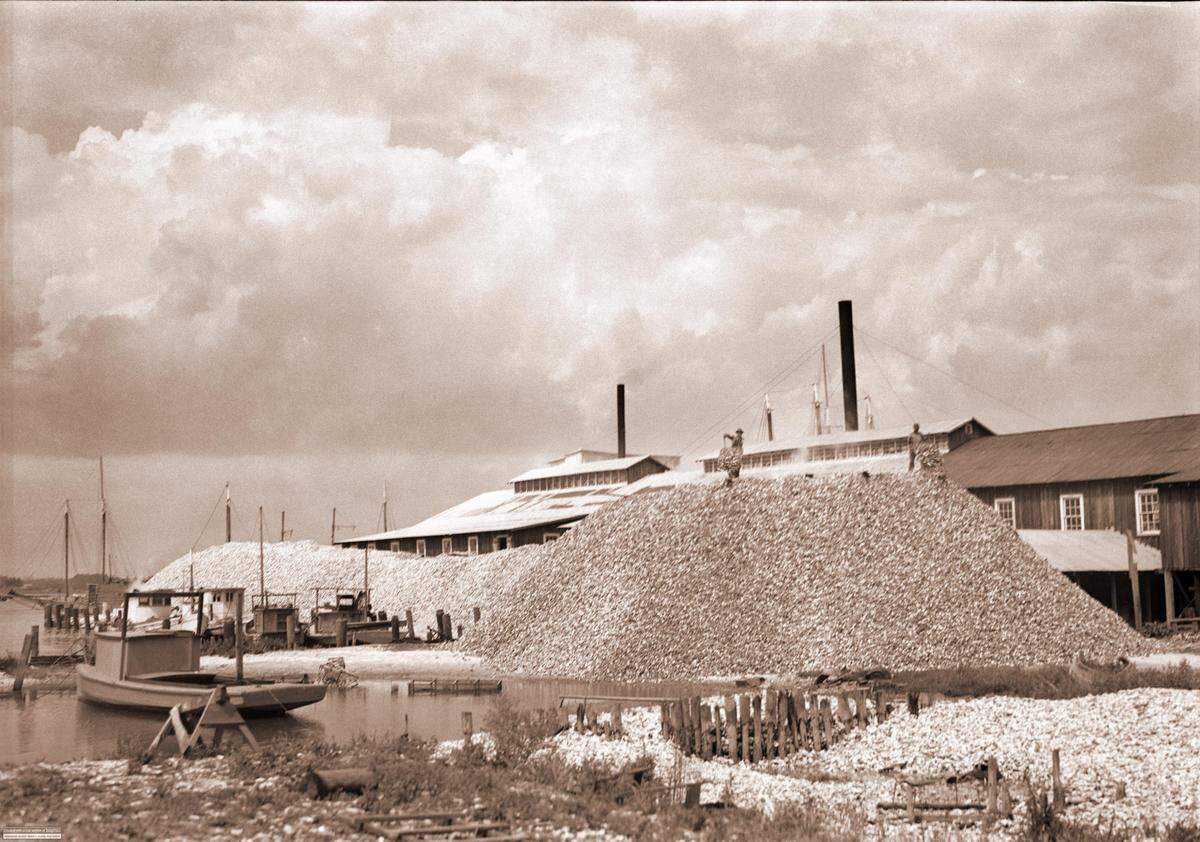
These new advances inspired the creation of the seafood factories that once dominated the Mississippi Coast. The Lopez, Elmer & Company seafood plant, established in 1881, was the first seafood processing factory in Biloxi.
While most of the men went to work on the boats out at sea, the women and children were put to work in the bustling, and often dangerous, factories. Many of these immigrants were forced to work long hours most days of the week for barely livable wages. It wasn’t until 1908 that a Mississippi law was enacted barring children under the age of 12 from factory work.
However, their work and the new technologies allowed for the mass shipping and sale of Biloxi’s seafood to a national and international market.
The turn of the century also saw a shift from classic seafood schooners to motor-powered trawlers. Schooners required a crew of six to operate and were relatively slow at harvesting, as opposed to the new trawlers which could gather more with just a crew of two. While most of these were owned and operated by the factories, some were privately owned and helped supply the people of Biloxi and its expanding restaurant scene with fresh seafood.
Over the next few years, several more seafood factories and industries popped up in Biloxi, turning it into one of the most commercialized seafood districts in the world.
Biloxi’s annual seafood processing in 1890 amounted to just over 2,000,000 pounds of oysters and 600,000 pounds of shrimp. By 1902, those numbers had increased dramatically, to almost 6,000,000 pounds of oysters and 4,500,000 pounds of shrimp.
The increased demand created more jobs, which attracted even more immigrant workers from Europe, as well as French-Canadians from Louisiana, increasing Biloxi’s total population from 1,500 to over 8,000 by 1903.
In less than two decades, Biloxi had grown from a quiet and underdeveloped coastal town into the economic and industrial center of Mississippi. These developments led to Biloxi becoming known as the “Seafood Capital of the World.”
Losing the Title
Unfortunately, the Great Depression and both World Wars hampered the Biloxi seafood industry’s growth. Some of the original dozen factories closed during this time period, while production and exports fell drastically.
A number of hurricanes, disasters, and climate change in the late 20th and early 21st centuries also hurt the industry, and has caused the oysters to disappear from the Mississippi Coast. During this time, Biloxi lost the title of “Seafood Capital of the World.”
Despite these challenges, the seafood industry remains an integral part of Biloxi and Coastal Mississippi’s culture. This is best seen through the annual Biloxi Seafood Festival.
Meanwhile, the new casinos and restaurants built along the coast in the 1990s came to rely on local fishermen and companies to provide fresh seafood to tourists and locals.
Many Coastal Mississippians and Biloxi natives still rely on seafood for their livelihood and can trace their family history back to the original immigrants and workers. While it may not be the Seafood Capital anymore, Biloxi’s seafood scene is still one of the largest and most unique in the nation.
This story was originally published December 10, 2023 at 6:00 AM.