
This is the history of Prohibition on the MS Coast: Miami trips, murder and more
During the height of National Prohibition, a number of prominent Biloxians pooled $100,000 to invest in a Cuban rum-running venture. Their intermediary headed to Miami by train, and while taking a nap he stuffed the money in his pillow case.
Almost sleeping through an Alabama train change, he hurried aboard the new car. Soon, his frantic wire to the train company dashed the hopes of an Alabama train porter headed home with the fortune. The incident, never recorded but believable given local booze shenanigans, became a pass-down tale.
Several years before that, an inspection of an Oklahoma-bound lumber car filled with 6,000 board feet of Mississippi pine revealed 1,000 hidden gallons of liquor. The newspaper reported, “The liquor was identified as Cuban black strap alcohol of the kind largely used in the manufacture of synthetic high grade whiskeys.”
And a few years later in 1927, eight stills were destroyed in the Kiln-Fenton area of Hancock County. One reporter observed, “Prohibition agents participated in the capture of the stills, a synthetic plant and many spurious labels, revenue stamps and ready made ‘Scotch’ and ‘Gordon Gin’ tops. Cached liquor was unearthed in sawdust cellars.”
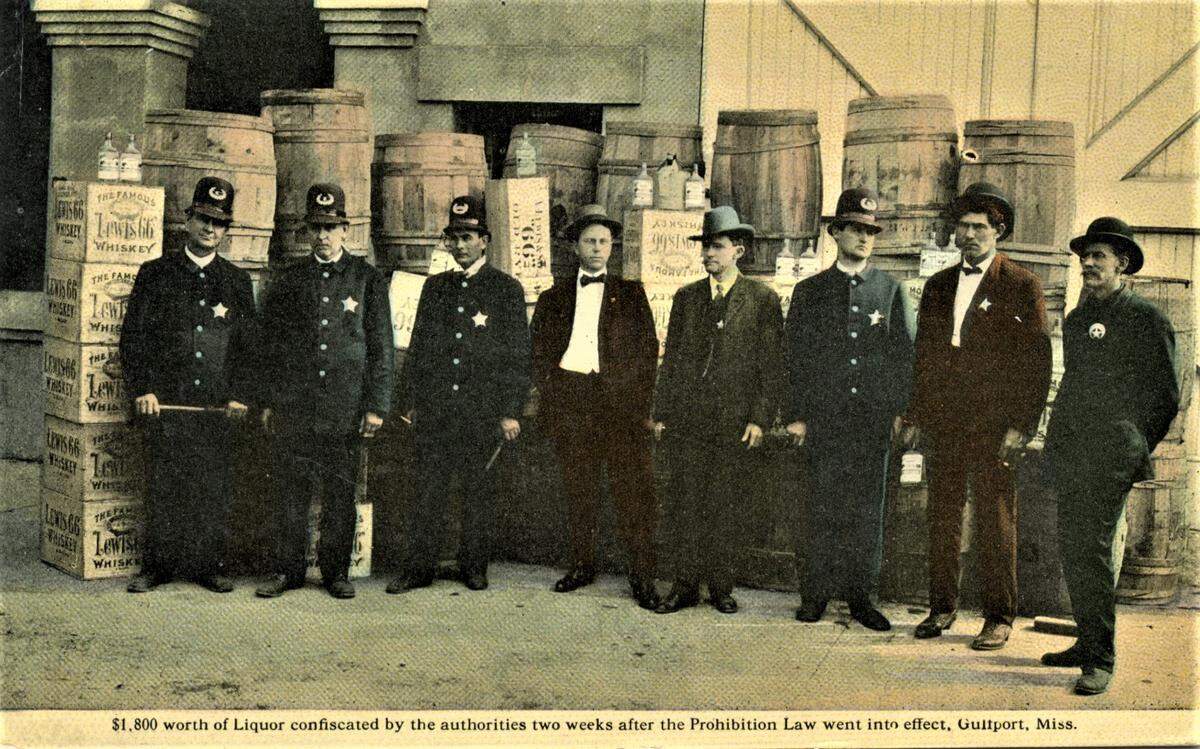
The history of alcohol on the Coast: Booze, murder and more
And so go the stories of Mississippi Gulf Coast days of prohibition, sometimes retold as family lore, sometimes documented in newspapers. Coastal counties and pineywoods were in the thick of bringing illegal booze to the state and to the country, using the islands, the sound, bays, highways and railways as transports.
Blind tigers sold the alcohol locally in stores, houses and secret saloons. Rum-runner brought it by boat from Cuba and Central America. Schooner captains made more money smuggling booze than with seafood. Locals found floating bottles, ditched by runners in hot pursuit, and happily took the goods home. Bootleggers produced “white lightning” in stills.
Mysterious murders piled up. Boys from Bay St. Louis to Gulfport to Pascagoula were paid well for unloading and hiding the caches. The U.S. Coast Guard established a base to catch the runners. Following state and federal laws, prohibition officers and local law enforcers raided and arrested — and sometimes they didn’t.
Local prohibition stories have as many ingredients and are as mixed up as a Mississippi Mud Martini. Not surprisingly, the state’s 113 years of alcohol forbiddance are filled with contradictions.
For example, Mississippi outlawed drinking, owning and selling alcoholic beverage, yet charged a 10 percent tax on alcohol sales because politicians knew it happened anyway? That practice stopped in 1966 when statewide prohibition was repealed and counties given the option to vote themselves dry.
Just 13 months ago, Mississippi became the last state to officially be declared all wet, and legislative moves are underway to change other 20th century drinking laws. Mississippians are in a wait-and-see period, knowing their history of temperance, religious influence and attempted legislation of morality.
When Mississippi was under its early state prohibition, the editor of this newspaper, then called The Daily Herald and owned by the local Wilkes family, wrote a rare 1917 editorial:
“We do not attempt to go into the causes of the moral forces that are back of the anti-whiskey wave. We do not and will never believe that the world needs reforming in the sense that a man must be legislated into good morals.”
Even if in the end it was deemed bad public policy, prohibition gave rise to some great blues music and classic literary characters, including William Faulkner’s Tommy, a bootlegger in “Sanctuary,” a 1929 novel that takes place in Mississippi.
There’s also Tennessee Williams’ “Cat on the Hot Tin Roof,” whose characters drank nearly constantly despite Prohibition.
The book takes place in the Mississippi Delta but some of the 1958 movie of the same name was filmed in Bay St. Louis. Elizabeth Taylor, Paul Newman and others in the film crew stayed at the Broadwater Beach Hotel in Biloxi, an establishment known for drinking and gambling in these illegal times.
As for prohibition music, some of it survives today and highlights such Mississippi blues greats as Muddy Waters and other names highlighted on the Mississippi Blues Trail, which features historic markers from the Delta to the Coast.
1919 was the year the National Prohibition Act, also identified as the 18th Amendment, went into force and singer Bill Murray recorded “The Alcoholic Blues,”which includes this telling verse:
I’ve got the blues, I’ve got the blues
I’ve got the alcoholic blues
No more beer, my heart to cheer
Goodbye whiskey, you used to make me frisky
So long highball, so long gin
Oh, tell me when you comin’ back again?
Answer: 1933, for many Americans but not for Mississippians.
Repealing prohibition
“What America needs right now is a drink,” declared President Franklin D. Roosevelt when on Dec. 5, 1933, he signed the 21st Amendment repealing National Prohibition.
Mississippians still could not legally pour themselves a glass because state leaders refused to sign on, believing legislating booze was paramount. They lengthened state prohibition for another 88 years.
Not surprisingly, Mississippi became a U.S. leader of prohibition with a total of 103 straight years under its so-called dry belt.
Not until Jan. 1, 2021, could all Mississippians imbibe without breaking the law. That day the Magnolia State joined the ranks of wet states, but that didn’t end Mississippi’s prohibition story. According to House Bill 1087 signed on Jan. 1, 2021, counties can hold new elections to become individual dry counties.
Local interest in prohibition is further heightened by a mysterious tunnel recently discovered during renovation of a Roaring ‘20s building on Biloxi’s Howard Avenue. The Kress Building, now reopened as the Ground Zero Blues Club, was built in 1927 by New Yorker, S.H. Kress, who founded a popular national variety store chain.
The three-story Kress Building has a basement, a rarity for sea-level Biloxi, and an odd trap door that leads to a tunnel.
“It’s purpose is a mystery,” admitted Lee Young, an Ocean Springs attorney turned entrepreneur. “The plan is to send a camera down there and have a clear acrylic floor so people can see it for themselves. It’s certainly not a sewer tunnel. It was used to move goods of some type.”
Meanwhile, locals speculate about the underground passage, which travels from partially exposed old rail tracks and across Howard Avenue, which was part of a 20th Century district known for its illegal back-room gambling and drinking. To date, no city records or plans have been uncovered that mention a tunnel.
Young and his business partners, including actor Morgan Freeman who also is connected to the original Ground Zero in Clarksdale, realize they have a curiosity on their hands, one that plays well with their revival of the Biloxi music scene. The Biloxi blues club opened this month.
Kress grand opening in 1927
At the Kress grand opening in November 1927, 5,000 people came and were entertained by Bertucci’s Melody Boys, one of Biloxi’s bands and yet another historical thread connecting the site’s past and present.
No locals have yet come forward with tales or documentation that the tunnel was used for illegal prohibition transport — or for anything. Biloxi did have a reputation for illegal gambling and drinking in many of its stores, bars and hotels, including the Avalez Hotel once across the street. Before the Kress opened in 1927, the site was the popular George Tremmel Groceries.
Stay tuned as the prohibition tunnel story unfolds. Meanwhile, the curious can bone up on the Gulf Coast’s fascinating history of booze, both legal and illegal.
By the mid-1800s, Biloxi, East and West Pascagoula, Bay St. Louis (then called Shieldsboro), Mississippi City (now part of Gulfport) and the town of Pass Christian were informally called “The Watering Places.” Mississippi’s string of coastal villages were sirens to the folks of New Orleans and Mobile, who escaped big-city life by taking steamboats and later railroads to the Coast.
A popular Biloxi destination was Green Oaks, a hotel complex near the current Ohr-O’Keefe Museum of Art that included its own fishing fleet, pier, orchestra, billiard halls and plenty of opportunities to drink and gamble.
One 1847 advertisement in the New Orleans newspaper bragged: “The table is kept in the best style, and the Wines and Liquors are of superior quality; Claret free at dinner.”
Coastal counties were and still are more open and laissez faire in attitudes than their upstate counterparts, who in 1908 got their way by convincing state legislators to pass the first partial prohibition, believing alcohol caused all the country’s social ills from poverty to divorce.
The first state to pass any prohibition law was Maine in 1846, with a few others following suit. Mississippi was happy to become the 20th Century’s prohibition leader, outlawing alcohol a decade before National Prohibition. Of note, Mississippi was the first state to approve the 18th Amendment.
When Roosevelt remarked at the repeal of National Prohibition that Americans needed a drink, Mississippians didn’t agree. Not until 1966 did they repeal prohibition.
One popular tale is that the sheriff of Hines County, where the mid-state capital resides, raided a Mardi Gras ball at the Jackson Country Club where liquor was being served. Legislators listen to the uproar of prominent citizens arrested by the sheriff and liquor sales were finally legalized. The 1966 legislation, however, didn’t make the state wet because each county had to vote to make alcohol legal.
With this county option, the Coast and other tourist-minded areas were first to jump on the booze wagon. If the coastal counties had not voted themselves wet, their 12 casinos would not exist today.
For the 55 years that counties had a wet/dry option, most remained dry but slowly moved to the other side. When the state officially became wet in 2021, prohibition was still enforced in 29 of 82 counties.
The complete picture of Mississippi’s 103 years of prohibition includes economics in addition to the obvious religious and moral conviction of the influencers. Coast historian, author and professor emeritus Charles L. Sullivan, has summed it up this way:
“The making and running of illegal liquor became an economic boost, to Mississippi in general and the Coast in particular. That’s because the forests of South Mississippi had cut over and the area needed an economic boost to replace the lumber industry. The liquor industry was illegal, of course, but it was locally acceptable.
“By the time the 18th Amendment came along, Mississippi, already a Prohibition state for 10 years, was fired up to be a supplier. The bootleggers and rum runners could easily turn from supplying this state to supplying a whole nation.”
Federal watchdogs in 1923 pegged the Coast’s booze contraband value for that one year at $1.5 million dollars. That would be $25 million today.
Kat Bergeron, a veteran reporter and feature writer specializing in Gulf Coast history and sense of place, is retired from the Sun Herald. She writes the Mississippi Coast Chronicles column as a freelance correspondent. Reach her at BergeronKat@gmail.com or at Southern Possum Tales, P.O. Box 33, Barboursville, VA 22923