As a Black family searched for a loved one, white Picayune groups spread rumors of fear
July 15 was tax day during the pandemic, so Eric Jarvis, a tax preparer, was stuck in his downtown office when he got a text from a friend.
It said a “Black militia” was assembling at Stonewall’s, a barbecue restaurant nearby, and preparing to march down West Canal Street, the town’s main commercial corridor.
Jarvis got in his car and drove toward West Canal. There were no Black militia members.
But as he continued down Main Street and neared the Picayune Police Department, he saw something else: dozens of white men milling around their cars and trucks in a large parking lot near the station.
They were members of right-wing militia groups who had come from across Mississippi and Louisiana in response to Facebook claims that antifa and Black Lives Matter were planning to attack Picayune. Antifa, short for anti-fascists, refers to loosely organized opponents of right-wing extremism, while Black Lives Matter is not a specific group of people but rather a movement with supporters nationwide.
The reason for the militia groups’ interest in Picayune? It started when a young Black man named Willie Jones went missing.
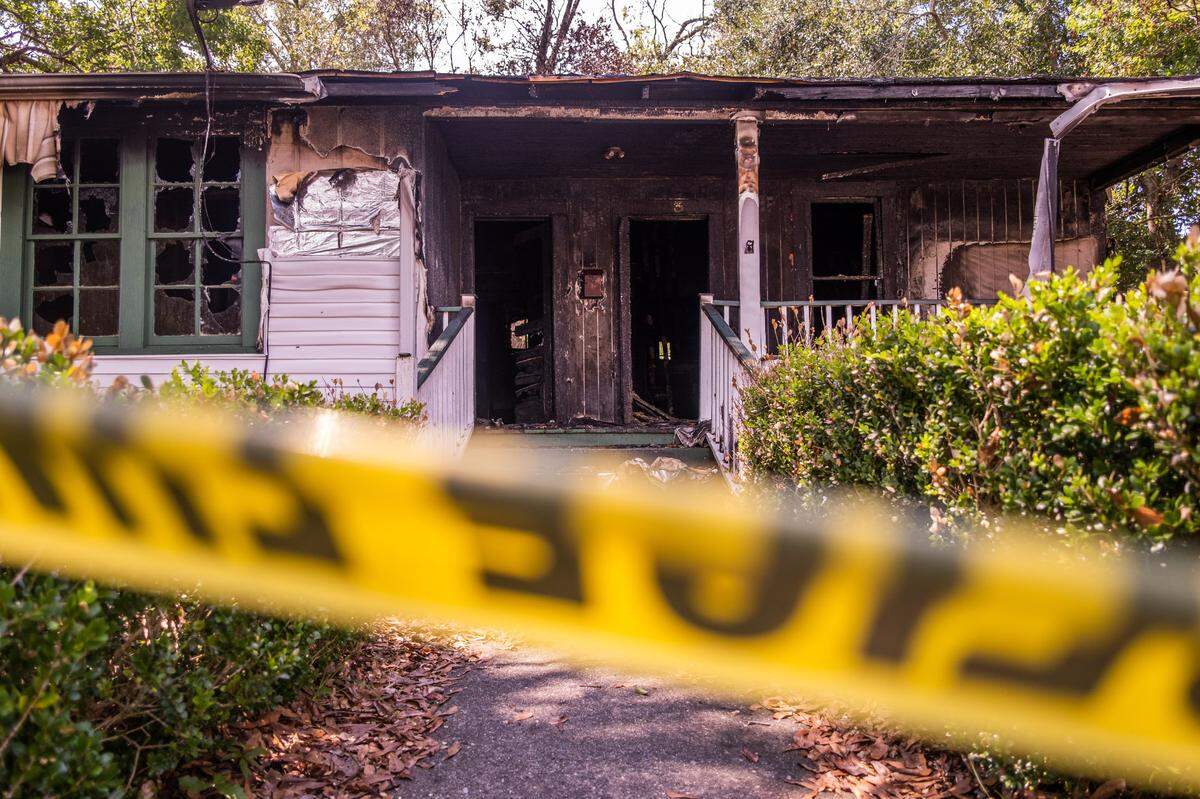
A young white man named Dustin Gray was a person of interest in Jones’ disappearance, and in the early morning hours of July 14, the law office belonging to Gray’s father had been set on fire.
That set off a perverse game of telephone based on a single Facebook post. The post warned — falsely — of a threat posed by Black Lives Matter and a Black militia, and it urged alertness against violent attacks on Picayune on July 15.
But the only event plans circulating on social media for the 15th were for a prayer vigil organized by Willie Jones’ family.
The social media frenzy lasted only about two days, and ended with a thunderstorm on an otherwise peaceful evening.
But to Jarvis — a white conservative who said he has spent most of his life avoiding thinking about race — the event showed that Picayune’s race relations are uneasy.
Many of his white neighbors were willing to believe and amplify Facebook rumors, with no evidence, that groups comprised mostly of Black people posed a threat to their town.
“If nothing else, we got the rumor mill going here,” Jarvis said. “It exploded here, by white people who felt threatened by a grieving Black community.”
What happened in Picayune keeps happening around the country. Communities share vague information about violence and outside agitators, and armed men show up to fend off threats that never materialize. Jarvis worries if it happens again, it could be much worse.
“If all it takes for us to line up with guns is a scary Facebook post, we have now entered a constant war zone,” he said.
Rumors flood Facebook
Hours after the law office burned, rumors that groups were targeting Picayune began to appear on Facebook.
The Sun Herald has identified what appears to be the first post.
A screenshot posted in comments on a public post shows a Picayune man wrote in a Facebook group called “the Mississippi minute Man militia” just after 11 a.m. that “There is a situation brewing in my town Picayune Mississippi.”
“Rumor is BLM is here in Picayune and more are coming!” he wrote. “They have also boarded up Picayune police department! The US marshals are on their way here as we speak!”
He also issued a call to action.
“I’m asking each of you if you are a patriot and feel the same way and if this pops off like they are saying please come to Picayune,” the post continued. ”Not to fight or shoot are kill but to stand guard over our business and our community and help protect our town from these criminals!”
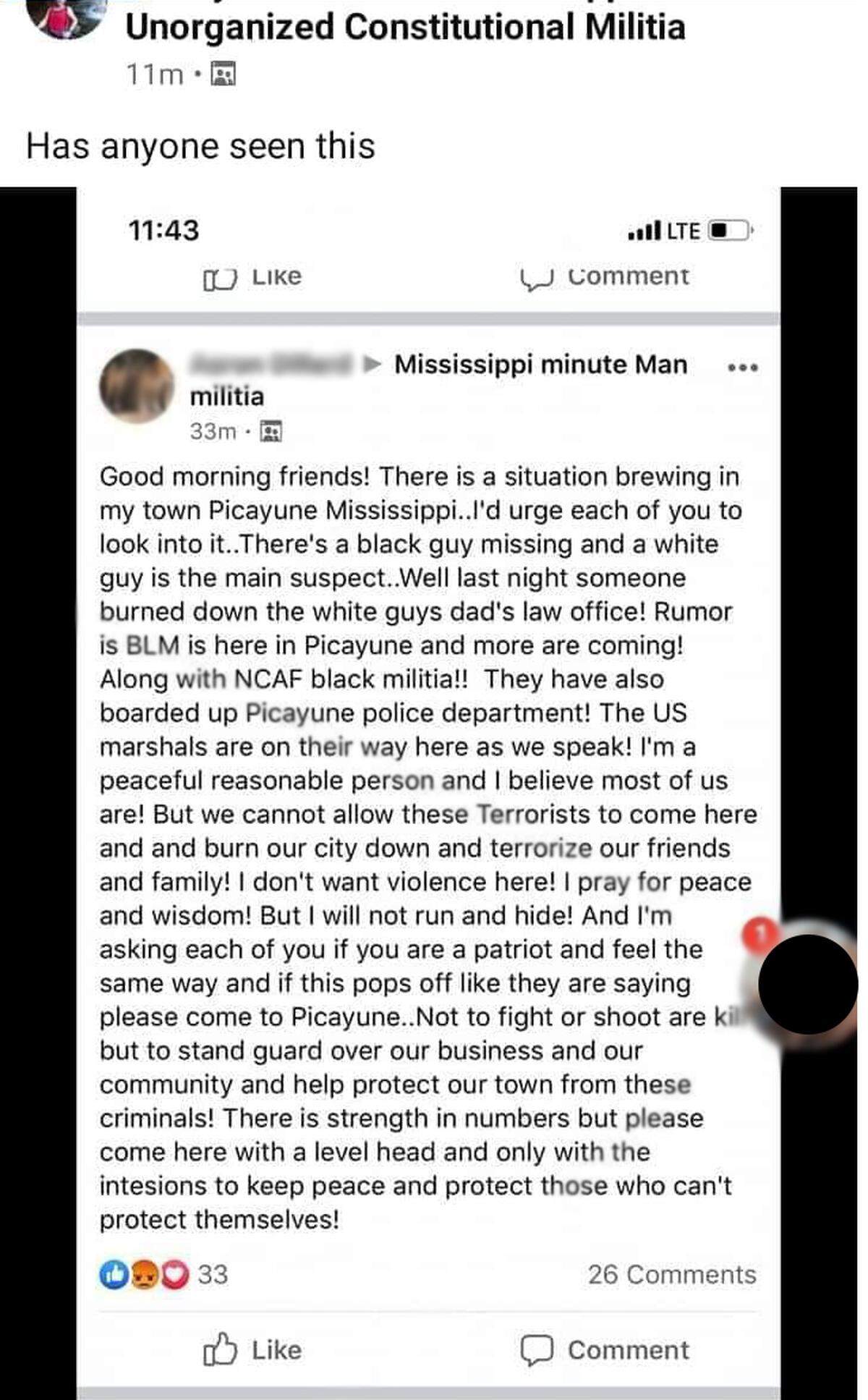
Nearly 9,000 people belong to the private Facebook group, which describes itself as a “Patriotic militant group.” Soon, the information was being shared outside of the group, across Facebook.
The Sun Herald reached out to the original poster for comment, but he did not respond.
The claims were not true.
Picayunians had organized demonstrations in support of Black Lives Matter throughout the summer. But those demonstrations were — like hundreds of others around the country — a response to the killing of George Floyd by a Minneapolis police officer, and many other police killings of Black men and women in the last few years. They were entirely peaceful.
The police department had put its hurricane shutters down in March, when it closed to the public due to the coronavirus pandemic. “This is nothing new, they’ve been in place for months,” it said on Facebook.
And the U.S. Marshals were never on their way to Picayune, said Shermaine Sullivan, chief deputy of the U.S. Marshals Service for southern Mississippi.
Residents fearful over false protest claims
Using Facebook to search publicly visible posts, the Sun Herald identified at least a half dozen posts on personal accounts and in public groups that shared the exact language used in the original post.
Sometimes the posters indicated it had been copied and pasted from another post, but often they didn’t, creating the impression they had firsthand information about the situation.
Other posts riffed on the original information or asked if anyone had heard anything relevant.
Many of the posts drew dozens of comments from people expressing fear for their town or offering their own, unverifiable information supporting the claims.
“I talked to a man at the ammo store and he said he called his detective friend and was told it was true and he said he should protect his inventory,” read one comment on a post in a group for residents of Nicholson, a town just south of Picayune.
Some people pushed back, pointing out the police department had been boarded up for months, or that there was no evidence for what the post described.
Criticisms and questions about the posts, however, were often met with a doubling-down. On one post repeating the dark warnings of violence, a woman commented that it was “misinformation.”
“I am against all the rumors and putting people in fear,” she wrote. “That is when ignorance takes over and becomes criminal.”
“I only shared it because I believe in protecting our town and not like those other places where nobody showed up until it was too late,” the poster replied.
“[She] has the right to post whatever she wants and believes,” another commenter added.
At first, Jarvis thought the posts were mostly just silly, another example of cartoonishly shrill rhetoric on social media.
“Hey, gang, I hate to interrupt but if the revolution can be postponed 24 hours I’d REALLY appreciate it,” he wrote on the evening of July 14. “Tomorrow is this year’s big tax deadline and tonight some of us have to work late so if it’s convenient can we please move our small town Armageddon to Thursday because I’ll be honest... the timing of all this is sub-optimal?”
Worried church members call sheriff
The posts quickly had consequences offline, as people reached out to law enforcement, public officials and church leaders for advice.
Business owners downtown started calling City Manager Jim Luke, asking if they should close up early on July 15. Luke, who said he never saw any evidence supporting the Facebook claims, walked from business to business, reassuring people that they were safe.
“Once the rumors started, each person would add a little something to that,” Luke said. “By the time it went through dozens and dozens of people, that just magnified it.”
On Wednesday morning, Pearl River County Sheriff David Allison got a text from a Picayune preacher, asking if he should hold Bible study that evening. He also got phone calls from people worried about the Facebook posts.
“My response was, we don’t know any more than you know,” Allison said. “We’re not anticipating any problems. I just kind of left it at that.”
Allen Hickman, a pastor at Resurrection Life Church in Picayune, was on vacation at Smith Lake in Alabama when he started getting calls from congregation members.
They had variations of the same fears: Black Lives Matter was planning to riot. Protesters were being bused in from Houston. The government was shutting down the interstate between Louisiana and Mississippi. When Hickman asked for the source of these claims, the answer was always Facebook.
Hickman tried to reassure them.
“I just thought I would tell our people look, I can’t fix everywhere,” Hickman said. “But y’all don’t be part of the problem. Don’t be part of the fear machine. … You just stop and pray.”
Militia groups plan to come to Picayune
Bobby Mitchell is state commander of the Citizens Militia of Mississippi, a right-wing group founded in 2012 that aims to “see government restored to its original constitutional form.” The Southern Poverty Law Center lists it as an “extreme anti-government group.”
He said that around July 14, militia groups around the state were discussing what they had seen on Facebook and making plans to send members to Picayune.
Mitchell did his own research, contacting law enforcement officials he said he has developed relationships with over the years.
“Unanimously, they were all: ‘No, we’ve heard the rumors, but we have no evidence of it being true at all,’” Mitchell said.
He decided sending people to Picayune would only inflame the situation, so the Citizens Militia had one or two members in town on July 15, “just watching.”
But other militia groups made a different decision. Picayune Police Department Assistant Chief Dustin Moeller said various militia representatives called the department “several times.”
“Those are phone calls that were not returned,” he said. “We did not have any conversations with them, and it’s absolutely not someone or a group that we called in or requested assistance from at all.”
Nevertheless, militias made plans to travel to Picayune.
“North picayune exit at the exon on the right is where we’re meeting,” said one post in the South Mississippi Militia Facebook group on Wednesday morning.
In the fray, a family’s pain forgotten
Amid the frantic warnings about antifa and Black Lives Matter, the agony of Willie Jones’ family and friends was an afterthought, if the social media posters mentioned Jones at all.
Many white Picayune residents, Jarvis believes, weren’t following his disappearance until Jim Gray’s law office was burned. Jarvis himself didn’t know about the prayer vigil until it was almost under way.
People who were sharing the posts were mostly concerned about “people coming in from the outside,” not their neighbors, said Hickman.
A story in the Picayune Item on July 14, however, indicated that police expected any outsiders who came to town would be “people supporting the Black Lives Matter movement,” traveling to Picayune “as part of a vigil for Willie Jones.”
“We are preparing for that and doing what we can to make sure that those in attendance stay safe,” the story quoted Moeller as saying.
The story continued: “In response to rumors on social media, Moeller said that his department has prepared for any problems that may occur to ensure the city is safe.”
It was even possible that calling in the National Guard might be necessary, the story said: “As for any other departments or military presence, including the National Guard, Moeller said he would welcome and ask them for assistance if they were needed.”
Deidre Smith, director of public affairs for the Mississippi National Guard, said they couldn’t mobilize without an order from the governor, and had never been considering a potential deployment to Picayune.
Although Moeller told the Sun Herald the department had received calls from militias, the Picayune Item story did not mention those groups.
‘Everything was so peaceful’
The Sun Herald could not locate any Facebook posts that threatened violence in downtown Picayune, or that indicated any outside groups other than right-wing militias were headed to town.
After Jim Gray’s law office was burned, a few people posted or commented to the effect that they were not sorry to see it happen; one woman wrote that it showed “God is not pleased” with Jones’ disappearance.
Jones had been missing since July 6. His loved ones were frustrated by the slow pace of the investigation, and the lack of progress in finding him or Dustin Gray, who had not been seen for days.
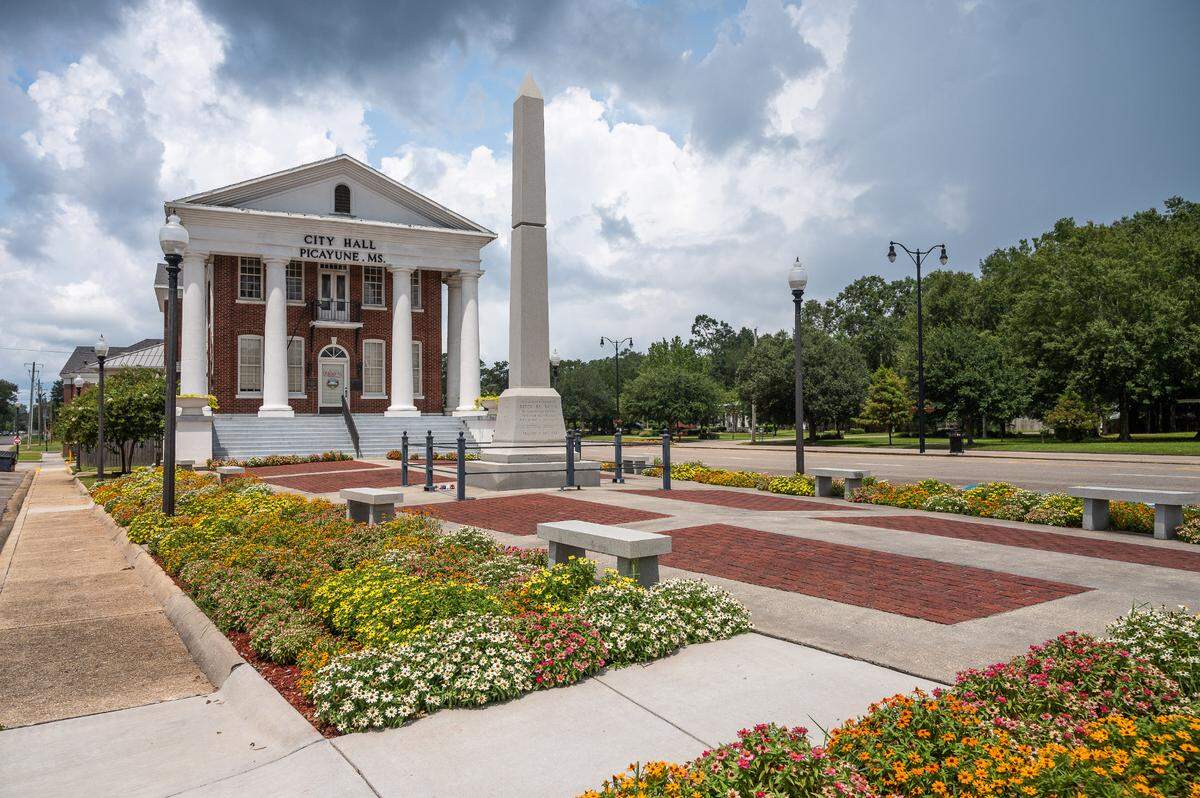
To some Black Picayunians, it seemed clear that to the people posting warnings on Facebook, Black lives didn’t really matter. One common refrain: Where was the concern and outrage when a young Black man was missing, before a white man’s law office burned down?
“Restaurants and businesses in Picayune are closing,” wrote Shira Stubbs, a Black Picayune resident, on July 15. “Instead of talking to us and understanding that tonight a VIGIL will be held to not only show support to the Jones family, but also to figure out a plan of action so that we as a community can search for us… The words, Black Lives Matter, was noted in the Picayune Item and weaponized against tonight’s PEACEFUL vigil.”
And Jones’ family and friends were all too aware that their cause — seeking the safe return of their loved one — had become an object of suspicion.
Kim Williams, who coached Willie Jones in elementary school gym class, had joined search parties for her former student. As a kid, he loved to play kickball, and always wanted to be the pitcher. She was horrified by what she saw on social media.
“It was very disturbing, because I knew it was all lies,” she said.
“I knew everything was so peaceful,” she added, referring to the efforts to find Jones.
Angel Anderson, a cousin of Jones, had watched as Facebook rumors were legitimized by comments the police made and local media reported credulously. She felt the police had shrugged at Jones’ disappearance and then leapt to defend Picayune from threats that existed only in racist imaginations.
But she wasn’t really surprised by what happened. She is affiliated with Black Lives Matter of Picayune, and she knew how many white Americans have historically reacted to movements for Black rights.
“In the present day as well as in the past, racist fear has a way of projecting anytime someone speaks up for Black lives, Black voices, and Black equality,” she said.
‘We’re hoping that nobody tries to push over here’
Shortly before the vigil began, Jones’ brother, Maurice, posted a “PSA” on Facebook, referring to his brother by his nickname, Chill.
“THIS IS A NONE VIOLENT RALLY!!!!” he wrote. “I REPEAT A NONE VIOLENT RALLY! THE OBJECTIVE IS TO #BRINGCHILLHOME”
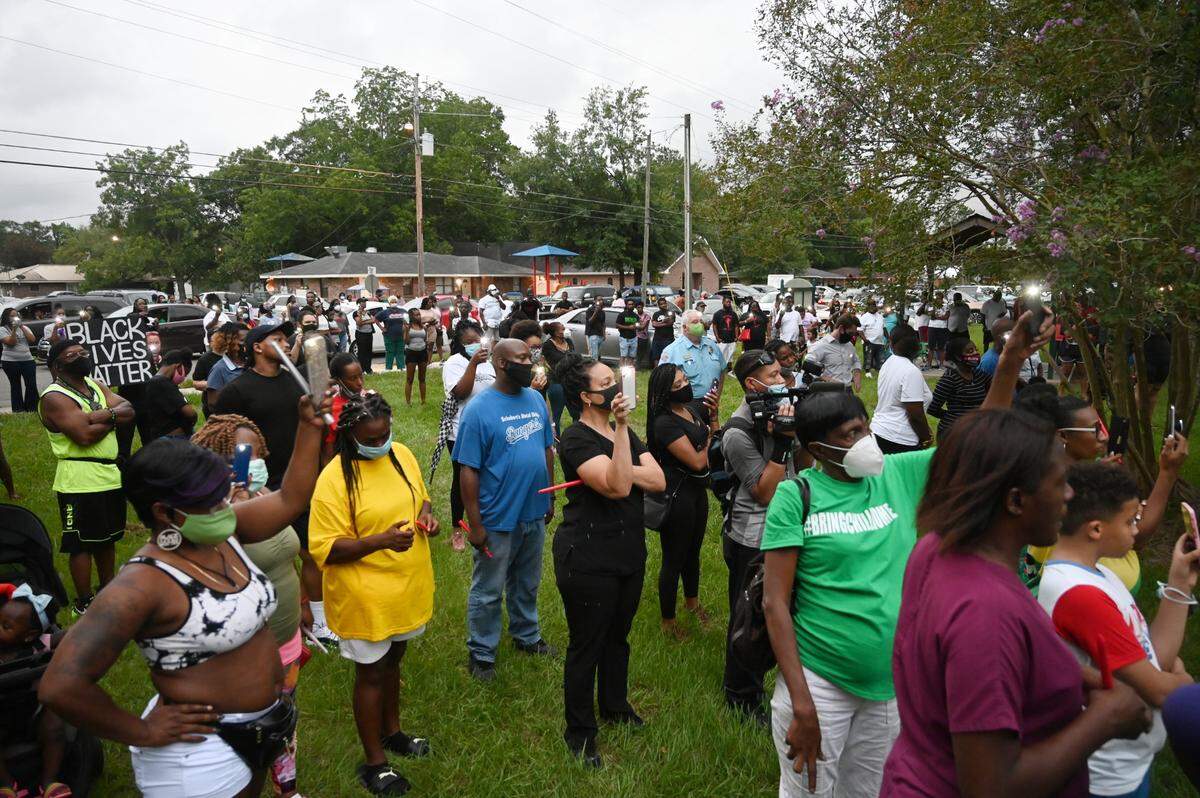
Less than an hour later, 200 of Willie Jones’ friends and family were gathered in J.P. Johnson Park to pray. The sky was an ominous gray, and the wind whipped at the trees. A storm was coming.
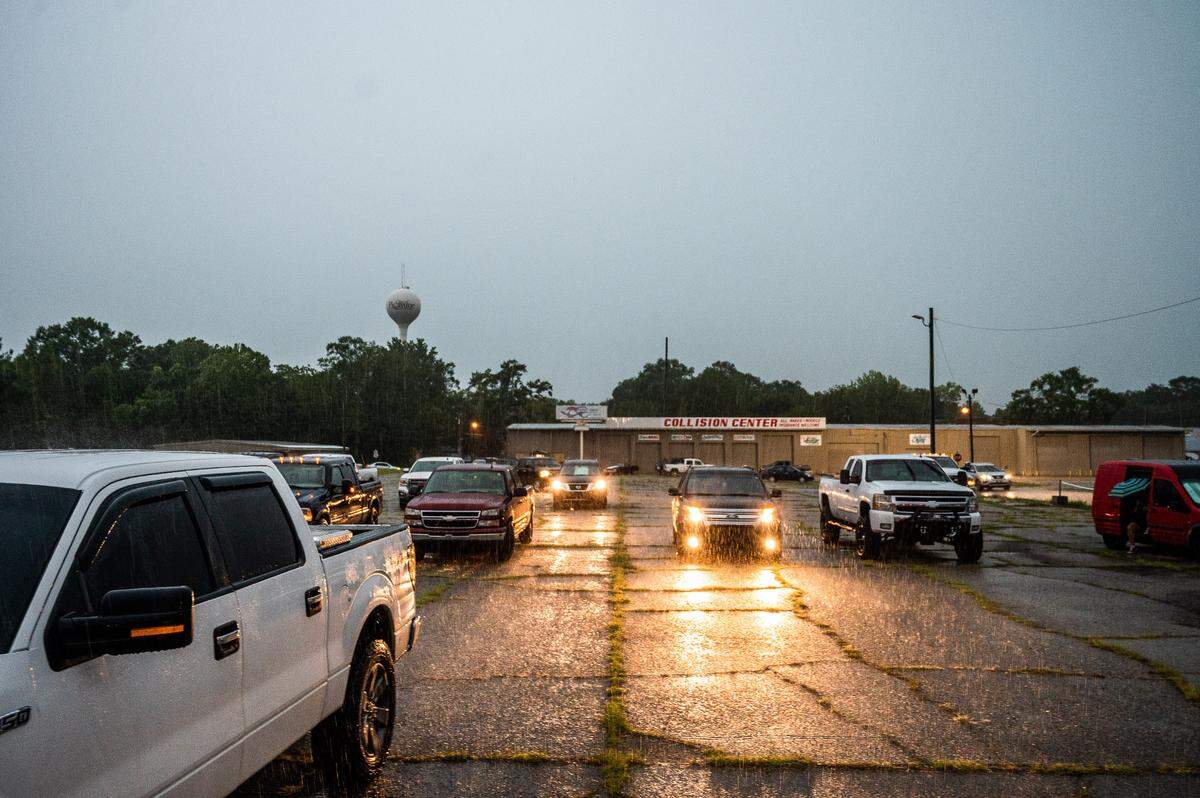
Half a mile away, dozens of militia members were parked in the large lot next to the police department. A woman who stopped to talk to them, but did not want to be identified, said the militia members were talking about 15 buses coming from Houston, and how the people inside were going to march down West Canal Street and burn down businesses.
At the park, people lit red candles for Willie. The militias were not mentioned directly, but their presence, and the social media frenzy from the last two days, cast a pall over the evening.
Donald Hart, the only Black member of the Pearl River County Board of Supervisors, prayed for calm.
“We ask for your peace that passes all understanding, Lord, that you would be with us during this difficult time, that you would send resolution to this town,” Hart prayed. “We ask that you will send a calm, even, Lord, from all of the opposition…. Lord, we ask that you would heal the land.”
Another speaker, Omar Muhammad, gestured in the direction of the parking lot where the militia members were parked.
“We’re hoping that nobody tries to push over here, and we’re hoping that nobody pushes over there,” he said.
After Jarvis drove past the militia members in the parking lot, he went to the park, still wondering if he might find what the Facebook posts had been warning of. He saw only the gathered crowd, listening to speeches and prayers.
Then the rain and thunder came. The prayer vigil attendees left the park. Some of the militia members pulled out of the parking lot and headed home.
Josh Hancock, founder of the Deep South U.S. Militia, had driven down from Petal. As the rain came down harder, he sat inside his car, waiting it out.
He and his group had come to protect the city, he said.
“It’s all over Facebook. Paul’s Pastries is supposed to be torched to the ground,” he said, gesturing across the road. “The little grocery store here, torched to the ground.”
He said he was not surprised that none of the threats had materialized, and was glad there had been no violence. But he wasn’t sure what to expect next.
“We’re here, and we’re not leaving ’til all of this is over,” Hancock said. “We’ll do everything we can to protect this little town.”
What would it look like for it to all be “over?”
Hancock said he didn’t know.
Worry about next rumor remains
Not two hours after the vigil, word reached Picayune that U.S. Marshals in Colorado had detained Dustin Gray and his wife, Erica. Two days later, investigators found Willie Jones’s body. His funeral service was held on Aug. 1.
To many in Picayune, there was one conclusion to draw: Prayer worked, helping to locate the Grays and then Jones. And the storm that ended the vigil had helped protect the city.
“It’s almost like the rain was a godsend, like the storm that came in was a godsend,” Hart said in an interview. “Everybody had to pack up and go home.”
In the days after the vigil, Jarvis thought over and over about what he had seen as he drove from his office to J.P. Johnson Park. He felt sick when he thought about Maurice Jones, whom he has never met, seeing the militia parked outside the police department, treating his brother’s prayer vigil like a powder keg.
His Facebook feed had been full of speculation about antifa and Black Lives Matter and burning down businesses. But now, no one was acknowledging that none of that had happened.
He decided to use Facebook to call out what he had seen from his fellow white Picayunians:
“The white community in this community has an addiction to hate and fear & we just made a mistake,” he wrote on July 16. “... WE, white people, used social media to promote so much fear that ON THEIR WAY TO A PRAYER VIGIL AN INNOCENT, GRIEVING BLACK COMMUNITY GOT TO DRIVE PAST A RIDICULOUSLY LARGE GROUP OF OUR GOOD OLE BOYS SITTING IN THEIR TRUCKS WITH THEIR GUNS LOADED, GOD ON THEIR SIDE & FEAR AND ANGER IN THEIR HEARTS.”
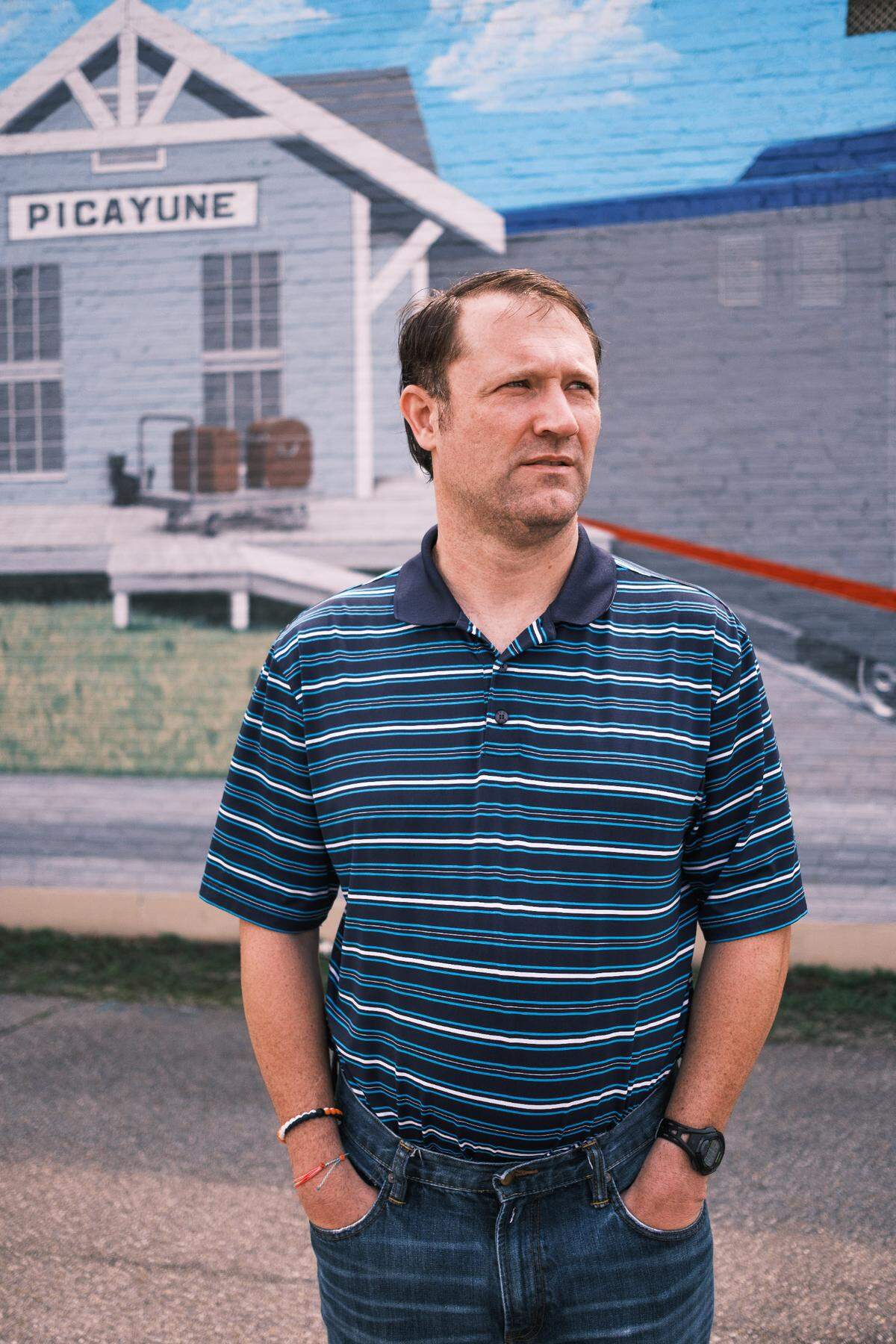
Jarvis, who says he is conservative and had been skeptical of the Black Lives Matter movement, suddenly felt like an outsider in the small town where he has spent his entire life.
He was relieved to see a video online of Allen Hickman addressing the week’s events at church on the Sunday after the vigil.
Pacing the stage, Hickman urged his congregation not to share information on Facebook if they didn’t know it was true. Tensions were so high, he said, that the town had been on the brink of a conflagration.
“How many lies are you gonna believe and send off down the line before you realize, Satan is just trying to get us?” he asked. “See, nobody ever goes back and says, I was wrong, please forgive me, we were wrong. Nobody ever does that. They just go on to the next rumor.”
Jarvis is still worried about the next rumor. What if the militia shows up again, and what if someone confronts them, armed like they are?
For most of his life, he said, he has looked for ways to tell himself that racism no longer shapes life for people in Picayune, Black and white. After those frenzied days in mid-July, he can no longer do that.
“The need for us to forget about it is strong,” he said. “But I don’t want to forget about it.”
This story was originally published August 18, 2020 at 5:40 AM.