
It’s time for a revival of the Gulf Coast shoo-fly
What’s in the shoo-fly name? A lot. Pesky flies may or may not be involved.
Through a long stretch of history, “shoo-fly” has served as the name of a children’s song written in 1860s, a still-popular Pennsylvania Dutch pie, a policeman who spies on his own squad and a stylish hat that goes in and out of fashion.
That’s not all. A shoo-fly is a 1950s-style rocking horse chair for children, a temporary railroad sidetrack, a nifty fly-swatter, an attractive Nicandra physalodes plant that attracts flies, a 1930s group game and a 1940s-era dance. In the dictionary, shoo-fly also means “scram or get out of here.”
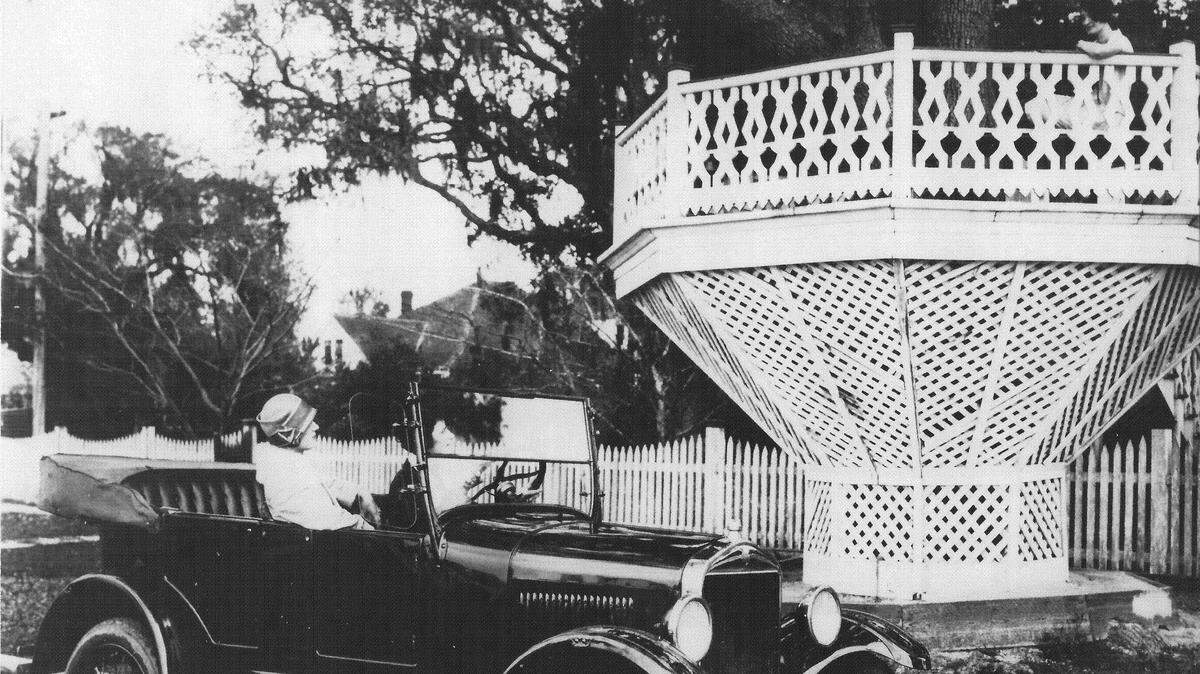
None of these, however, are the shoo-fly of the Mississippi Gulf Coast and other coastal regions blessed with giant, leafy Live Oak trees. In local cultural lingo a shoo-fly is a tree porch without a roof because it is wrapped around a large tree trunk and the leaves serve as a shady roof.
A bit of architectural engineering goes into the construction. The floor is usually eight to 12 feet off the ground, so stairs are necessary. It has rails and piers for the wooden structure to sit on the ground without injuring tree roots. Often, it is painted white and has built-in benches for comfort and lattice for attractiveness.
So why is the shoo-fly floor so high up? Local tradition says the height is to better catch the sea breezes and to thwart the biting horseflies, deerflies, gnats and mosquitoes. Even if that isn’t the case, the leafy shade is as refreshing as a glass of iced tea on a steamy Southern day.
The shoo-fly name makes sense if you understand the local reasoning for building them and have large suitable trees. The problem is that in the early days, when the Coast was developing into a resort, few took time to document the wooden structures. They were just there. The earliest known Coast photograph of a shoo-fly is 1895, although they are older than that.
As in most histories not set in stone, some folks will argue and imagine origins. Several decades ago, a local historian wrote that shoo-flies were likely named after cauliflower, at least an adaptation of the French word for cauliflower. Choux-fleurs is translated as “little cabbages.”
That line of thinking is that a shoo-fly with its trunk stem and painted white structure, often octagon shaped, looks like cauliflower. Plausible. Right? Cauliflower, however, was not a common U.S. vegetable for home-cooking until the 1900s, a fact backed by Coast grocery store advertisements that don’t even list cauliflower until 1913.
The photo of the oldest known shoo-fly appears in an 1895 travel book, “Along the Gulf,” that describes it as a “pagoda.” No historians have found a date for this shoo-fly’s construction, so they settle on “sometime prior to 1895.”
Documents show that particular Biloxi shoo-fly stood in front of a grand summer home built by George Smith, a pioneering New Orleans cotton press businessman who lived at the East Beach property from 1866 to 1908.
At one point Ray Thompson, who wrote the “Know Your Coast” column, invited readers to share stories about how shoo-flies got their name. Those responding to his 1956 request pointed out the obvious, that the structures are named after the common shoo-fly expression, said when shooing away pesky flies.
Thompson also uncovered this gem:
“The expression ‘shoo’ itself was a favorite and frequent one with the old time French housewives on the coast. They chased the chickens out of their gardens with their brush brooms shouting, ‘Shoo, shoo poulet!’ They would pick up their long skirts and fan them at the children when they were underfoot, ‘Shoo, shoo, petite!’
“So when they built their cozy tree platforms about 9 feet above ground because mosquitoes and deerflies did not seem to bother too much that high, it was perfectly logical for them to refer to their practically pest proof sanctuaries as shoo-flys.”
Logical. Right?
All but one of the 1800s and 1900s Coast shoo-flys belonging to homeowners and cities were destroyed by hurricanes. The best known, the one on Biloxi’s East Beach, was taken out by Camille in 1969. Newer ones, including two on Biloxi’s Town Green, went by way of Katrina in 2005. So, too, the one in Long Beach at Boggsdale.
Happily, one survivor constructed in Old Town Bay St. Louis will soon celebrate 30 years.
The Coast needs more of these tree sentries, chime shoo-fly advocates. They graciously speak of both past and present, of laid-back days still possible despite swirling modernization and storm losses.
More towns should build more shoo-flies. Businesses should turn them into inviting features. Homeowners who are stewards of suitable trees should bring these structures closer to home.
All the natural ingredients needed to launch a Shoo-fly Revival still exist: The coastal breeze, the blazing hot sun and those pesky biting bugs. The trees await.
Kat Bergeron, a veteran feature writer specializing in Gulf Coast history and sense of place, is retired from the Sun Herald. She writes the Mississippi Coast Chronicles column as a freelance correspondent. Reach her at BergeronKat@gmail.com or at Southern Possum Tales, P.O. Box 33, Barboursville, VA 22923.