She believes her breast implants were killing her. Now she wants to warn Coast women.
Tabatha Piraino feared she was going to die.
As her health crumbled over the past two years, the 42-year-old Harrison County woman consulted medical specialists who would treat her many symptoms but were unable to pinpoint their origin.
The list, exhaustive but not complete, was long: brain fog, migraines, severe anxiety and depression, panic attacks, chest pain, acid reflux, heartburn, nausea, back and body pains, pain in her left breast, severe fatigue, stomach ulcers, colitis, rectal bleeding, intermittent hives, body inflammation, chills, insomnia and early menopause.
The paramedic had voluntarily downgraded her license in August 2020 to emergency medical technician, driving an ambulance and assisting on emergency calls rather than treating the patients. She didn’t want anyone to get hurt because of her own health problems.
By April of 2021, she was no longer able to work at all. Her blood sugar plunged twice while on the job, causing her to pass out the second time. Both times, colleagues had to rush her to the hospital. Yet she did not have diabetes.
“I was too sick to do anything,” said Piraino. “And it was like nobody that I went to was finding any kind of cause or any conclusive management to any of the symptoms.”
It was around May that she found Facebook groups about breast implant illness. And she became convinced the gel-based implants she had gotten in 2009 were the root of her health problems.
“I knew that there had to be a reason for someone my age with no medical history to all the sudden be to the point where, some days, I couldn’t even get out of bed,” she said. “And I felt like my whole body was inflamed. I was taking all these medications to treat the symptoms and the medications made me so drowsy and out of it, it was almost worse than the symptoms themselves.”
In the Facebook groups, Piraino found thousands of women who described the same symptoms — and more — after getting breast implants.
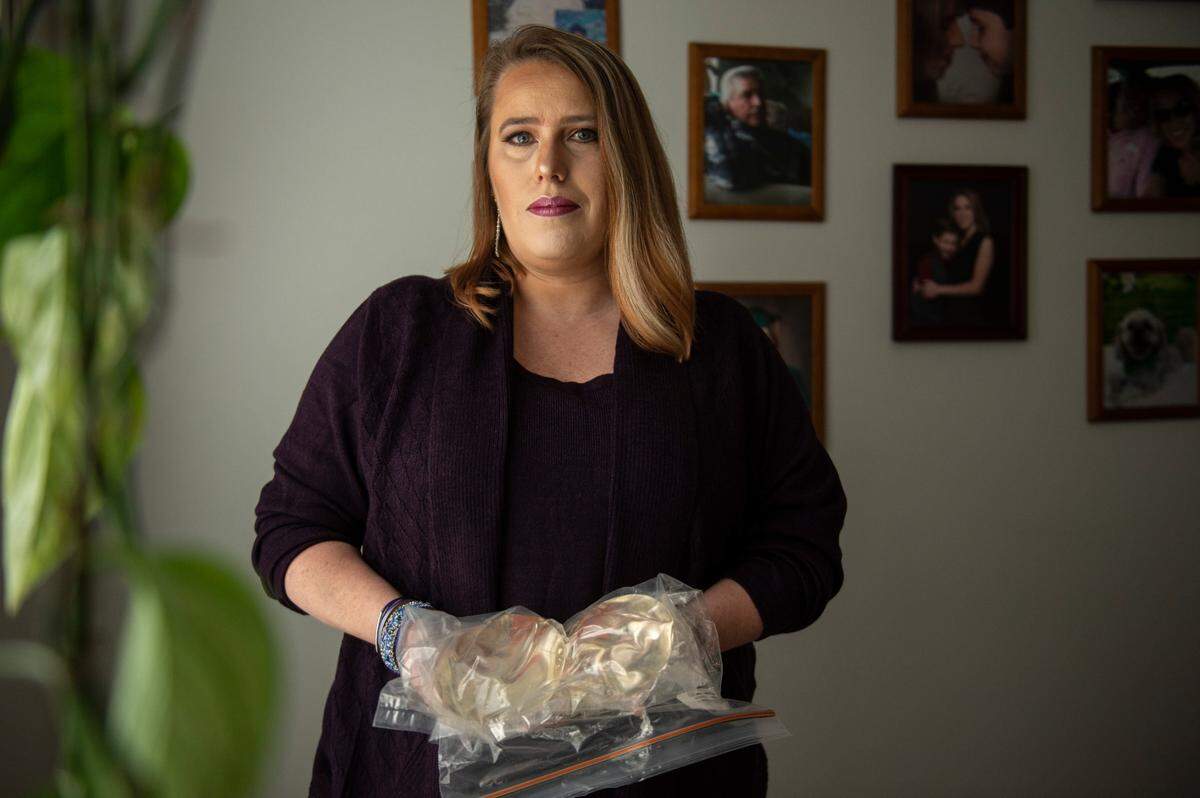
What is an explant?
Explant, or removing the implants and the capsules that form around them, was her only solution, a solution many women are unable to afford. Breast implant illness, while acknowledged by many in the medical community and even the Food and Drug Administration, is not recognized as an illness with a medical code for insurance coverage.
Yet breast implant surgery is the most common form of plastic surgery, with almost 2 million women worldwide undergoing the procedure each year, a medical study reports. The study says, 280,692 women in the U.S. had implant surgery in 2019.
Piraino continued her research, finding a plastic surgeon in Metarie, Louisiana, who recognizes the illness and performs explants. The husband she married just before her illnesses ballooned gave her the $7,400 for surgery that she was otherwise unable to afford.
She reached out to tell her story in hopes other women can avoid the suffering she has faced.
“When I went into this, I was just thinking I needed something to boost my appearance cosmetically,” Piraino said in a recent interview at her home on the Coast. “If I would have known the long-lasting impact that the implants would possibly cause — losing two years of my life, basically, losing my career, affecting my relationship with my husband and my son, almost making me bedridden — I never would have done it.
“I think it’s important that women know the symptoms, know the possible long-term effects, before they get implants, not after they start experiencing all these things and they don’t have the money to do anything about it.”
Plastic surgeon diagnoses BII
The board-certified plastic surgeon who performed her explant, Dr. Stephen Metzinger, agrees Piraino was suffering from breast implant illness. Metzinger performed a total capsulectomy on Piraino, removing the implants and the capsules the body forms around them because the immune system recognizes them as foreign objects..
Piraino gave Metzinger permission to discuss her condition and release medical records the Sun Herald reviewed.
He performed the surgery Nov. 23, sending off cultures for testing from inside and outside the breast capsules. The tests revealed two types of bacteria outside the capsule in her right breast: staphylococcus and propionibacterium acnes. She also exhibited chronic inflammation and fluid collected inside the capsule encasing her left implant, Metzinger said.
The doctor concluded her implants contained a biofilm, a collection of microorgainisms, in this case bacteria, that adhere to the surface of a moist object and reproduce.
“I believe it’s this biofilm that is making the immune system demonstrate more inflammation and when that inflammation becomes extra-mammary, when it’s symptoms outside of the breast, that’s when I think you have BII,” Metzinger said. “My definition.”
“It’s very difficult for the body’s immune system to get rid of it, it’s difficult to get antibiotics to it and it’s kind of sealed inside that capsule.”
“Capsules are very vascular. It may be feeding this out to the body. And her immune system may have inflammatory mediators that are constantly irritated by this biofilm and that can also spread throughout her body.”
Why some women develop BII but many do not remains a question, but Metzinger believes genetics play a role. One theory is that some women’s immune systems are more sensitive to silicone or the byproducts, he said. Regardless of the material inside implants, saline or silicone gel, the shells that contain them are silicone.
Also, a contaminant can be introduced when implants are inserted. Metzinger and other surgeons have learned to use triple antibiotic irrigation and a Keller funnel, much like a baker’s bag, to avoid contact with the patient’s skin during implant surgery, which greatly reduces the risk of introducing bacteria.
Metzinger said women should always use a board-certified plastic surgeon for breast augmentation or reconstruction. They should receive a lengthy form that describes possible complications and should read it carefully. He said regular followups with patients also are important. Women also should realize that breast implants are like tires. They wear out and should be replaced every 10-15 years.
Studies scarce on Breast Implant Illness
Few studies exist on breat implant illness. But the FDA in Sept. 2020 did finalize a “black box warning” for implants that addresses a rare cancer that can occur with textured implants.
While final FDA guidance also mentioned breast implant illness, the term was not included in the warning language after objections from the Medical Device Manufacturers Association, says an article in MedTech Dive, a newsletter and website that reports on trends that shape medical technology.
Instead, the FDA warning says: “Patients receiving breast implants have reported a variety of systemic symptoms such as joint pain, muscle aches, confusion, chronic fatigue, autoimmune diseases and others. Individual patient risk for developing these symptoms has not been well established. Some patients report complete resolution of symptoms when the implants are removed without replacement.”
A 2020 study published in the Aesthetic Surgery Journal notes little research exists on BII, despite increasing use of the term and surgeons reporting that more patients are seeking explants.
“There are no diagnostic tests for BII, no evidence-based methods to differentiate it from other conditions that share similar symptoms (eg, fibromyalgia, irritable bowel syndrome) and little knowledge about who will respond favorably to explant surgery,” the study says.
Some theories even focus on the role social media might play in creating fear and anxiety that could lead women to seek unneeded medical intervention, the study says. The study notes that the term BII was coined on social media.
However, the study also says that most of the 60 women who participated and had undergone explant surgery reported improvement in at least some symptoms afterward.
Health issues disappear after explant surgery
Piraino said her “health turned around 100%” less than three weeks after the explant surgery. Before she was on pain management for inflammation.
“It was like the inflammation that I had in my body, where I felt like everything was on fire, that was gone,” she said. “Automatically gone.”
She said the heart palpitations, breathing issues and chest pains stopped.
“Already I feel better. Before, it was difficult for me some days to hold conversations because of the brain fog. I was always feeling like I was disconnected from the world. That’s gone.”
Today, Piraino feels like she’s getting her life back and is working to become re-certified as a paramedic.
She hopes more women will become aware of BII, and the risk of breast implantation, when they read her story.
Of all the specialists she saw while she was sick, she said, not one questioned whether her breast implants might play a role in any of her illnesses.
“I knew I had to get them out,” she said. “There wasn’t any other option but to get them out. It was either that or I felt like I would be dead in a year. And I told my doctors that: There was no way I would live another year.”
This story was originally published December 30, 2021 at 8:55 AM.