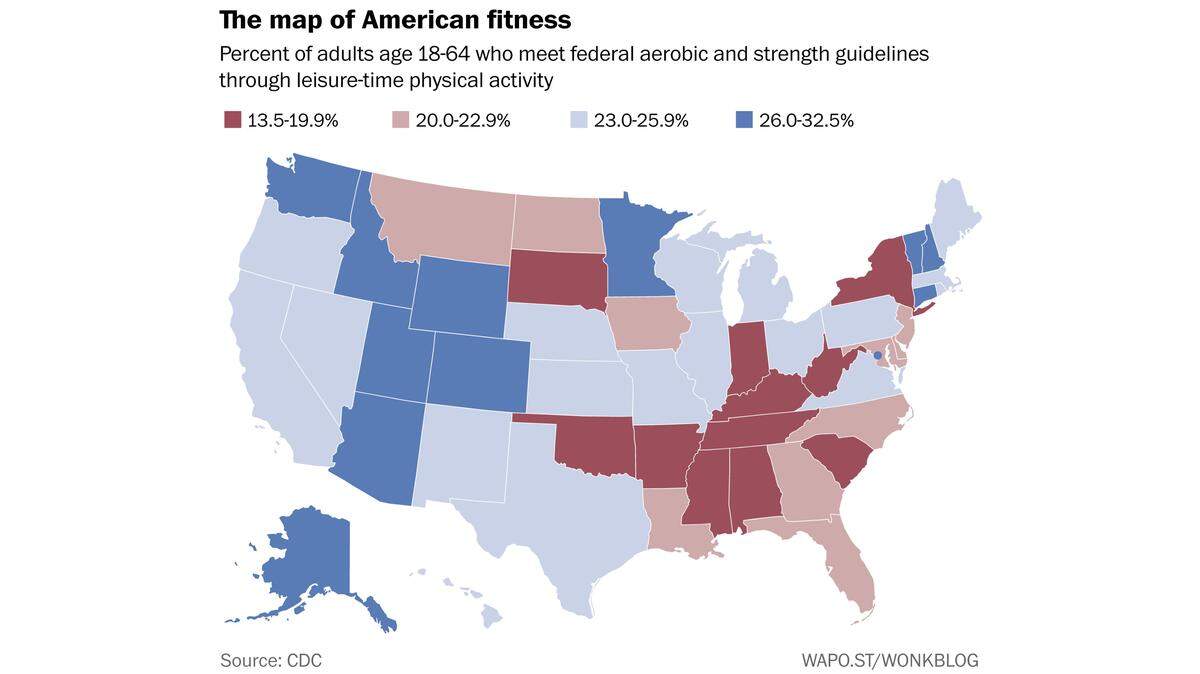
Just 23 percent of American adults age 18 to 64 meet federal guidelines for weekly physical activity, according to a report released last week by the Centers for Disease Control and Prevention.
But the report finds that some states are doing a much better job of staying active than others. The share of adults meeting federal guidelines ranges from a low of 13.5 percent in Mississippi to a high of 32.5 percent in Colorado.
What's driving those differences? In other words, why do people in Colorado exercise so much more than people in Mississippi? To find out, we pulled state-level data from a variety of sources in a semi-scientific effort to identify the factors — demographic, cultural, economic and otherwise — that have the biggest relationship to whether residents of a given state accomplish their weekly workouts.
Among the nine indicators we analyzed, the biggest predictor of weekly physical activity at the state level was money: Residents of states with bigger median incomes were more likely to get out and exercise than people in low-income states.
We uncovered some surprises in the data, too. Heavy drinking is slightly correlated with more physical activity, believe it or not. Warmer temperatures are linked to less exercise. And other characteristics of the physical environment, such as daily sunshine and mild winters, don't actually seem to matter much.
Here are a few definitions before we dig in. According to federal guidelines, adults should perform at least 150 minutes of moderate physical activity, or 75 minutes of vigorous physical activity, each week. They should also do some muscle-strengthening activity, such as calisthenics or lifting weights, at least twice a week.
The CDC report looks at the percentage of adults in each state meeting those guidelines through leisure time physical activity — e.g., jogs, bike rides, trips to the gym and other activities that aren't part of their jobs. Some adults may also meet those guidelines through work, particularly if they have demanding physical jobs. But the CDC isn't as interested in that activity for a number of reasons: Those types of jobs are becoming less common, and research has shown that occupational physical activity carries health risks and even risks of mortality that don't exist for leisure time physical activity.
The federal guidelines set a high bar for physical activity — fewer than one in four working-age adults are actually getting that much exercise. We pulled data from a number of sources, including the U.S. Census, the CDC and the Kaiser Family Foundation, to see what factors were correlated with meeting the federal guidelines at the state level.
We've plotted these relationships in the accompanying charts. In each of the nine charts, each circle represents a state. The y axis is the same in every chart — it shows the percentage of adults meeting the guidelines. The x axes represent the other variables we looked at. Red lines through each chart indicate overall trends.
Finally, that r-squared number in the top right of each chart is important: It indicates just how closely related the variables are, with bigger numbers indicating a stronger relationship. The higher the r-squared, the better job a variable does of predicting state-level physical activity rates.
We found that, overall, median household income does the best job of predicting physical fitness out of the variables we looked at: The more money you have, the more exercise you get. You need disposable income to buy a gym membership or running shoes, after all.
The CDC study takes this relationship one step further by looking at the types of jobs people have in each state. States with higher percentages of people in managerial and professional roles, which tend to pay more money, have higher rates of physical activity.
We also turned up an interesting correlation between religiosity, or rather the lack thereof, and physical fitness: States with higher numbers of non-religious people had higher rates of exercise. As the Public Religion Research Institute has reported, cities tend to be "hubs" for the religiously unaffiliated, and they're often full of the types of high-paying jobs that the CDC links to higher rates of exercise. There may also be a simple mechanism at work by which people who don't go to church have more time to exercise on the weekends.
Conversely, fitness is negatively associated with the share of people in a state who voted for President Donald Trump in 2016. This is where we need to point out, emphatically, that simple correlations like these don't tell us much about causation. It seems highly unlikely that pulling the lever for Trump would somehow make a person decide to hang up her running shoes. More likely, Trump support is related to a whole host of other structural factors, like income and demographics, that also relate to rates of fitness.
It remains interesting, however, that Trump support is about as good of a predictor of physical fitness as the percent of a state's residents in poor or fair health. Economic factors may be lurking behind both indicators here.
Here's something of a puzzle: Rates of heavy drinking (eight or more drinks per week for women, or 15 or more for men, per the CDC) are correlated with greater levels of leisure time physical activity. This may seem counterintuitive, but again, research has indicated that higher-income individuals tend to drink more.
The physical environment, on the other hand, seems to play less of a role in exercise amounts than one might think. Warmer daily temperatures show a slight negative correlation with rates of exercise — the hotter it is, the less people work out. But the overall physical environment, as measured by the USDA's Natural Amenities scale, doesn't seem to play much of a role at all. This starts to make sense when you consider that many people get their exercise in indoor, climate-controlled gyms.
Let's wrap it all up with one final question: Should you even care about any of this? Here's the answer: Only if you enjoy being alive.
At the state level, higher rates of physical activity are correlated with longer lifespans. There's about five years of difference in average life expectancy between the least physically active state (Mississippi) and the most active (Colorado).
Moreover, this is one question where we can fairly safely say that correlation does equal causation, as evidenced by the reams upon reams upon reams of research showing the importance of physical activity for living a longer, healthier life.