Dobbs orders MS COVID-19 patients to isolate immediately or face fines and jail time
Mississippi’s top health officer, Dr. Thomas Dobbs, issued a statewide order Tuesday afternoon that people diagnosed with COVID-19 should isolate immediately at home or face fines or jail time.
The order applies to all Mississippians.
“We have a lot of COVID activity throughout the state right now, so it is absolutely critical that anyone infected with COVID-19, and not hospitalized, must remain in the home or other appropriate residential location for 14 days from onset of illness (or from the date of a positive test for those who are asymptomatic),” Dobbs said in a press release.
Under state law, anyone suffering from COVID-19 who willfully violates Dobbs’ order can be charged with a felony because it is a life-threatening disease. On conviction, a violation is punishable by up to five months in prison and a fine of up to $5,000.
At a minimum, state law says, failure to obey a health officer’s order is a misdemeanor punishable by a fine of up to $500 and up to six months in jail.
Dobbs says that people infected with COVID-19 should limit exposure to people inside the household and no visitors should be allowed in the home. The infection person should stay in a specific room and use a separate bathroom if available.
Dobbs also said COVID-19 patients should wear face masks if they must be around others in a home.
How to isolate if you have coronavirus
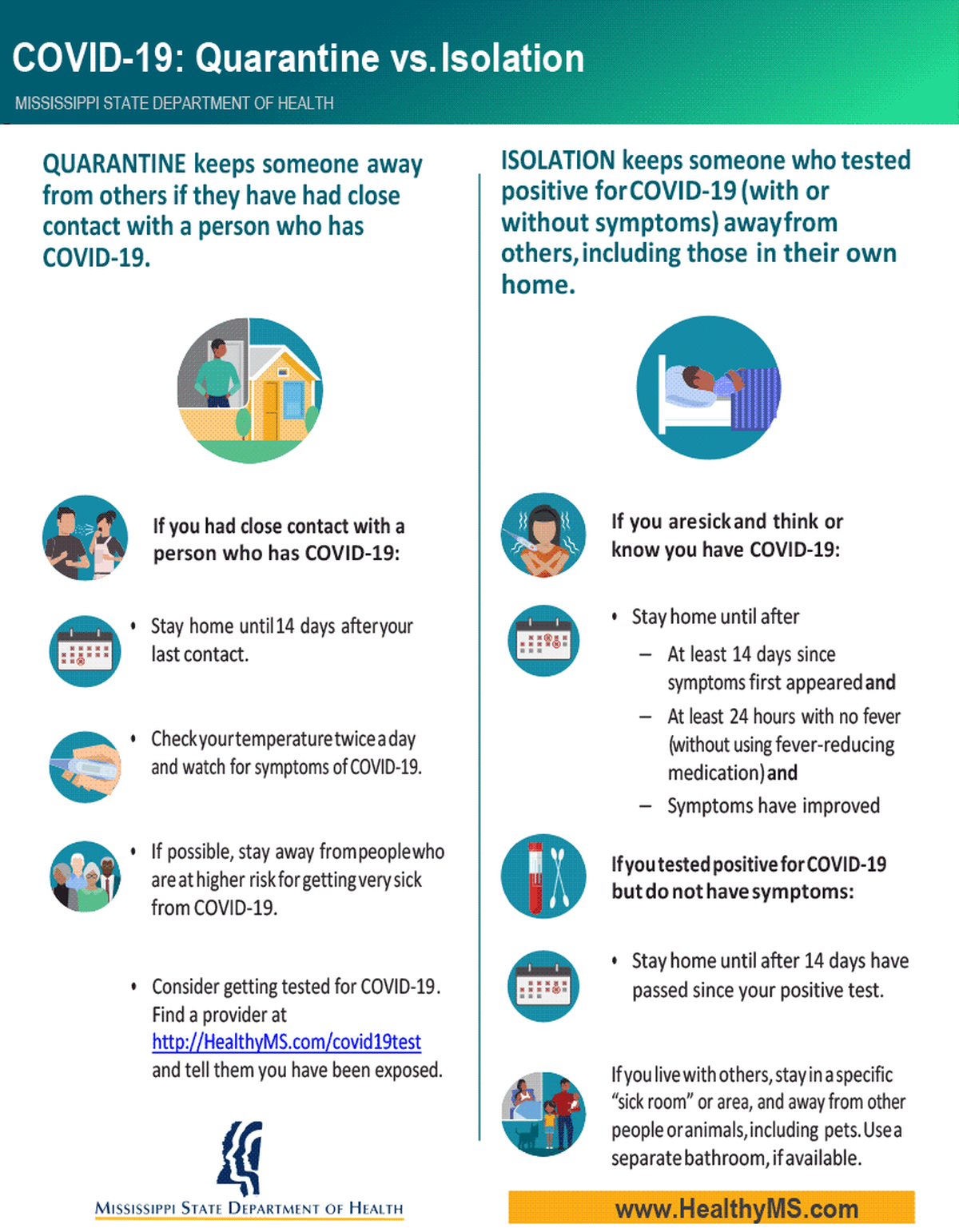
Here are the differences between isolation and quarantine, according to the Centers for Disease Control.
Isolation
Isolation keeps someone who tested positive for COVID-19 away from others.
You don’t have to have symptoms to be isolated. Anyone who tests positive for COVID-19 should isolate themselves at home, away from others you may live with.
- If you are sick, know or think you may have COVID-19, stay home until:
- At least 14 days have passed since your symptoms began, and
- It has been at least 24 hours since you last had a fever, without using fever-reducing medication such as Tylenol (acetaminophen) or Advil (ibuprofen), and
- Your symptoms have improved.
If you tested positive for COVID-19 but do not have symptoms:
- Stay home until after 14 days have passed since your positive test.
Isolation includes staying away from others in your home.
If you live with others, stay in a specific room or area reserved just for you. Stay away from other people or animals, including pets. Use a separate bathroom if available.
Quarantine
Quarantine keeps you away from others if you may have been exposed to COVID-19.
Close contact with someone who has COVID-19 indicates the need for quarantine at home.
If you have had close contact with someone who has COVID-19:
- Stay home until 14 days after your last contact.
- Check your temperature twice a day, and watch for symptoms of COVID-19.
- Stay away as much as possible from those who could become very ill from COVID-19, such as older adults or those in poor health.
- Consider getting testing for COVID-19, even if you do not have symptoms. Contact a testing provider near you, and let them know that you have been exposed.
This story was originally published August 4, 2020 at 1:57 PM.