
Beloved New Orleans meteorologist David Bernard is leaving TV. He’s got big plans.
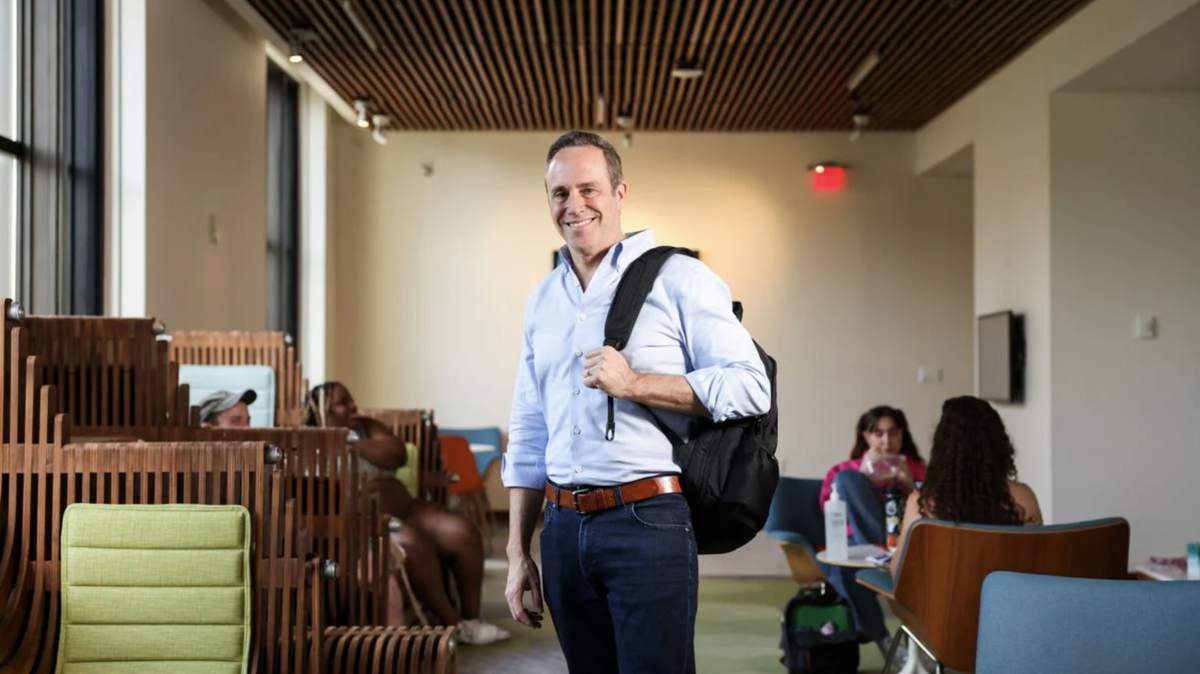
David Bernard didn’t back down.
After a viewer insulted the WVUE Fox 8 chief meteorologist with a homophobic slur in an email this summer, Bernard posted the email on Facebook, publicly shaming the sender.
“I’d gotten to a point in my life where I wasn’t going to accept that kind of behavior from anyone,” he recalled this week. “The only way to stop that is to call it out, to stand up and say it’s wrong and make people accountable for their actions.”
As a young man, Bernard thought his sexual orientation would prohibit him from being on TV. So it’s fitting, in a full-circle way, that his public stand against homophobia came near the end of his successful three-decade career as a TV meteorologist.
Nov. 17 will be his final Fox 8 broadcast, following three months of working part-time.
In August, Bernard, who is 53, enrolled at Tulane University’s School of Social Work. After finishing the 16-month master’s degree program in December 2023, he plans to get licensed as a clinical social worker. He wants to work with patients who have experienced trauma.
So instead of helping the whole city face hurricanes, he’ll guide individual clients navigating their own, more personal storms.
“I’m used to talking through things with people, but on a much bigger scale,” he said. “This will be on a more intimate level. It’s going to be a challenge, but it’s something that’s needed, and something I want to do.”
WVUE anchor Lee Zurik has assured Bernard that he’ll miss the newsroom action. “He’s right,” Bernard said. “How do you not miss something you’ve done for 30 years?”
In the early 2000s, he spent several years on the WWL-TV morning show alongside anchor Eric Paulsen. Their on-camera bickering belied a mutual respect and close friendship that endured even after Bernard landed at a competing station.
“David and I had a battle of egos for years,” Paulsen said. “I hate to say it, but he’s still at the top of his game.”
When Bernard first told him he was leaving the news business, Paulsen’s initial reaction was, “‘Wait, you’re retiring before me?’ But David’s really smart. When he wants to do something, he will.
“I have no doubt he’ll be great. His life is so much more than being on TV.”
‘A scary time’
Growing up in Houston, Bernard was no stranger to severe weather. In 1977, a near miss by Hurricane Anita sparked his interest in meteorology. After Hurricane Alicia hit Houston the week he started high school in 1983, he knew he wanted to be a meteorologist — a dream he thought was impossible.
“It was the 1980s, and it was a really scary time to be gay,” he said. “People were dying daily from the AIDS epidemic. The level of homophobia was as much as it had ever been.
“In my little world, I just didn’t think that you could be gay and be on television. Since I knew that the former wasn’t going to be changing, I suppressed what I really wanted to do.”
He enrolled at the University of Texas as a business major, and hated it. As he started the gradual process of coming out, he switched to a broadcast meteorology major.
Then, at a gay bar in Austin, he met a local TV meteorologist who helped him get an internship. During a spring break trip to Mexico, he met another gay meteorologist, this one from Houston, which led to another internship.
“I suddenly realized that not only could you be gay on TV, but maybe everybody on TV was gay,” he said, laughing.
“That just shows the importance of visibility, of gay people being out and visible and advocating for younger people. Obviously, there are a lot more people in the media who are out now, way more than 35 years ago. But there are a lot of people in their teens and early 20s who still have a lot of the same fears.”
His first on-air job after graduation was in Corpus Christi, Texas. He moved on to Amarillo, where he learned being gay could, in fact, be a career hindrance.
At the end of his first year in Amarillo, the station’s news director took him to lunch. Bernard was expecting a merit-based pay raise.
Not only did he not get the raise, he was informed that the station’s general manager “had heard (Bernard) was at a gay bar. I was basically told ‘there’s no future here for you.’
“I was stunned. I was 23 and still really uncomfortable with all this stuff. Emotionally, it was devastating. That’s probably the worst thing I know of that happened to me professionally, as far as being gay.”
Fresh opportunity
A fresh opportunity soon presented itself at KJRH in Tulsa, Oklahoma.
“My boss there was my first news director who I felt had solid judgment and really showed me the way in the business. It was a great newsroom environment.”
His work in Tulsa caught the attention of WWL-TV, which offered him a job in 1997. Being from Houston, he’d visited New Orleans many times; in the 1970s, his mother bought furniture from Hurwitz Mintz.
Coming to WWL, he was “a little intimidated. I was 27 and I’ve got Angela Hill, Bill Elder, Dennis Woltering, Eric Paulsen, Sally-Ann Roberts and all these people surrounding me who were way beyond my years in experience.
“But I quickly found a spot for myself, I feel. Being on that morning show was great.”
After eight years, he sensed he’d plateaued. He was “ready to grow. I felt I needed something bigger.”
Following his acclaimed coverage of Hurricane Ivan, Bernard was recruited by Bryan Norcross, the director of meteorology at Miami CBS affiliate WFOR.
“Miami wasn’t necessarily on my proverbial radar. But I wanted to continue to cover tropical meteorology. If you’re going to do that, it’s Miami and New Orleans.”
He sold his house near Tulane University in the summer of 2005, days before Hurricane Cindy dropped a tree on its garage — and six weeks before Hurricane Katrina flooded it.
After a difficult first year in Miami, he thrived. When Norcross left WFOR in 2008, Bernard was named chief meteorologist. That same year, he became the hurricane consultant for the CBS Evening News and CBS This Morning, giving him a national profile.
“It was fantastic,” he said. “But I got to a point where I thought, ‘Where do I really want to be?’”
The answer was New Orleans.
Following an opportunity
In 2015, Bernard started talking to management at WVUE, where longtime chief meteorologist Bob Breck was nearing retirement.
“It sounded like there was going to be an opportunity,” Bernard said. “One thing led to another, and we worked it out.”
He would not be moving alone. In Miami, Bernard had met real estate executive Charlie Urstadt. They became a couple.
“Charlie was like, ‘I knew you were going to want to move back to New Orleans one day — I just didn’t know when,’” Bernard said.
They settled into the Garden District and became involved in the city’s civic life. Urstadt, now chairman of Urstadt Biddle Properties Inc., a publicly traded real estate investment trust that specializes in shopping centers in the New York tri-state area, served two terms as the Ogden Museum of Southern Art’s board chair.
Bernard enjoyed being back on the air in New Orleans. He found a new work family at Fox 8 and an attentive audience.
“I have a wonderful following in the city, because people are genuinely interested in local news and weather and what we do. People value that here. You don’t find that in most cities anymore.
“Which begs the question: ‘Why are you leaving one of the best jobs in TV?’”
Unforeseen circumstances
Over the years, he’d thought about becoming a therapist, but “still loved broadcast meteorology and thought there was another act in this career.”
He planned to retire from TV at 60, until unforeseen circumstances accelerated the process.
In late 2019, he started experiencing severe flu-like symptoms, a burning sensation in his face and neuropathy in his feet and hands. He was eventually diagnosed with toxoplasmosis, a disease linked to parasitic infection.
His medical ordeal, coupled with the stress of an active hurricane season, took a toll.
“It was a nightmare,” Bernard said. “I had all these terrible symptoms. Nobody knew how COVID might impact me. 2020 was a disaster.”
While covering Hurricane Zeta that October, “I could barely walk to my car, I was in so much pain.”
The bigger picture
Taking stock of his life, he realized that, after 30 years as a meteorologist, “I’ve accomplished everything I wanted to accomplish. I’ve gotten to do things I never thought I was going to be able to do. Maybe I needed to close the book on this.
“There are a lot of sacrifices you make in TV. There’s even more sacrifices when you’re a meteorologist in a hurricane market.”
The prospect of working such a demanding job until age 60 was daunting. I can’t do this another seven years, he thought. I’m exhausted.
As with any job, “you accept the bad parts because the good parts are greater. But at this point, the scales started tipping. The negatives started outweighing the positives, at least for what I wanted the next part of my life to look like.”
He and Urstadt, who got married in 2019 — Paulsen officiated — wanted more time for travel and other pursuits. Social work offered flexibility and the opportunity to still do work that matters.
“When I’m 65 or 70, if I still want to work parttime and see clients a couple days a week, this fits that,” Bernard said.
“It’s a privilege that I’m able to make this choice in my life. And it means a lot to me that I’m still going to be helping people — just in a different way.”
This story was originally published November 10, 2022 at 4:11 PM.